
Someone asked me recently, in preparation for a podcast interview, how I’d make money as fast as possible if I had to start over.
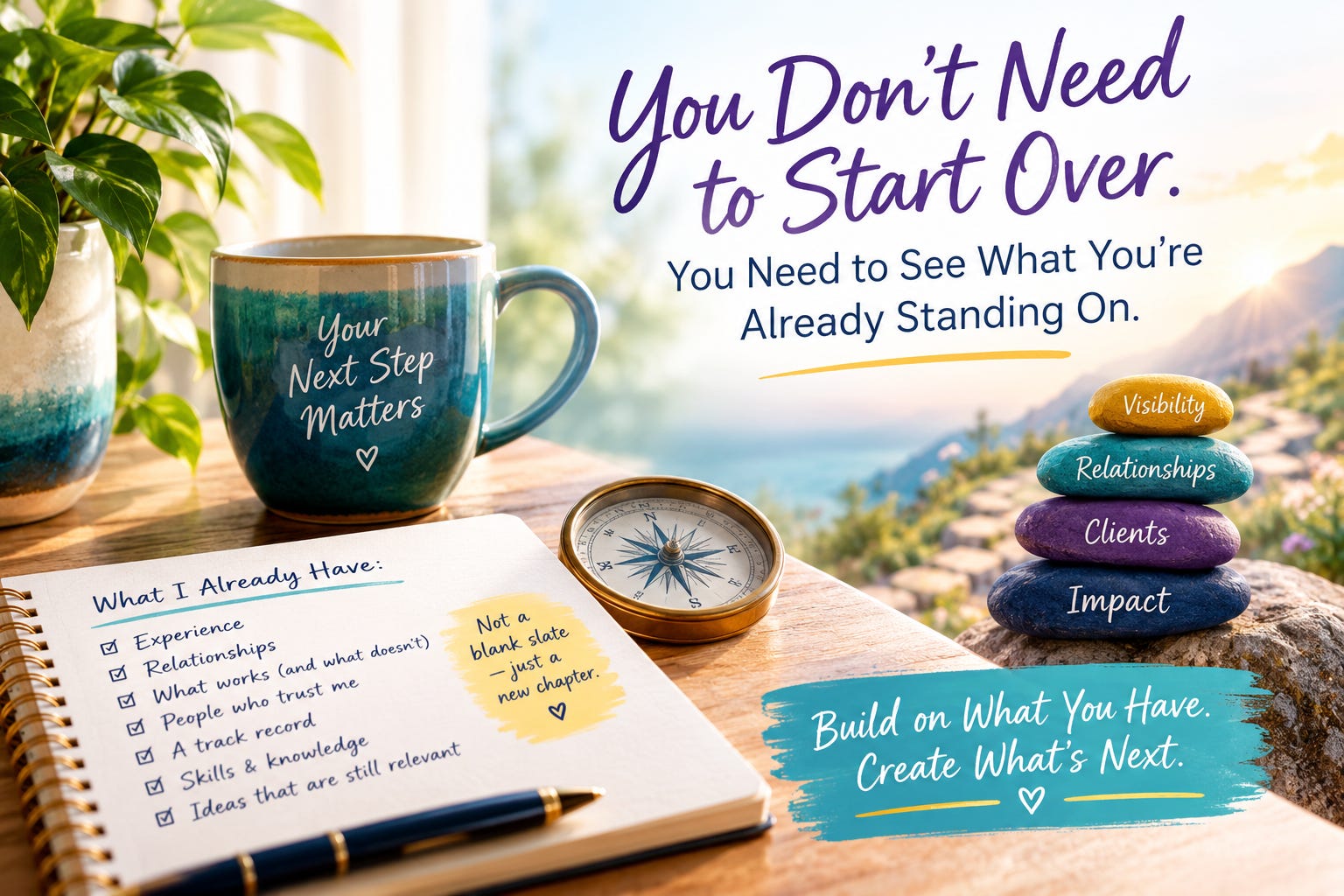
It’s a fair question. But the more I thought about it, the more I realized I wouldn’t actually be starting over.
I’d still have everything I’ve learned. I’d still have the relationships I’ve built. I’d still have all the things I’ve tried that worked, along with plenty that didn’t. I’d still have the hundreds of conversations I’ve had with coaches and entrepreneurs and everything they’ve taught me about what people struggle with.
After more than 45 years of building businesses and watching other people build theirs, I wouldn’t be walking into this as a blank slate.
And neither are you.
I think that matters, because when we imagine starting over, we tend to focus on everything we think we need to create. A new offer. A new audience. A new website. A new platform. A new strategy.
But maybe the better question is: What do I already have that could make the path from here to there shorter?
That’s the question I’d want to answer first.
I understand the appeal of starting over. I’ve done it myself.
There’s a wonderful energy that comes with a new idea. Suddenly we’re researching again. We’re changing things. Maybe we’re rewriting our positioning or creating a new offer. It feels like something is happening.
And sometimes starting over really is the right decision. We change. Our businesses change. What we want changes. Something that made perfect sense a few years ago may not fit us at all anymore.
But I’ve also watched people abandon things before they’ve really learned what wasn’t working.
An offer gets very little response, so they change the offer. That doesn’t work immediately, so maybe the niche is wrong. Then the messaging changes. Then the website. Then they start wondering whether they should be on a different platform.
Before long, they’re building an entirely new business when perhaps only one part of the old one needed attention.
That’s the piece I think we miss.
Starting over can feel like progress because there’s so much activity involved. But every time we replace everything, we also lose the opportunity to learn from what we already had.
So before I asked, What should I try next? I’d ask something much less exciting:
Did I really need to replace this, or did I need to adjust it?
If I were beginning again today, I’d start with an inventory.
Not the kind where you sit down and write a formal list of every credential you’ve earned since you were 22.
I’d look at the things that have happened naturally over the years.
What do people ask me about?
What kinds of questions keep finding their way into my inbox or conversations?
What have I done enough times that it seems fairly ordinary to me now, even though someone else is still struggling to figure it out?
I’d pay attention to those things because there’s something there worth exploring.
Then I’d look at relationships.
Who already knows me? Who trusts me? Who has seen me solve a problem? Who have I worked with in the past? What communities am I already part of?
We tend to dismiss these relationships when we start thinking about building a business because we’ve been trained to think in terms of audiences.
How many followers do I have?
How big is my email list?
How many people saw my post?
But an audience and a relationship are not the same thing.
If I needed to make money sooner rather than later, I’d be much more interested in the people who already know and trust me than in trying to convince thousands of strangers to notice me.
And finally, I’d look at my track record.
Not the polished bio version.
I’d look at the actual problems I’ve solved. The people I’ve helped. The things I learned inside jobs, businesses, volunteer roles, communities, families and all the other places where we become who we are.
When you start putting those pieces together, something interesting can happen.
You begin to see paths that weren’t obvious when you were staring at the blank page wondering what you should build next.
Once I understood what I was actually starting with, I’d want somewhere for all of it to lead.
The first thing I’d create is a simple client journey.
I’m not talking about an elaborate funnel with seventeen steps and automations everywhere. I mean getting really clear about where your client is starting, the specific problem you’re helping them solve, and what needs to be different for both of you to know that problem has actually been solved.
That specificity matters. “I help people feel more confident” leaves a lot of room for interpretation. What are they unable to do, decide, create, change or accomplish when they first come to you? And what will they be able to point to at the end and say, Yes, this is different now. This is what I came here for.
Once you know that, you can map the rest of the journey. Where does someone who has that particular problem find you? What do they need to hear from you to recognize that you understand what they’re experiencing? Where can they get to know you better? What is the natural next step when they realize they want help? And once they become a client, what actually moves them from where they started to the result you promised?
That’s the client journey I’m talking about. It doesn’t end when someone pays you. It ends when the problem they came to you to solve has been solved.
I think a lot of us create content and offers without ever getting this specific. We’re visible, and we may even be attracting people, but the path itself is fuzzy because the beginning and the destination are fuzzy.
I’ve certainly done enough of that over the years.
Today, I want to be able to see the whole path, from this is where they are to this is where we’re going, and know exactly where I’m inviting them next.
This might be the biggest thing I would do differently.
Once we decide we’re building something, our instinct is usually to go looking for more people.
More subscribers. More followers. More traffic. More views.
There’s nothing wrong with wanting to grow. I want to grow too.
But I wouldn’t begin there.
I’d begin with conversations.
Maybe there’s a former client I haven’t spoken with in a while. Maybe someone keeps asking me questions about the very thing I’m considering offering. Maybe there’s someone in a community who has been following what I’m doing and responding to my posts.
I wouldn’t approach those people thinking, How can I turn this person into a client?
That would feel awful.
I’d talk to them.
I’d find out what they’re working on. I’d listen to the words they use. I’d pay attention to what they’re struggling with and whether what I’m considering actually helps.
Those conversations give us something that sitting alone tweaking an offer never can.
They give us real information.
And sometimes they lead to clients. Sometimes they lead to referrals. Sometimes they lead to a completely different realization about what people actually need from us.
That’s why I’m so interested in relationships as a business strategy.
You don’t necessarily need an enormous audience.
You need people who know what you do, understand how you can help and have a way to come closer when the time is right.
There comes a point when starting over isn’t really about finding a better idea.
It’s about deciding what comes with you.
Maybe the offer really does need to go.
Maybe you’ve outgrown the niche.
Maybe you never want to use a particular marketing strategy again. I have a few of those myself.
Fine.
Leave them.
But take the lessons.
Take the relationships you built. Take the experience. Take the content that still has something useful to say. Take what you now understand about the people you want to help. Take all the mistakes that taught you what you never want to do again.
You earned those.
Starting again doesn’t require pretending none of it happened.
And I think this is where starting over can actually become something really hopeful.
You aren’t rebuilding the person who got you here.
You’re letting that person help you decide what comes next.
So if you’re looking at your business right now and thinking about starting over, maybe don’t start with the new offer.
Give yourself a little time to look around first.
What are you already standing on?
What do you know now that you didn’t know before?
Who already knows and trusts you?
What have you created that still has life in it?
What have people been asking you for that you’ve barely noticed because it comes so naturally to you?
And what are you completely ready to leave behind?
You may still decide to start something new.
But this time you won’t be starting from nothing.
You’ll be starting from experience.
And there may be a much shorter path from where you are to where you want to go than you realized.
If Substack is part of what you’re building next, I created the 9-Day Substack Moment Challenge for exactly this kind of moment.
It isn’t about spending nine days turning your entire business upside down. We’ll take one small step each day to help you get your Substack set up more intentionally, start publishing and begin creating a place where the people who find you can get to know you.
Because maybe you don’t need another fresh start.
Maybe you just need your next small step.
Join the 9-Day Substack Moment Challenge →Your First 7 Days are FREE
With love & clarity,
Jill Hart💜The Coach’s Alchemist
Amplify Your Voice • Monetize Your Mission • Get Visible
And now for the controversial stuff…
AI Statement: I fucking love AI. I’m very open about it. However, I refuse to participate in the AI detector bullshit. AI detectors reproduce racial bias by disproportionately misclassifying the writing of people of color and multilingual writers as non-human. Requiring people to prove or justify how they write also unfairly targets disabled and neurodivergent people who may rely on AI as an essential accessibility tool. I refuse to participate in a practice that reinforces racism, punishes disability, and treats access needs as evidence of wrongdoing. I will not be justifying my use of AI or attempting to downplay it.
Please judge my work (and all work) by how it makes you feel. Do not outsource your decision-making power to a machine. This is Niki Bowen ’s disclaimer that I LOVE so much I’m adopting it too. I have opted out of the AI detection tool for all of the reasons posted above if you try and see if my writing uses AI I’ll save you the trouble - it does.
Comments
Nothing yet. Say the first thing.
Sign in to join the conversation.