
Jews played a tremendous part in the creation of the 20th century comic industry, particularly in America, where some of the best known and most enduring comic book characters were the invention of Jews. Superman, who first appeared in print in 1938, was the brainchild of Jerry Seigel and Joe Schuster, the following year Bob Kane and Bill Finger invented Batman. In the 1940s, Stan Lee, Jack Kirby and Joe Simon furnished the Marvel Comics stable with superheroes of the calibre of Spiderman, Captain America, the Hulk, Thor, Iron Man and the Avengers.
These artists were all Jews. Their predilection for super heroes has been variously explained as the Jewish underdog’s way of fighting back, or a reflection of the immigrant dream of outsiders turning into heroes. Alternatively, they were simply highly imaginative and talented people who found a niche and understood how to develop it. Interestingly, they were all men; there were several Jewish women cartoonists working at the time too, but, as many men have found, they didn’t care much for super-heroes.
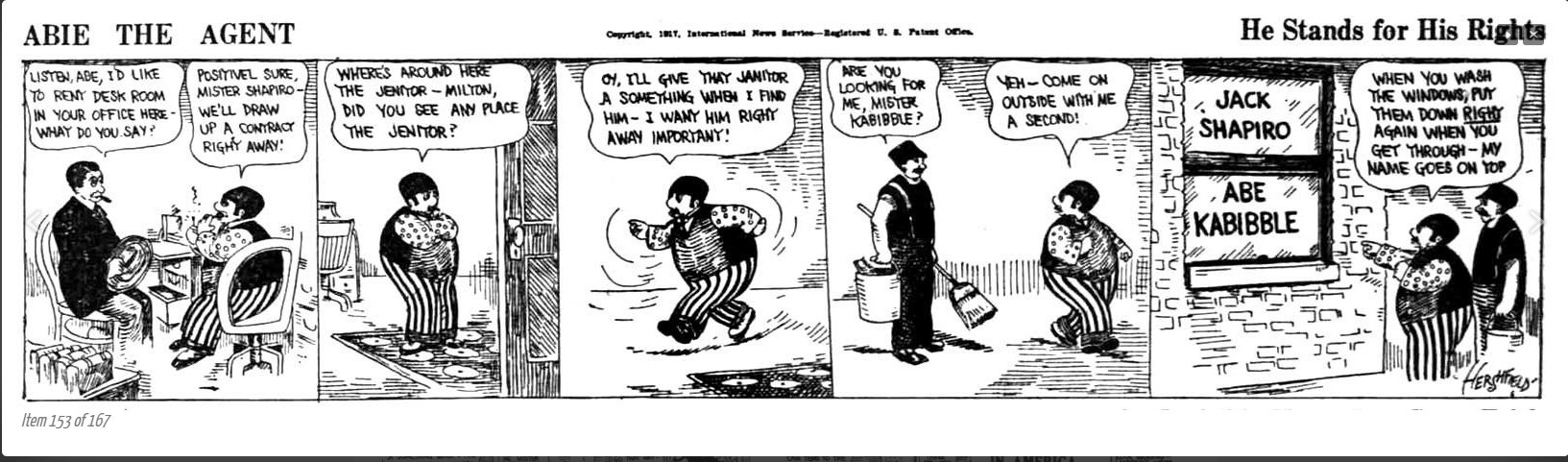
Tellingly, none of the many super heroes these artists created were Jews. Unlike Abie Kabibble, a cartoon character created by Harry Hershfield. He was Jewish. But he was most certainly no super hero.
From the Archive
The Myth of the Judeo-Christian Tradition
·
June 30, 2022
Most days my rather voracious inbox receives at least one email extolling the ‘Judeo-Christian tradition’. The email will invariably have come from the USA, generally though not exclusively from an evangelical Christian website or the politically conservative Christian right. (Why I choose to receive these emails is another story).
Would you like to read everything I write? Upgrade to a paid subscription today!
Harry Hershfield was a generation older than the cartoonists who created the super heroes. Most of the super heroes were created by men born between 1914 and 1922; Harry Hershfield was born in 1885. He grew up in an era when cartoons regularly depicted minorities with very little sensitivity - Black, Irish, Chinese, and Native Americans, as well as Jews. Most of the time this was not intentionally racist, it was merely a reflection of the ethnic diversity of American society with its large number of immigrants. But the cartoons during Hershfield’s childhood played to the stereotypes; they depict Jews with protruding noses and bulbous lips, speaking with funny accents, burning down their stores to collect insurance or counting their money. The cartoonists gave them stereotypical names, Irish Paddy and Jewish Abe, and created inter-ethnic hybrids with stage plays like Abie’s Irish Rose and Kosher Kitty Kelly.
In 1910 Hershfield created a comic strip in William Randolph Hearst’s New York Journal. Named Desperate Desmond, it featured a Jewish character, a cannibal chief named Gomgatz. As a cannibal, Gomgatz was the first Jew in a comic strip aimed at regular American society not to be stereotyped. Even though his dialogue, such as it was, was peppered with Yiddish words.
Anti-immigrant feeling in America was running high at the time yet Hershfield’s editor, Arthur Brisbane, noted that Gomgatz the Jewish cannibal did not elicit any negative reaction among readers. He thought it might be an interesting experiment to devise a cartoon strip based on a Jewish character living a normal American life.
Hershfield agreed. He was proud that he had introduced cannibal chief Gomgatz, but felt he had further to go in his desire to paint a true picture of the New York Jewish community in which he lived. He said that wanted to create a ‘clean cut, well-dressed specimen of Jewish humour’ to counter prevailing depictions of Jews оп the stage and in burlesque which portrayed a type of Jewish humour ‘not all complimentary to the Jewish people and not all justified’.
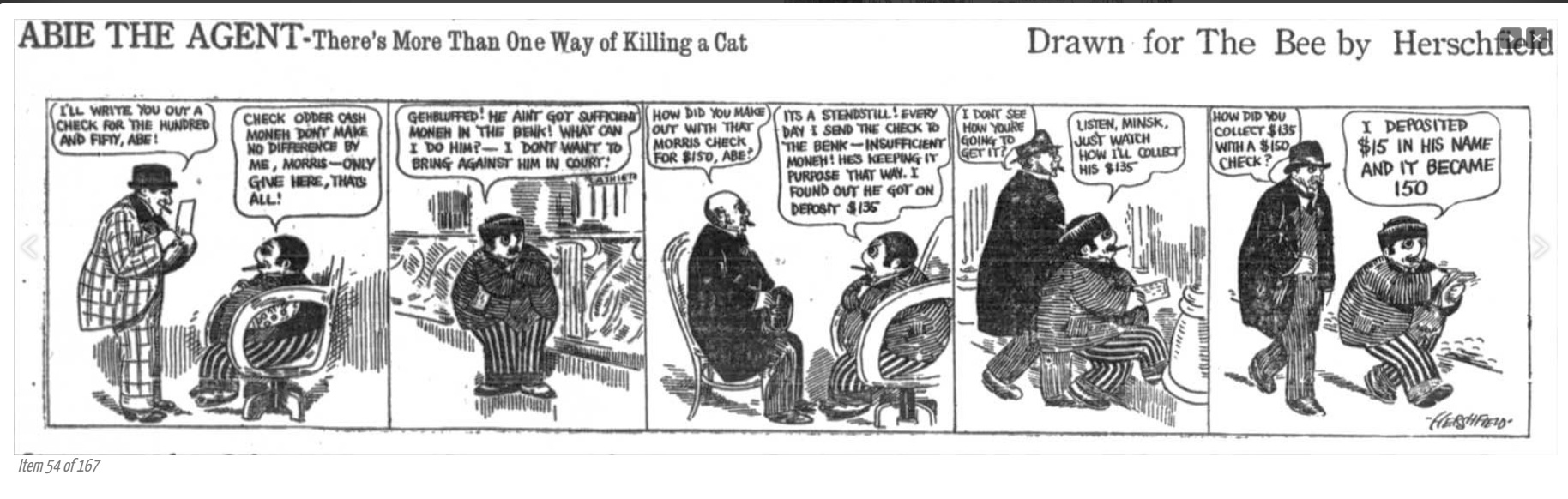
The cartoon strip that Harry Hershfield came up with was called Abie the Agent. It ran in the New York Journal from 1914 to 1935 (apart from a four year break). It came out in black and white during the week and in colour on Sundays. Its hero was a New York motorcar dealer named Abie Kabibble.
There is considerable discussion on the internet about the meaning of Abie Kabibble’s surname. It sounds Yiddish, but it is not, and nor are there any close sounding Yiddish words from which it has been corrupted. Nobody has come up with a satisfactory explanation for the name. It seems to be made up; intended to be meaningless but with a Yiddish flavour.
Abie Kabibble is a somewhat pedestrian character. No super hero, he is a small rotund man, a bit of a schlemiel who sells cars and generally doesn’t get things right. Neatly dressed, always in striped trousers and with a small moustache, there is nothing of the hatted, bearded, slovenly Jewish caricature that American readers were familiar with. Nor was his demeanour threatening. He looked more like a clown than a salesman. But he was undoubtedly a Jew, he moved in Jewish circles, his friends were Jews, and so were his business colleagues.
The strip was popular. By 1920, it was being read by 20 million Americans each day. In his book Smoothing the Jew, Jeffrey A. Marx argues that Hershfield “smoothed” Abie’s Jewish identity and behaviour in order to show how Jews can integrate into mainstream American society, while being able to retain their own unique identity. Abie does this in part by speaking English rather than Yiddish, and although his English is far from perfect, this enhances his appeal, showing that he is making an effort.
He also has a balanced attitude to money. Hershfield had to resolve the conflict between Abie’s desire to live the American Dream, to earn money and live well, and the prevailing stereotype of Jews as rich and greedy. Money figures in most episodes of Abie the Agent and over the course of the series he does grow wealthy. But with few exceptions (including the strip featured on the Abie the Agent Wikipedia page), there is rarely a hint of him being obsessed with money or grasping. And on the rare occasion, when Hirshfield does sail close to the stereotype, it is invariably with humour. “It ain’t the principle,” Abie once told a waiter who overcharged him, “it’s the ten cents”.
Abie Kabibble was popular because he remained within the cultural boundaries that non-Jewish Americans could relate to. He never talks about yomtov, or matzo or shabbes, words that might make a non-Jewish reader think he was reading something beyond his cultural frame. And Hirshfield was fortunate that he was drawing his cartoons for a relatively tolerant journal; it was reported that one of his fellow cartoonists, Bert Levy, had withdrawn from a contract with a different paper and sacrificed a decent salary, because he did not want to continue drawing a strip that he felt was offensive to his fellow Jews.
By the time the strip came to an end, in 1935, Abie had changed, and so had American society. He had moved jobs several times, growing more prosperous and middle class, and most Americans no longer thought of Jews as immigrants or outsiders. The need to portray them, as Hirschfield had done, as normal, conventional American citizens no longer existed. When the next generation of Jewish cartoonists began their careers, they were under no constraints. They were free to use their imaginations in ways that Hirschfield had never been able to consider. Instead of drawing middle class salesman, the Jewish cartoonists of the late 1930s onwards were free to draw superheroes. And if, deep down, their creation of a super hero was a secret Jewish fantasy, it was a secret they kept to themselves.
From the Archive
The Myth of the Judeo-Christian Tradition
·
June 30, 2022
Most days my rather voracious inbox receives at least one email extolling the ‘Judeo-Christian tradition’. The email will invariably have come from the USA, generally though not exclusively from an evangelical Christian website or the politically conservative Christian right. (Why I choose to receive these emails is another story).
Comments
Nothing yet. Say the first thing.
Sign in to join the conversation.