
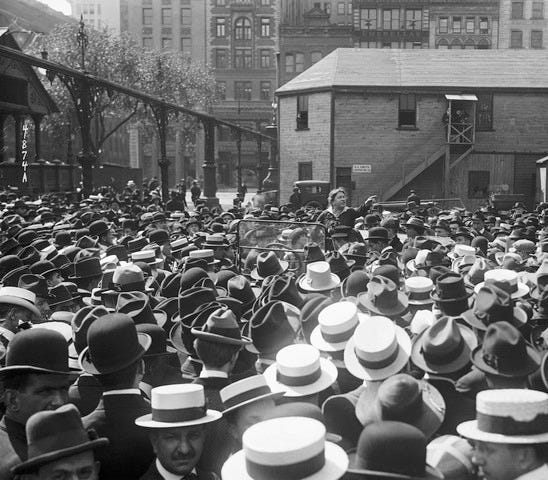
J. Edgar Hoover, future head of the FBI, called her “one of the most dangerous women in America.” Today Emma Goldman is regarded as a feminist icon and a role model to many women.
Born in 1869 in the Lithuanian town of Kovno, Emma Goldman had an unhappy childhood, the family member who bore the brunt of her abusive father’s temper. By all accounts an intelligent child who loved to learn, he refused her an education, sending her to work in a factory and telling her that ‘all a Jewish daughter needs to know is how to prepare gefilte fish, cut noodles fine, and give her man plenty of children.’ When she was 13 the family moved to St Petersburg but two years, later, after her father tried to force her into marriage, she and her sister fled Russia, settling in Rochester, New York in 1885.
Life in Rochester was little better; she earned $2.50 a week working ten hours a day for a coat manufacturer; lonely and depressed she married a fellow Russian immigrant and in no time the marriage fell apart. Shortly afterwards, she experienced a political epiphany. It radicalised her, and changed her life.
The catalyst for Emma’s political awakening was a strike in Chicago where police had fired on the strikers, killing several people. Local anarchists gathered for a protest rally, the police tried to break it up and someone threw a bomb into the crowd. Many people were wounded, a police officer was killed and four leaders of the anarchist rally were arrested, tried and sentenced to death. Emma, who had been following the events closely and reading everything she could on anarchism, emotionally identified with the condemned anarchist leaders. She described her feelings on the day they were hanged:
I had a distinct sensation that something new and wonderful had been born in my soul. A great ideal, a burning faith, a determination to dedicate myself to the memory of my martyred comrades, to make their cause my own, to make known to the world their beautiful lives and heroic deaths . . . My mind was made up. . . . . I would go to New York to prepare myself for my new task.
Anarchism today has a bad name. Sometimes depicted in cartoons as grinning fiends holding fizzing bombs, anarchists are seen as destructive nihilists who want to overthrow the State and replace it with nothing. It is an unfair characterisation even today, it was even more unfair in the late 19th century when the anarchist movement was at its peak. Far from being destructive, 19th century anarchism was utopian. They believed in the goodness of human nature, that if people were left alone, without the pernicious influence of governments and authority, an ideal society would emerge, founded on justice and equity. They may have been naïve, but they were passionate. Emma Goldman defined anarchism as “the philosophy of a new social order based on liberty unrestricted by man-made law; the theory that all forms of government rest on violence, and are therefore wrong and harmful, as well as unnecessary.”
My next book, The Rothschilds, will be published in December. You can pre-order now from Waterstones with a 25% discount!
https://www.waterstones.com/book/the-rothschilds/harry-freedman/9781335000972.
Offer valid until July 24!

Comments
Nothing yet. Say the first thing.
Sign in to join the conversation.