
Introduction
I’ve always wondered how an individual can own the soil beneath our feet. How can someone own a beach, or own a Lake? It doesn’t really make sense to me. For example, the English Costal Path (which is a GREAT national asset) is currently being blocked in one small section on my beautiful Island, by none other than English Heritage who own Osborne House - the former Royal residence.
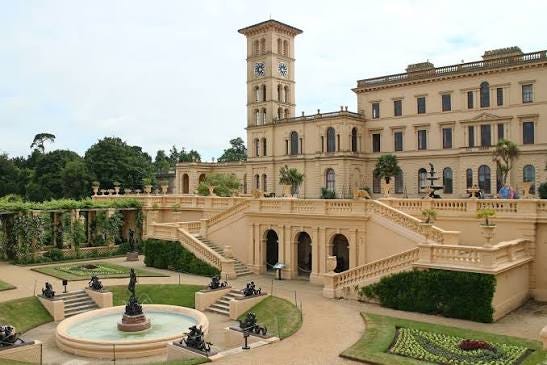
They claim it would put the Royal Families collections in Jeopardy. Kate from the Ramblers association took the opportunity to ask the King himself:
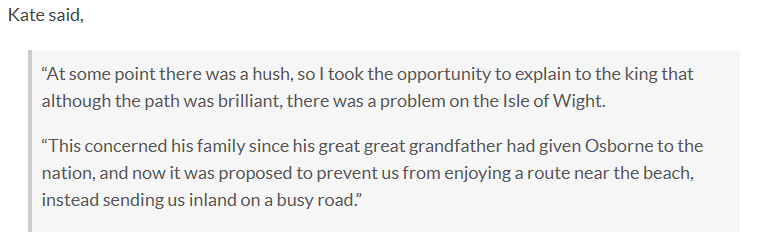
Needleless to say, the King has not yet intervened. But this example cuts to the heart of this article - who actually owns our land? Who controls it? who can access it? Is it us? The Royals? Organisations like English Heritage? I still cannot understand how a beach can be private, is swimming round the bay? Is it still private when the tide is fully out? Surely it is a collective asset for all of us to enjoy?
Weather you believe we evolved from more primitive life forms, or were put here by a deity, the most obvious answer is that we all own it, right? In fact, early British inhabitants held a Pagan reverence for the land - with many natural sites being collectively revered in a pan-psychic sort of way. The land was God, and they were part of the land. So how did we get to where we are today?
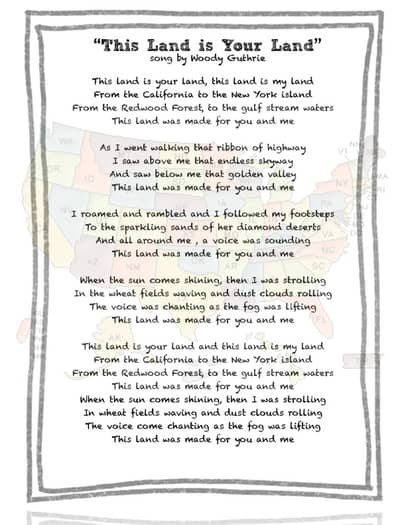
Britain has one of the most beautiful landscapes in the world. From the beaches of north Cornwall to the Brecon Beacons. From the Scottish Highlands to the white cliffs of Dover. We have ancient temperate rainforest, beautiful Munros, and vast beautiful lakes; Britain really does have it all. However, Britain has also long been recognised as having one of the most concentrated patterns of land ownership in Europe (although the exact extent is difficult to measure because there is still no complete public register of ownership which in itself is problematic).
The land beneath our feet has value beyond wealth. It is our food, our shelter, our home. It is the very essence of Britain. Land is however, also one of the most important forms of wealth. Unlike other assets, more cannot be created, and we all exist within it. Whoever controls the land therefore controls housing, agriculture, infrastructure and natural resources, as well as the space in which communities live. Those with land can earn income simply by charging rent to those who don’t own land, or they can keep other people out of their land altogether.
This article explores how Britain’s land came to be owned by a relatively small number of individuals, institutions and organisations, and fundamentally to ask if there is another way. It examines the historical origins of land ownership, who owns Britain today, and why this matters. Let’s take a look…
Looking back through time
Now, I am no historian. I last studied history as part of my IB over a decade ago, and I’ve never really studied British history which is why I find this so interesting. Therefore, if you notice any inaccuracies or missed points, please do share them in the comments. This article aims to promote collective learning more than anything else!
That being said, we cannot really understand who owns Britain today without taking a look back and trying to understand the past, and that’s because Britain’s modern pattern of land ownership is rooted in over a thousand years of history.
In pre‑Norman times, earls and thegns held varying amounts of land within a relatively decentralised system. However, this suddenly changed in the 11th century. The pivotal shift came after the Norman Conquest of 1066, when William the Conqueror confiscated much of the land held by Anglo‑Saxon nobles and redistributed it to his supporters (Man claims land, and gives it to his friends). Under this new feudal system, all land was legally held by the Crown which in turn created a hierarchy of ownership directed by the King, that concentrated wealth and political power among a small elite – sound familiar?
This simplified description applies most directly to England rather than to all of Britain. Now, this is where this series is going to get very difficult, but also very interesting, as what we call Britain is in reality a complex unity of very different nations with their own unique history and circumstances. For example, Wales was only gradually brought under Norman control, with feudal structures spreading unevenly alongside continued Welsh resistance, while Scotland remained independent and developed a similar feudal system later under its own kings rather than through conquest. Ireland, including what is now Northern Ireland, lay outside the immediate impact of 1066; feudal landholding was introduced there only after the Anglo‑Norman invasions of the late twelfth century, and even then, English control remained partial, with many regions continuing under native Gaelic rule for centuries. (This article will largely focus on the three nations of ‘Britain’ whilst recognising that it is often assumed to be interchangeable with ‘the UK’ so will reference Northern Ireland from time to time). However, the trend remains clear – the same amount of land but concentrated in fewer hands.
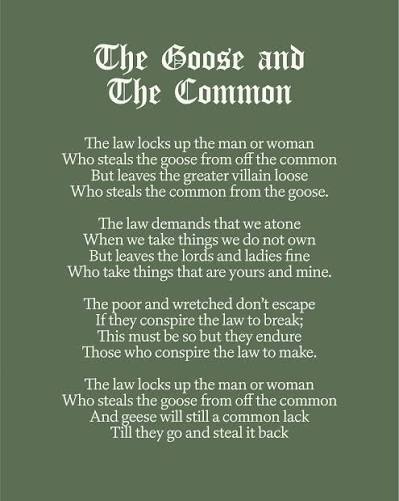
Throughout the Middle Ages, large estates remained in aristocratic families and ecclesiastical hands, a pattern which has survived to this day. Between the sixteenth and nineteenth centuries, the Enclosure Acts transformed the countryside - and is often viewed as one of the biggest acts of robbery in our history. Common land that had traditionally been available for grazing livestock or gathering fuel was enclosed into private estates. While it can be argued that enclosure improved agricultural productivity, it also displaced many rural families and accelerated the growth of landless labour. Essentially, it stole the common land from the common folk.
Industrialisation then created enormous fortunes, but unlike many other countries, Britain’s traditional landed aristocracy retained much of its wealth by adapting to economic change. Rather than disappearing, many estates diversified into urban property, commercial development and financial investment, meaning they simply got richer and richer.
The result is that many of Britain’s largest landowners today can trace their holdings back centuries. Generation after generation are born into wealth, and into land.
So, who owns Britain now?
Determining who owns Britain is surprisingly difficult because England and Wales do not have a complete land register. Millions of acres remain either unregistered or are held through complex ownership structures. In my experience, complex and mirky structures tend to be mirky for a reason – to avoid scrutiny!
I also want to add that land ownership in itself is not necessarily a terrible thing. Although Karl Marx suggested that property is theft (as ownership necessitates taking it from the commune), this in principle can be true whilst also remembering the reality of where we are today. I for one would love to own a small farm, so that I can rewild it and live of the land - and although I would love for that to be under a mass scheme of common ownership - it sometimes feels too far away. The distinction for me is that it cannot be at the expense of others or the community. Perhaps a smaller scale private communal ownership scheme could work - whilst retaining our overall goal, but let’s carry on with the article for now and hold on to that thought.
Comments
Nothing yet. Say the first thing.
Sign in to join the conversation.