
It’s safe to say the politics right now feels pretty exhausting. For those of us who care strongly about the state of the country, and those who feel the sense of societal injustice deeply, it can feel like a full time job just trying to hold down hope.
For me, I’m moving into a period of rest (or a period of political burnout depending on your outlook). It all feels too much, and it feels overwhelming. However, at the same time I have found some hope and faith by reconnecting with another part of myself.
My Time at Buddhafield:
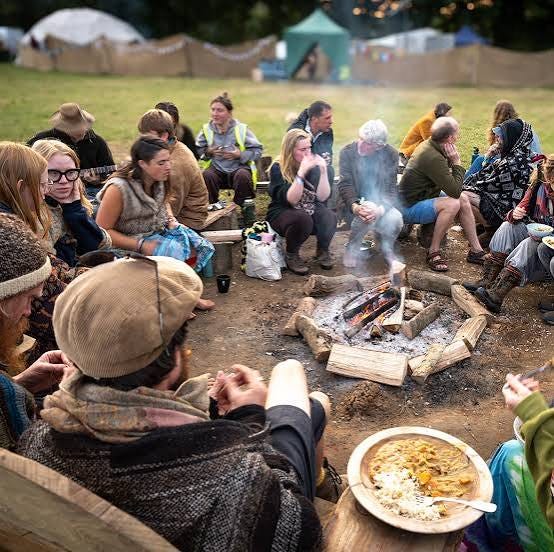
Last weekend, along with thousands of other hippies, I spent the weekend reconnected with myself, my community and the land we live in at Buddhafield. Based on the principles of Buddhism, Buddhafield is a festival of connection, growth and unity. It is a festival which shuns societal norms and opts instead for values such as Sangha (community), compassion and individual and collective growth.
The weekend has many meaningful workshops based on Yoga, Meditation and spiritual growth. However, it also has a focus on societal change - and dreaming of a better world - then taking steps to make it happen. There were sessions on communal living, communal businesses and how to live congruently with spiritual values whilst living in Babylon. This is all completely inline with my socialist values, however what struck me was the lack of big ‘P’ politics.
What is social change:
Social change movements tend to focus on shifts in how we live, and what we value and prioritise. A fundamental belief is that things do not have to be the way that they are, and that we are free to live in a different way. For example, the community living approach breaks down the landlord/tenant narrative and instead focuses on shared ownership and community. Likewise, the collective business approach breaks down the boss/employee narrative and replaces it with shared ownership and collective mission. What’s more, collective projects like community farms tend to have a focus on sustainability and ‘right living’. Local community food for local communities which also benefit the planet. These are ways of changing society from the ground up. In essence its an ‘opt-out’ of Babylon - a rejection of societal norms.
The movement also aligns with issues of global justice such as the freedom of Palestine and the end of genocide in Gaza. Direct action is a place firmly at home in the social change movement which aligns itself with spiritual values and ethical norms, rather than corrupt societal legislation which only seeks to sustain the mega-rich corrupt bastards at the top.
Why does this movement not meet the ballot box?
One of my biggest take homes of the weekend was how these wonderful, insightful and highly skilled groups of people have effectively opted-out of mainstream politics and given up on it all together. Whilst I understand where this lack of faith in politics comes from, and I also understand the ‘conscientious objector’ approach to politics, it feels to me that it doesn’t quite work.
I have always said that if you don’t do politics, then politics does you. We know that those who benefit from the Babylonian system will always vote, and they will also pour lots of money into politics ensuring the system stays the same. This means that in order to achieve broader system change we need to prioritise political organising alongside the social change movement. As a group, ‘non-voters’ always outnumber the largest political party - and this is something to remember.
Is there an alternative to party politics?
In the current system - I really don’t think there is. Even independent MPs eventually end up creating voting blocs, then eventually new parties form. Within the current parliamentary system, in order to create change you need a majority, and in order to make consistent change, you need a consistent majority which is whipped to vote along party lines.
There are other systems that could serve society better - for example sortition. However we will only get there through Parliamentary change (unless a revolution is on the cards, which I cannot for see coming).
The Green party, for example, want to introduce voting reform, and they want to start challenging Babylonian concepts by dismantling the vulture-capitalist system in favour of eco-socialism. This aligns with the social movement in everyway, which is why I believe the social change movement needs to step-up its political organising game.
Big up Greens Organise
I want to close with a shoutout to Greens Organise who were the only political group at Buddahfield. They understand that social change and political change come hand in hand. If you want to see deeper organising on the left, and in-line with eco-socialism, then please consider joining Greens Organise.
That’s all from me for now.
You may have noticed I’m taking some time away from social media to rest and restore. I will continue to write through Substack, so please make sure you have subscribed.
If you are able to, please consider a paid subscription to help continue this work and receive exclusive content. Here is a special 50% off community offer!
Thanks friends!
No posts
Comments
Nothing yet. Say the first thing.
Sign in to join the conversation.