
There is a version of this story where Augusta National breaks Rory McIlroy, but on Sunday he made sure we would never have to read it.
Finishing twelve under after rounds of 67, 65, 73 and 71, McIlroy became only the fourth player in Masters history to defend his title.
I was not surprised. I want to put that on the record.
When McIlroy won last year to complete the career Grand Slam, my overwhelming feeling was not relief on his behalf, it was something closer to inevitability.
When he arrived at the course in Georgia this week as defending champion, I expected him to win again - I just wish I had placed a bet on it.
“I would like to think that I will play a little bit freer and I will play like I have already got a green jacket - which I do.
Sometimes I maybe just have to remind myself of that.”
Rory McIlroy
The story the world tells about McIlroy and Augusta begins on a Sunday in April 2011.
At age 21 he had a four-shot lead going into the final round and a tee shot on the 10th that flew acutely left, saw him triple-bogey the hole and shoot 80, to finish 10 shots off the eventual winner, Charl Schwartzel.
For the next 14 years, that moment followed him everywhere.
Every April, the narrative was dusted off and republished.
What the narrative always missed is that wounds and weakness are not the same thing.
Augusta has ended the major ambitions of players every bit as talented as McIlroy, and Greg Norman is the starkest example.
In 1996, Norman walked onto the first tee with a six-shot lead (the same margin McIlroy held through 36 holes this week) and proceeded to shoot 78, losing by five to Nick Faldo.
Despite Norman winning 91 titles worldwide and spending more than 330 weeks as world number one, Augusta came to define him not by what he achieved but by what he could not close out.
Jordan Spieth is a more recent mirror, and a reminder that winning a green jacket does not automatically inoculate you against Augusta’s darker tendencies.
Spieth won here in 2015, and returned the following year as defending champion holding a five-shot lead with nine holes to play - only to unravel on the par-3 12th, hitting two balls into Rae’s Creek and making a quadruple bogey.
He was still being asked about that 12th hole during this week’s Masters, ten years on.
Last year’s Players Championship offered a glimpse of why McIlroy is different.
During a practice round at TPC Sawgrass, McIlroy pulled his tee shot on the 18th into the water, and a spectator heckled him with a reference to 2011.
What followed was a viral moment, and whatever you make of McIlroy’s reaction, it was a reminder that he is as human as the rest of us.
This week, a different kind of stat did the rounds:

Jason Sobel@JasonSobelGolf
There are 91 players in this week's Masters field. The player in 91st place for driving accuracy is 91st on the leaderboard. The player in 90th place for driving accuracy is Rory McIlroy.
11:52 PM · Apr 10, 2026 · 1.58M Views
124 Replies · 607 Reposts · 24.9K Likes
The implication was clear.
Rory was leading the Masters with driving that ranked second-worst in the entire field.
The wheels, surely, were about to come off.
They did not.
The truly great athletes do not erase the painful memories, they carry them differently overtime.
“I think winning a Masters makes it easier to win your second one.”
Rory McIlroy
It is worth remembering that even last year’s victory was not straightforward, with Rory missing the final putt on the 18th before eventually seeing off Justin Rose in a playoff.
The science behind this is simple and it starts deep inside the brain.
When an athlete returns to a place where something went badly wrong, the brain does not greet them neutrally.
The amygdala - the brain’s threat-detection centre - has already encoded that location as dangerous, filing it away as a contextual fear memory with the help of the hippocampus.
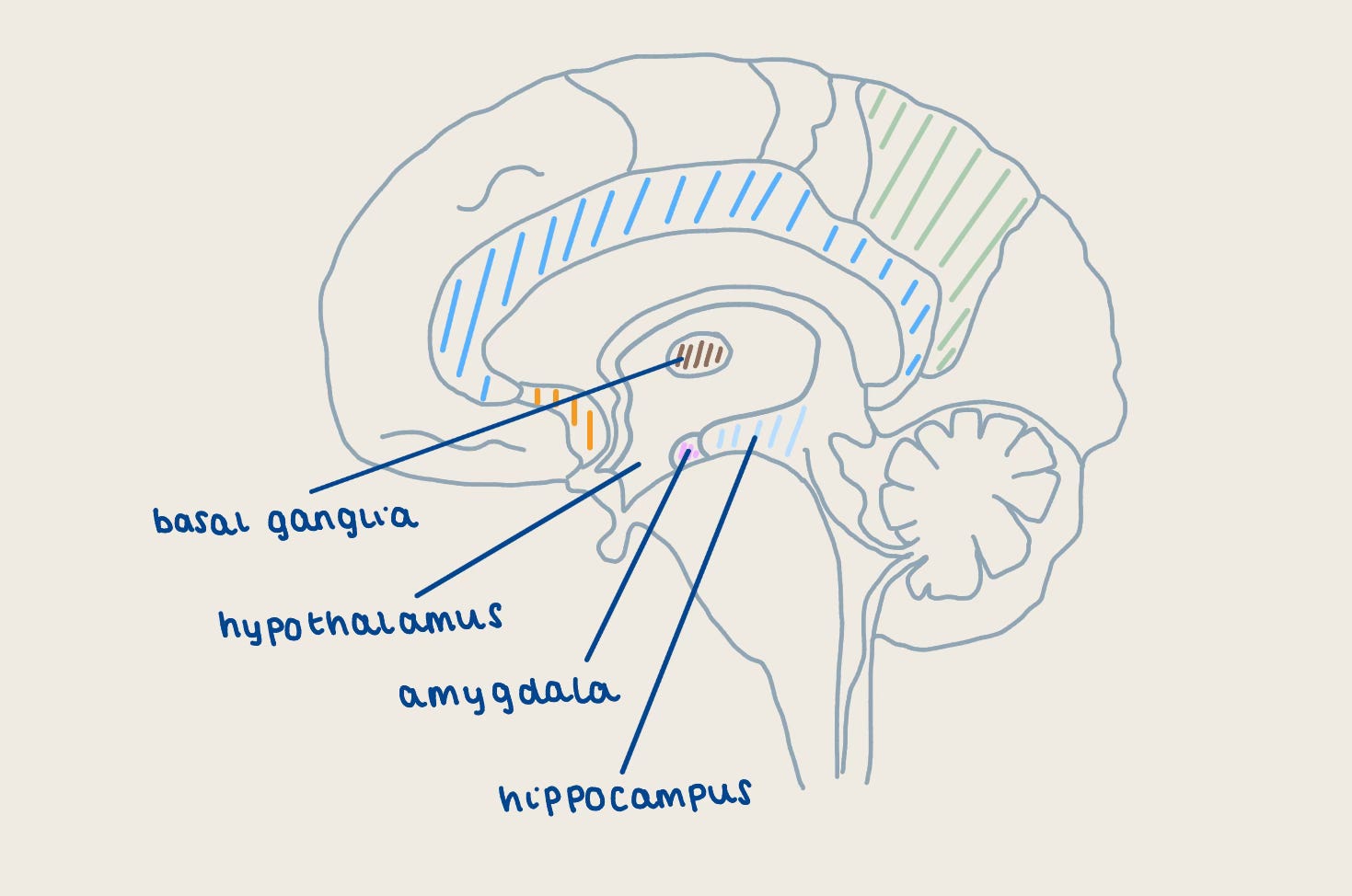
The moment a player steps back onto that tee, or finds a similar lie to the one that cost them the year before, those structures fire before conscious thought even gets a chance.
The rational, thinking prefrontal cortex quietly steps aside, and something older and more protective takes over, the part of the brain that remembers pain and wants, above all else, to avoid repeating it.
In golf, that neurological hijacking shows up in gripped hands, shortened swings and a strategy built around limiting damage rather than attack.
The basal ganglia, which normally automate a well-grooved swing so smoothly it requires no conscious effort, becomes disrupted by the flood of stress hormones (cortisol and adrenaline) that the amygdala has triggered.
The Masters, with its history and yearly return, is exactly the environment that drags all of that back to the surface.
As Gabby Herzig wrote in The Athletic last year:
What changes when you win?
The amygdala does not forget, but it is forced to update.
The old threat memory is not erased, but a newer, more powerful association is laid over the top of it.
The hippocampus now holds both versions of the story, and for the first time in fourteen years, the positive one carried more weight.
Without delving into the psychological approaches players may use, it is clear this win was also made so much easier because the conversation around the clubhouse and course was no longer filled with doubt about whether McIlroy would ever win a Masters.
It allowed him to just play his natural attacking style.
That said, winnings the Masters in never easy and if it were as simple as winning once meant you could easily win again, far more than just four golfers in history would have managed it.
“I thought it was so difficult last year because of trying to win the Masters and the grand slam and then this year I realised it is just really difficult to win the Masters.”
Rory McIlroy after winning
Winning the Masters back in 2025 was visibly a weight off a very talented golfers shoulders, one currently ranked second in the world.
So this year, when Rory held a Master-record six-shot lead through 36 holes and then watched it dissolve on Saturday, there were no visible alarm bells.
He has been in darker places here than a one-shot deficit on a Sunday afternoon, and he knew the way out.
A birdie on 12 and 13 took him into the final hole -13.
He bogeyed 18, which is very Rory, and still won by one over Scottie Scheffler, joining Jack Nicklaus, Nick Faldo and Tiger Woods with a back-to back green jacket.
“I did want to come back here and prove last year was not a fluke.”
Rory McIlroy
One small confession, though: there was part of me hoping Justin Rose would have his moment this year.
"It is another little stinger.”
Justin Rose
He has come so close, so many times.
Augusta owes him one.
If you enjoy reading Pavilion End you can show some appreciation below 🍸
For inquiries contact: harriet@north-view.com
Comments
Nothing yet. Say the first thing.
Sign in to join the conversation.