
The views and opinions expressed in this post are solely those of the author and do not necessarily reflect the views, policies, or positions of the Organization of American Historians.
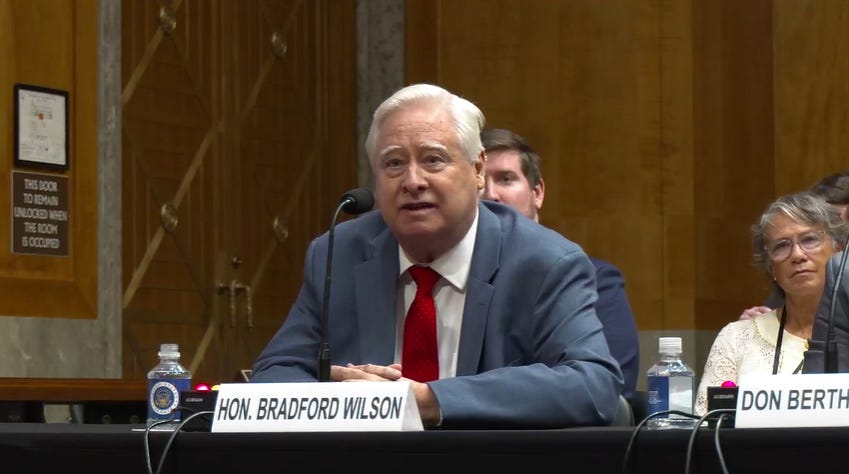
Senate confirmation hearings are meant to test nominees’ qualifications, probe their understanding of the offices they are being nominated to, and give the public confidence that those entrusted with leadership of public institutions appreciate and are qualified to undertake the responsibilities they are about to assume. The June 17, 2026, Senate hearing on the nomination of Bradford Wilson to serve as Archivist of the United States (AOTUS) did almost none of these things.
Wilson appeared as one of 11 nominees, divided between 2 panels, not in a dedicated confirmation hearing customary for AOTUS nominees. His nomination received only a handful of minutes of questioning. There was no meaningful examination of his vision for the National Archives. There was no discussion of NARA’s mounting challenges. There was limited opportunity to assess how he would navigate what has transformed into one of the most politically fraught positions in the federal government.
The hearing revealed as much through what was ignored as what was addressed
As a reminder, this was the hearing to determine perhaps one of the least appreciated but critical federal appointments: the leadership of the institution responsible for preserving the documentary record of the United States government. AOTUS’s responsibilities are wide-ranging and include the statutorily required enforcement of the Presidential Records Act and the Federal Records Act; overseeing a geographically diverse system of facilities in 17 states plus the District of Columbia; ensuring the integrity of record-keeping within 15 executive departments and hundreds of agencies; monitoring declassification efforts; and ultimately, providing to the American people the ability to hold the government accountable for its actions.
As HARPPing on History has noted in past posts, the National Archives is one of the central institutions of democratic accountability in the United States. The records it preserves allow historians to understand the past, journalists to investigate government actions, Congress to conduct oversight, courts to establish facts, and for Americans to understand what their government has done in their name.
Today, NARA’s mission is under unusual strain, underpinned by years of anemic funding and more acutely by actions of the current administration. The Archives faces enormous backlogs in declassification, Freedom of Information requests, and digitization. These issues have been compounded by absence of leadership since the February 2025 firing of then-AOTUS Colleen Shogan, the loss of capacity and institutional knowledge resulting from firings and the exodus of career archivists, and growing political pressure over what types of federal records are preserved for the future.
Archivists, historians, and professional organizations urged Senators to question the nominee about these challenges, including—especially—how to ensure the independence of the institution.
The most revealing aspect of the hearing was not what was said but what was left unsaid.
Yet the hearing never explored how Wilson would protect the Archives’ independence when political interests collide with public access. Given the unusual paneling of 6 nominees at once plus the 5-minute allotment to each Senator for all panelists, the hearing format allowed for few substantive questions. Wilson’s responses were vacuous. On the Presidential Records Act for example, Senator Gary Peters asked Wilson how he would ensure compliance with the law after President Trump’s previous retention of presidential records at Mar-a-Lago. Wilson’s answer was brief and non-specific. “I’m a rule of law man,” he said, “and I intend to follow the law, including on the subject of the disposition of federal records.” Before any follow-up could occur, time expired.
The most revealing aspect of the hearing was not what was said but what was left unsaid. There was no sustained discussion of the National Archives’ role in protecting government records. There was no inquiry into its capacity to account for let alone preserve born-digital records. There was no exploration of transparency obligations, public trust, or the independence necessary for the Archivist to serve administrations of either party.
The Archivist of the United States is not simply another executive branch appointee. The office sits at the intersection of history, public memory, rule of law, and democratic accountability.
For historians, archivists, and anyone concerned with democratic governance, AOTUS confirmation hearings are critical because they offer a rare public opportunity to articulate what the institutions is or should be. This means asking why government records matter, who they belong to, and how they support accountability, transparency, and historical understanding. They force nominees and senators to articulate the purpose of the office, the values it should uphold, and the public interest it is meant to serve. When that conversation doesn’t happen, the public loses an opportunity to understand why NARA matters.
The absence of a substantive hearing happened against an important backdrop. That is, historians, archivists, and other advocates raising concerns about the current administration’s efforts to reinterpret the Presidential Records Act, and more broadly to reshape how history is presented and interpreted across the federal government and about what many see as erasures of broad swaths of the historical record. All of these issues go hand in hand.
The Archivist of the United States is not simply another executive branch appointee. The office sits at the intersection of history, public memory, rule of law, and democratic accountability. A hearing that devoted only a few minutes to the critical responsibilities of AOTUS says as much about the current state of and commitment to government transparency as it does about the nominee himself.
Beth English is a historian of the United States specializing in histories of labor, gender, deindustrialization, and globalization. She is the Executive Director of the Organization of American Historians.
Renée K. Carl is a professional genealogist and advocate for historical records access and preservation.
No posts
Comments
Nothing yet. Say the first thing.
Sign in to join the conversation.