
The views and opinions expressed in this post are solely those of the author and do not necessarily reflect the views, policies, or positions of the Organization of American Historians.
Few historians need to be convinced of the importance of teaching history at the K-12 level. We know that students need rigorous history education to be good neighbors, engaged workers, informed voters, and thoughtful advocates. At the very least, K-12 students are more likely to enroll in university-level history classes if they catch the history bug before they arrive on college campuses. So how do we make that happen?
We make history local.
The Athens Film Project in Georgia is premised on that idea. In addition to the basic but pressing need to document and amplify local histories, local history projects like ours can engage both students and non-historians in the necessary endeavor of local history preservation, and, ideally, make them history supporters for life.
The Athens Film Project is a town-and-gown initiative of the Athens Historical Society (AHS)—a non-profit, community organization run by volunteers. Since making mini-films involved a steep learning curve, it may be helpful to share what we have learned since we began in the hope that readers will launch similar initiatives.
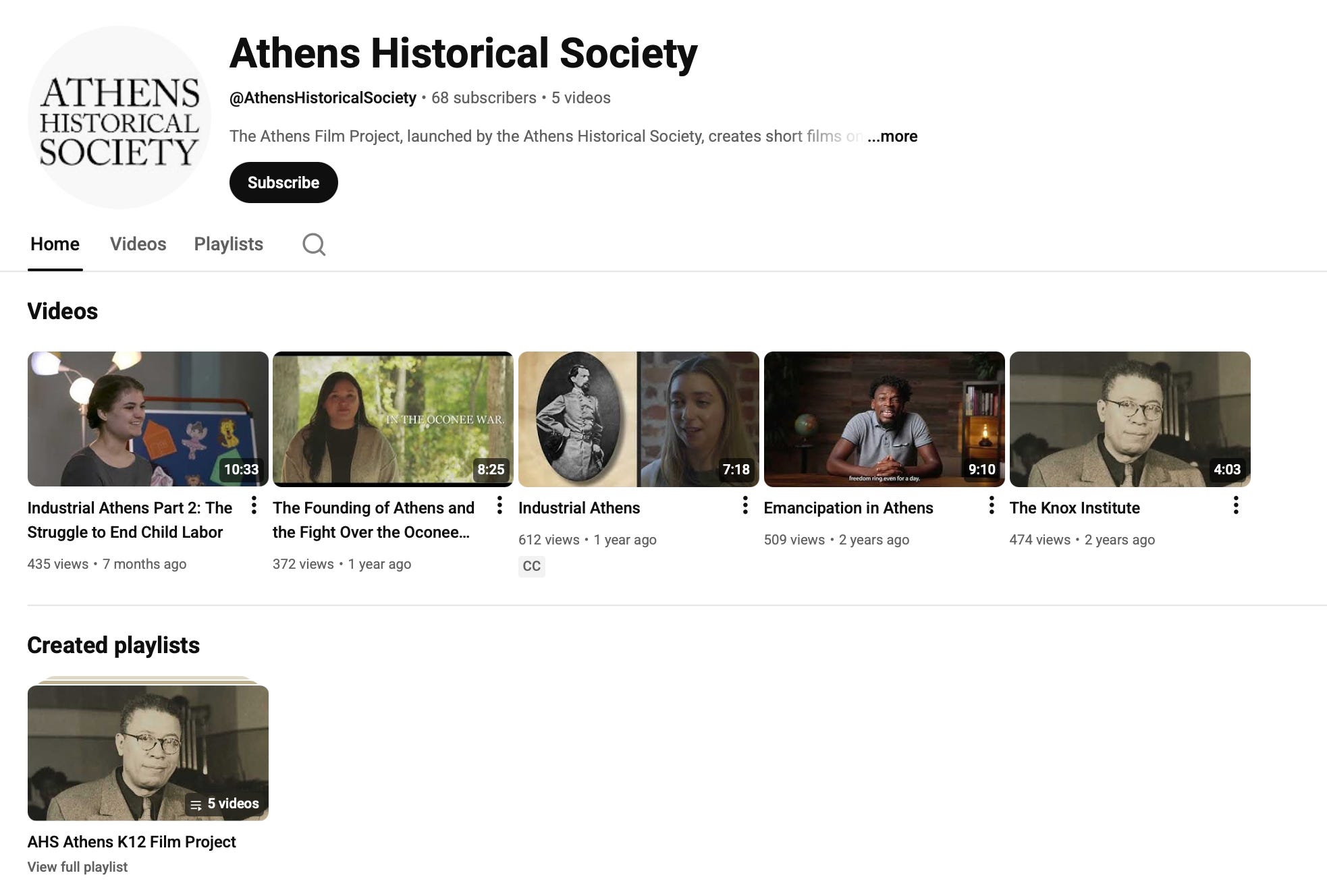
Fair warning: the project is time consuming and costly by the standards of most local history projects, but it is decidedly worthwhile. In the six years since we started, our volunteer fundraiser has raised $230,000 from several small grants and many large contributions from Athenians who appreciate the project. We have made five short films and have a sixth in post-production. Our films are now an official part of the Athens Clarke County social studies curriculum. They are also on YouTube, and have been screened and discussed in venues around town.
We began the project by asking local US history teachers whether short films would be useful to them. They said yes, but only if the films were very short, as in five to eight minutes long. We then scanned the topics in the Georgia Standards of Excellence for 11th grade US social studies classes, the list of terms approved by the state assembly that teachers are supposed to cover. We reasoned that if we stuck to that list, teachers would be more likely to use the films. (Since Georgia has a “divisive content” law, teachers who show our films can point to the state’s list if they are challenged.)
We then sent out a call for proposals to various filmmaker lists and to AHS members, asking filmmakers to propose 5-minute films that feature modern landmarks students would recognize. And since teenagers are accustomed to fast moving videos—my adult kids watch videos at 1.5 speed on their devices—we said we wanted the pacing of the films to fall in between Ken Burns and TikTok. Hold the fiddle music.
We had a contract drawn up by a local attorney who worked pro bono and offered filmmakers $5,000, to be paid out in installments as various benchmarks were met (e.g., contract signing, script approval, “first cut,” and final version).
The AHS Film Committee soon accepted two proposals, one on the industrial revolution in Athens and one on the Knox Institute, an important local Freedmen’s Bureau school. Neither filmmaker was a historian. Neither had made a historical documentary before.
The director of the Knox Institute film had a relatively easy task compared to the other filmmaker because his narrator, gubernatorial candidate Michael Thurmond, had written a book on African American history in Athens. He delivered a lovely film but found the process challenging. He said he had expended the budget before he had shot a minute of film! The Industrial Athens director had to piece together a story from multiple sources, which is normal for historians, but was a surprise to him. We decided the result was unusable, although we paid the filmmaker in full because it was a learning experience for all of us.
We concluded that historians needed to take over the research and writing process. We collaborated with the University of Georgia’s History Department to jointly fund a $21,000 graduate research stipend. The “Film Fellow”—an exciting new role for a UGA grad student—would research and write three (later, reduced to two) short scripts, as well as find images and secure permission to use them when necessary.
The Film Fellow tackled Industrial Athens again—this time it got made—and wrote the script for a film on emancipation. The next graduate student/Film Fellow, likewise co-funded with UGA History, wrote one script on the integration of Athens schools and another on the founding of Athens and the struggle between Georgians and the Muscogee over the Oconee River, which runs through town and was the boundary set by a treaty after the Revolutionary War.
The trickiest bit was squeezing a complicated story into a few pages (a page of single-spaced script equals about 2 minutes of film). Once we had a draft script, we would ask the film committee, our teacher consultants, their students, and subject experts for their thoughts. Meanwhile, we searched for images. The Film Fellow would organize them in a spreadsheet along with citations and permission information and try to get high resolution copies. You need a lot of images to avoid too many slow pans over single photos or paintings.
Finding images and getting permission to use them are big challenges. For films on early subjects, there are few images but they are usually in the public domain. We find loads of images for modern topics but can’t always get or afford the rights to use them. If our films were only shown in classrooms, fair use would apply, but they are not. For example, Atlanta Journal Constitution asked for $1,400 for temporary rights to use one grainy image from 1954. We passed.
Our film on the founding of Athens was especially challenging since the script begins 10,000+ years ago. Since the Oconee River was key to the film, I hired a drone pilot to film a section of the river where there are no buildings, roads, or bridges. That gave us the motion in our motion picture. My UGA colleague Claudio Saunt let us use an animated map from his Invasion of America project. The filmmaker filmed the two narrators, both Cherokee doctoral students, and the late Joshua Haynes on whose book the script was largely based, walking and talking on a woodland trail. Still images of 18th-century sketches and paintings and one animated bison made up the rest.
There are time-consuming jobs for the executive producer. One is to find appropriate locations for shoots. Since the 1831 Athens Factory is now the School of Social Work, I was able to get a faculty member to let us all squeeze into her office, which had an old brick wall we could use as a backdrop. But I discovered a week before the shoot that we needed the university counsel’s permission to film on UGA’s campus. We received it but it was a close call.
Tracking people down is another key job. Local films depend on local knowledge, which requires connections. The Film Fellow initially had no luck convincing the “Forgotten Five,” the people who were the first Black students to attend all White public schools to talk with us on camera. Luckily, a school board member and a local author/activist persuaded two of them to let us interview them for the film.
I also learned that it pays to be on location when we film. The filmmakers do not always notice a mispronounced word or a narrator emphasizing the wrong word in a sentence. But once a shoot is done, there are no do-overs. Filming is the most expensive part of the enterprise, after the graduate stipend, so reshooting a scene is not financially feasible. Someone has to be paying very close attention the first time around.
There are other expenses I could not have predicted. The filmmakers rent equipment and insist on buying insurance, which costs over $1,000. It seems extravagant—we’re not filming stunt drivers, after all—but if someone drops an expensive camera or, worse, drops it on their foot, we will be glad they got coverage.
Reading this may have made you less, not more, inclined to take on this sort of endeavor but there are probably ways to make it easier. Each film could have a different executive producer, a strategy we’re trying this summer, or faculty could do the filmmaking as part of a class instead of on top of a full teaching load. A grant could fund a course reduction or you may find a filmmaker who leads a double life as a historian.
The proof of concept with this local history approach is the feedback, which has been superb. The first word out of a student’s mouth after seeing our film “Emancipation” was “amazing.” A local social studies teacher said the films stimulate animated discussions in their classroom. A world history teacher noted that when he taught about the Aztecs and Incas in the past, students often asked what was happening in our area at the same time. Now he plays our 8-minute film on local Indigenous history and colonization by Europeans and their descendants. We hired him to create linked assignments and assemble primary sources to go along with them.
Hopefully, films about local history will excite students, help them understand how our communities came to be, and make them recognize that they need to understand the past so they can shape a better future.
Cindy Hahamovitch is the B. Phinizy Spalding Distinguished Professor of History at the University of Georgia. A scholar of southern US, immigration, and labor history in a global context, she is the author of The Fruits of Their Labor: Atlantic Coast Farmworkers and the Making of Migrant Poverty, 1870-1945 (UNC Press, 1997), and the prize-winning, No Man's Land: Jamaican Guestworkers in America and the Global History of Deportable Labor (Princeton University Press).
No posts
Comments
Nothing yet. Say the first thing.
Sign in to join the conversation.