
Welcome to 10 Days of AI Basics. If you do not know me, I’m Harper. I have a decade of experience in AI: a M.S. & B.S. from Stanford University in computer science for artificial intelligence, 4 years building AI at Meta, and was Founding Engineer and then Head of AI/ML at a startup acquired by NVIDIA. I also love to teach, and at Stanford I TAed CS courses, including a PhD-level core AI course called Decision Making Under Uncertainty.
TL;DR Training is an iterative process in which a model learns from data to update its internal parameters. Through gradient descent and loss minimization, the model gradually improves its ability to transform inputs into correct outputs, and techniques like regularization help ensure it generalizes to new data.
Welcome to Day 4 of 10 Days of AI Basics. Today, we discuss model training, which is genuinely the heart of machine learning; it is where the model actually learns from the data it has been given.
You can watch my long-form video on this (below) or the short, 90-second version here.
If you think about what we have covered so far (what AI is, what data looks like, what model architecture provides), training is what brings it all together. You have the raw skeleton of a model from the architecture, and training fleshes out that skeleton by updating internal parameters so that the model can properly transform input data into the correct output.
Consider this example: imagine training a baby to classify pictures as dog, cat, or duck. At first, the baby just randomly guesses; with three classes, accuracy would be around 33%. Over time, as the baby guesses and receives feedback (no, that was actually a dog; yes, that was a cat), the baby starts to learn which features distinguish each animal. The baby develops internal representations of what makes a dog a dog, what makes a cat a cat. Neural networks work the same way; they update parameters to represent concepts, features, and ideas as numbers, then apply mathematical functions to those numbers.
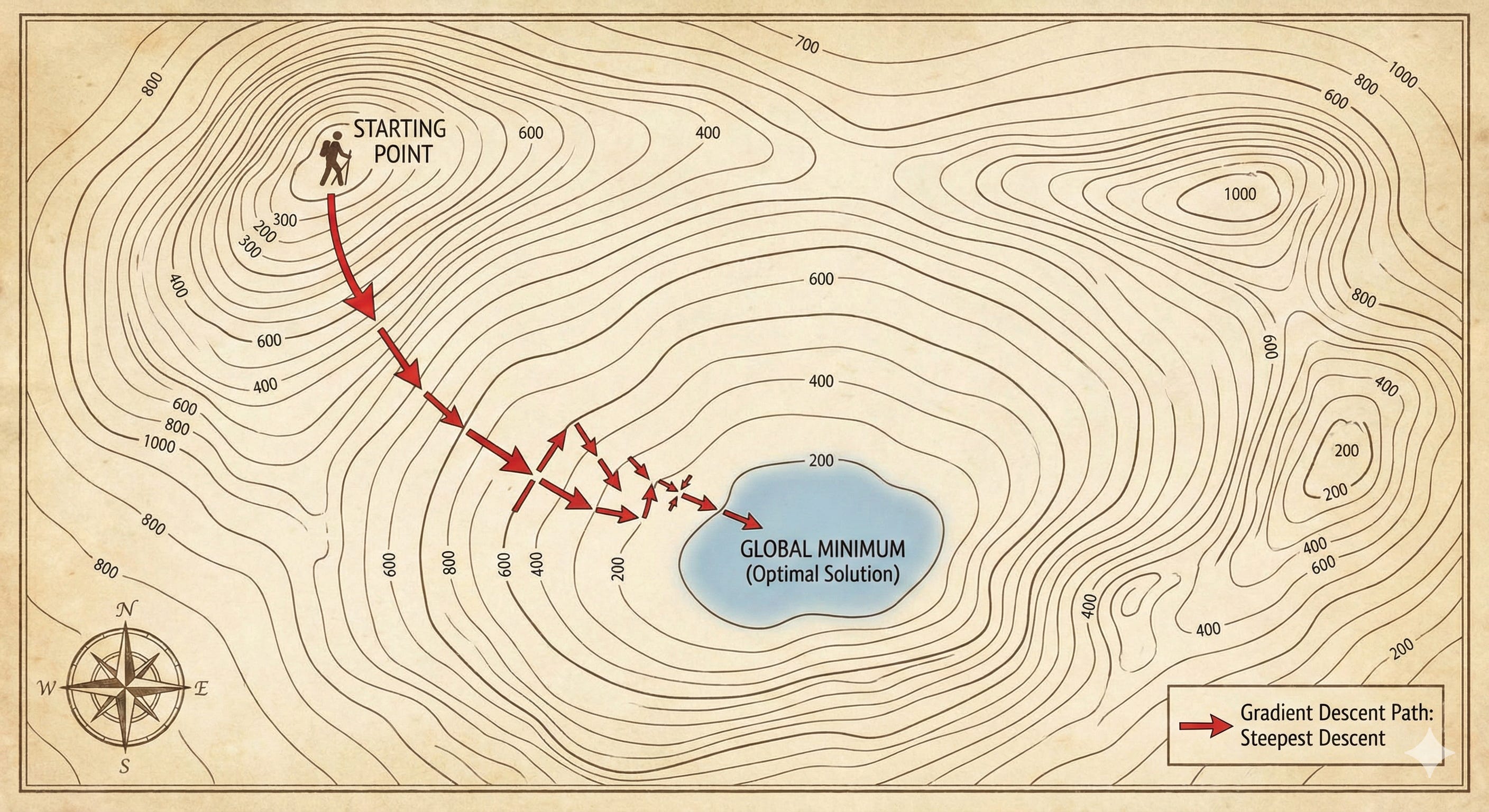
The goal of training is to find parameter values (variables in the models’ matrix multiplications, determined by training & gradient descent, and then made static for production) that minimize errors across the broadest possible range of real data. This is where loss functions come in; they measure how “wrong” the model is, and gradient descent is the algorithm that finds which direction to move to reduce that wrongness. Imagine a topographical map with hills and valleys; you want to find the lowest point, and gradient descent tells you which direction is downhill.
You have three types of data in training: training data (used to update parameters), validation data (used to check performance during training without updating parameters), and test data (held out until the very end). This separation is crucial because you need to know how the model performs on data it has never seen.
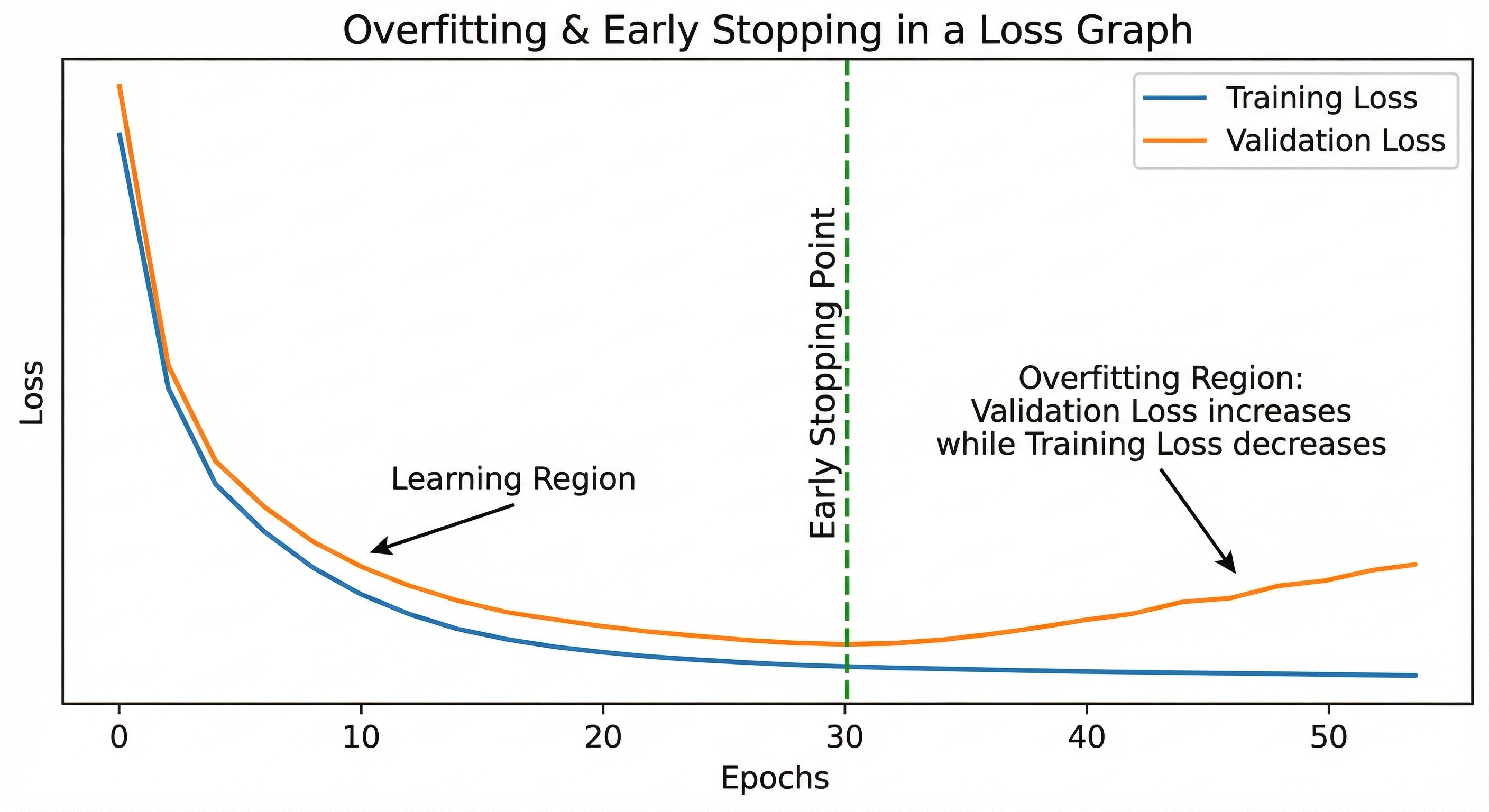
Overfitting is one of the biggest challenges; it occurs when a model performs very well on training data but poorly on new data. The classic example: imagine your dog, cat, duck classifier relies heavily on a speech bubble in the image that says “meow” or “woof.” When you deploy it in the real world, where images do not have speech bubbles, it fails. Regularization techniques combat this. Dropout randomly sets neurons to zero during training, forcing the network to distribute learning across many neurons rather than relying too heavily on any one. Early stopping monitors when validation performance starts to decline and stops training before overfitting worsens.
Here’s a video of mine on overfitting & early stopping.
Transfer learning has changed everything. Training from scratch (starting with random parameter values) requires extraordinary compute. Instead, most models today start with parameters from a model that has already learned useful features, then fine-tune them for the specific task. I fine-tuned a model on my journal entries for about 30 minutes, costing roughly a dollar, and it learned to speak exactly like me. That is the power of transfer learning.
Today, models of the brain are actually being revised to represent our own learning as a mathematical gradient descent process - we’re learning about ourselves through AI. Pretty cool.
Feel free to ask any questions in the comments, and I hope to see you back for Day 5.
No posts
Comments
Nothing yet. Say the first thing.
Sign in to join the conversation.