
Thundercat’s brother’s durag
A cerulean crushed velvet he substitutes for a crown of thorns while he cruises Sunset. I can’t wait to get drunk and tell you how terrible my life has been, he whispers too loudly during our drumline of the leaves for Billy Higgins. I’m grateful for his unreasonably tall white chaperone who has accompanied him to every event he’s been to at the venue. I’m grateful that the sharp gleam in his eyes is not yet bruised or jaded by grievances, though he grieves relentlessly, with that neurotic, not-yet-necrotic Los Angeles affect of the disaffected black Larry David. He laments and giggles over the drums, and just beneath the beat. I’m glad that the dilated pupils are steady and refuse to fidget even during unsolicited confessions of distress he glares down his own present like a shadow entering a distorted mirror, watching himself disrupt his own spirit with flickers of ego and insatiable loneliness. Heckling is his form of wisdom, carnal, carnival making, his casual atonal, dysfunctional heroism in spaces of decorum and ceremony, he plays the seething jester, not to be confused with the joker smiling into the pockets of thieves.
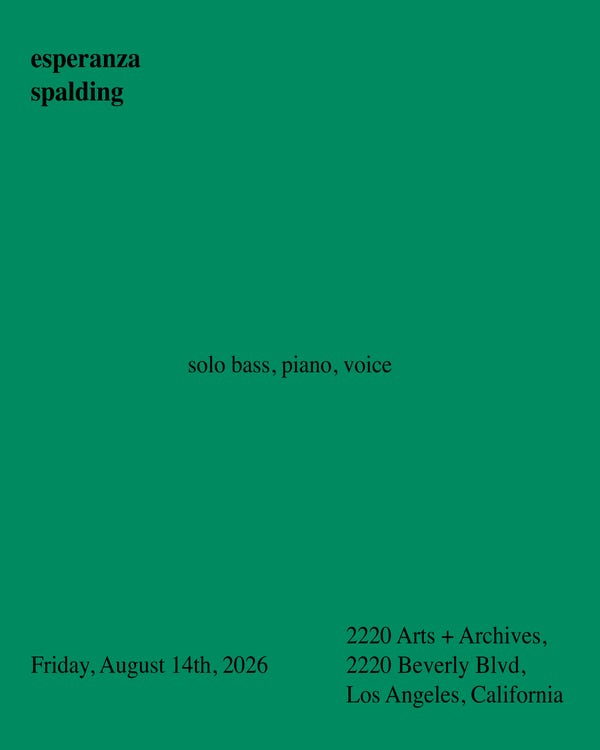
A few nights later at esperanza’s solo show he approaches me, asking to meet her. She’s friends with your brother, I baffle, you haven’t already met? And then, playing affable bodyguard, how are you gonna act when you do? Ima be chill. Joking I say, c’mon, just tell her your Thundercat’s brother before the other outbursts, and we head toward the green room. Intercepted by the goal and taking me literally, he removes his durag, curtsies, and yelps in his version of quietly, hi, I’m Thundercat’s brother. The durag remains dangling from the rail of a dolly stacked with chairs for three days and three nights, a sleeping amulet, a treatise on the humility or humiliation of family ties, on the nearness of us in our fractal Los Angeles, on the revisionist history of Hello, Dolly! playing softly in the minds of every pseudo nepo-baby of black music— I didn’t want to touch it, that plush grail of headdress. I filled it with rose petals and poem scraps, bits of a poem by Billy Higgins called Do a Million Echoes, a close-call in the tension between fraternity and hazing, brotherhood winning, the brotherhood in Invisible Man and the brotherhood in our invisible city beside the Holly, unholy cedar. We live in a place where the miraculous masquerades as disruptive, disturbance, a whistleblower having a word backstage, feigning incoherence, furtive glances between performances, garments left behind on purpose portending the immanent return or disappearance of Very Important Persons who cannot wait to tell us. Remember fun, how the funny guy is the lonely guy enthralled with polyester, Polystyrene, polyamory and punchlines? I’ll always think of you that way.
Backstage
The poet Kamau Daáood, a close friend to Billy Higgins, never knew Billy wrote poems in a kind of drummer’s scansion. Now he knows; Yousef found one of the three copies of the one published Higgins volume Space Jam, and made him a replica. Kamau came up in the Watts Writers Workshop in the ‘70s, in the trial by fire, working wage jobs, and watchmen hours at the bootleg General Electric to scribe by. Once upon a time Sonia Sanchez lent him some money he needed to keep his house. He paid her back in a casual wad of cash she never requested or expected and kept on an altar for years, her amulet, a nest of leaves unleveraged, not yet greedy for whirlwind, the green and gold aura around her letters. She called in from Philly to read to us with another Watts Writers Workshop alumnus, Baba Amde. It was her first time reading poems aloud to an audience in over a year. Small miracles between old friends. They spoke as if on a porch together with no audience before reading. Close listening to their conversation was an exercise in refusing sentimentality and it was easy to fail and hear only half of the oratory, or hear only the pantomime of the wisdom of the elders and feel replenished or self-congratulatory by proximity instead of sharpened, so we recorded.
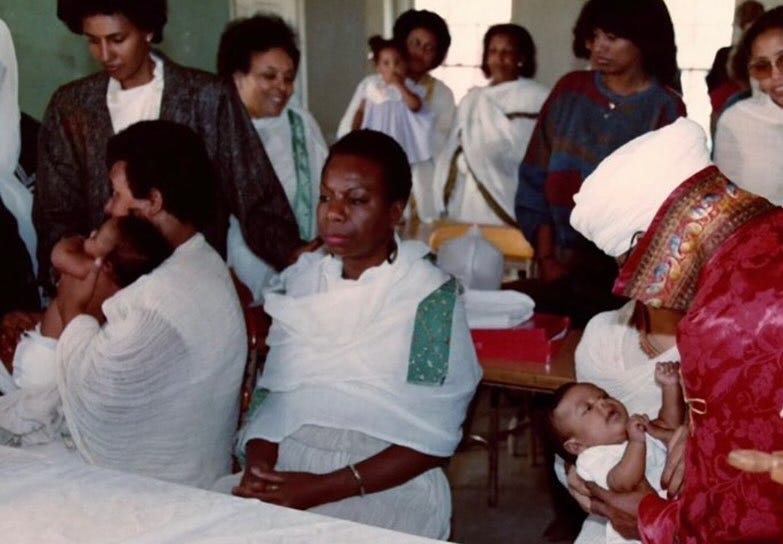
On the record Baba Amde described rescuing Nina Simone from a sanatorium in Los Angeles, acting as her priest, and later baptizing her. Had he not intervened, she may have died or disappeared in there; a very important person reduced to her disorientation, to wearing three dresses at once, rambling about disabused divaism, and forgetting the thunder’s her brother, and Sam Waymon, and here comes the sun.
Of depleted ritual
Festivals were once situated around harvest, highest or lowest light, or sacred occasions, and held to honor and commemorate the seasons, the gods, the ghosts of the future. Music, dance, poetry, thought, and sentience as channelled through these forms, existed in the service of the natural world and its patterns, and naturally aligned with festivals that functioned more like prayers into the heart of the impending season, as call and response with the divine order, as guardians of stories and inventors of stories that give our callings and cullings purpose, preparations for extended fasts or solitude in the service of tasks that demand extreme focus and sacred intent, and preparations for sacred gatherings, the muted conviviality of the everyday amplified on purpose so we notice it again. The feast anticipates the feat of the sovereign compelled to fast and forage for deeper meanings in its aftermath. The why we are here, aliveness itself, was attached to this cyclical conversation, this hope for the conversation on earth, this defiance of the cults of atomization and automatons.
Commercial festivals of the current spiritually and intellectually depleted age align with Qs 1-4 and feeble distortions in the new borderless nation of avatars inspired by the collective desperation of artists who will otherwise disperse, go hungry, merge with AI and be siloed to streaming and worth more dead than alive for the foreseeable future. They are asked to tour for money in relatively arbitrary cycles driven by album releases, press runs, or their audience’s entitled approach to leisure, and hype and price dictate where and how an event like Coachella might shift from marginalized gathering of kids experimenting with acid and Bjork in the desert to two weekends of empire-affirming too-big-to-fail consumerism orchestrated by the music industry’s gatekeepers and fate hoppers and groupies and the endless years of adolescence that make Americans Americans. Big fun! Remember fun? In this contrived context, festivals help gentrify music and region and become weapons of the state in that they divert instead of center, distract us from instead of aligning us with our sounds and seasons.
LA was recently confronted with something like this as Airbnb attempted to hijack jazz culture to sponsor an attempt at festival it then sabotaged with all of the deflated grandiosity of a bot breaking out of its Anthropic™ system. Artists who had been hired and offered uncharacteristically high rates to travel here and play, were informed their shows, and then the entire festival had been cancelled, at the last minute, and no compensation would come. Because the ritual corollary to the occasion was gentrification, the cancellations were cold and unceremonious, as sluggish as the invitations were grandiose. This is one consequence of just doing things to do them, deracinated from any spiritual urgency and maybe deploying the rhetoric of allyship or good will to tacitly exploit the precarious labor conditions of many artists and musicians who resist complete institutional capture in this era of clout and class warfare tempered by liberalism’s pathological civility and the cults of spiritual bypass it hosts.
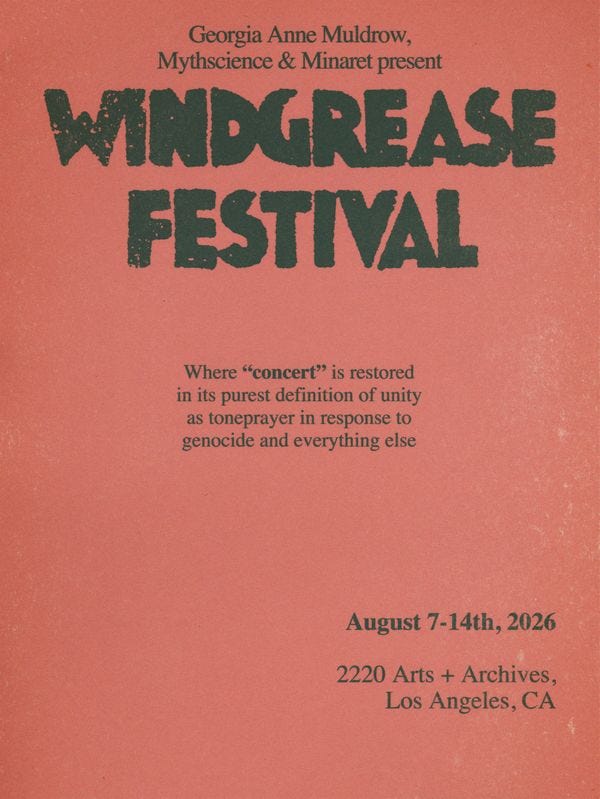
On the other side of time some friends and I hosted an alternative, called it The Windgrease Festival, a neologism of Georgia Anne Muldrow’s, and centered it around an archive of the most recorded jazz drummer in the history of the music, Billy Higgins. To not glamor the salt of the earth, to respond to a desire to experience and make music and poetry and the world around us behave differently, and to see what might happen without a corporate sponsor or any sponsor at all, just a compulsion to unharness the wind and improvise with it.
Scoring my blisses
I write extensively about the disorientation of sweet violence; where the sweet violence is entertainment, the music going from your ears (excerpts of the heart) to your cells, nerves, fascia, and coming back through you as you per-son-ality— you come through sound into the light of the world and I write about the dangers and thrills of wrong and right sounding). There are no errors in your true sound but there are obstructions on the path to accessing it that cause many to feign false versions of themselves, they never sound like themselves, they walk around like ghosts screaming in pitches we can’t quite detect and that’s the personality, a life of counterfeiting that will have to be repeated until the lost soul recovers a sense of purpose deeper than the addiction to pretending, a root system, a redemption song. Until then, you are encouraging ghosts to haunt you forever, is the only relevant refrain, life after life. Courage is a vice lately, it might be a a while for so many souls.
Sonia tells me she used to go out on the porch every morning and scream, primal bleating alongside the dawn birds, until a new neighbor moved in and accused freedom of madness’s demeanor. I think of her screaming against the sound of the title Melvin Van Peebles devised for his disoriented and violent suite, Sweet Sweetback’s Badass Song, I consider the difference between the violence in my childhood/home, and that in cinema, between the idea of the scream and the scream itself. An actress who starred in Wes Craven’s Scream is found dead. Pet the blue velvet as if it’s a genie. The difference isn’t vast enough. The films terraformed in us and we were their best villains and trojan animus.
Ima see myself out of the depleted myths and into Rich Homie Quan’s verse I’ve done a lot of sh*t just to live this here lifestyle. But Rich Homie Quan is also dead. Next refuge. No one cares about trauma anymore, inherited or appropriated, get it together and invent the next territory, the next thematic, a home that isn’t mimicking a movie scene and doesn’t forfeit any of its beauty to live exclusively offscreen. Our festival was an effort at that. Failed and a success. Remember fun? How it requires falling and scars on the knees of vocal cords. The tacit question was, what if you refuse to perform or sabotage performance so well you cure an audience of spectacle addiction and re-center ritual and collective improvisation? But the show must go on, even as it intends to function as a decoy for being together, we come together attached to the spectacular and leave yearning for the ribald, unadorned leaning in that happens backstage.
The muse’s backlash blues
What if all ticketed, concertized performance indicates active Stockholm Syndrome in the performer, that she’s afraid for her life. She enters the economy selling the habit of singing for her supper, in clubs, parks, studios, wherever, this becomes culture. On stage, she negotiates with voyeurs/customers/captors, and is spared, having made an elegant show of the deal, the artist is now an entertainer. Better than a minstrel, or why the need to be better than that which makes a way for us to be ourselves. If she tries to retain a little anonymity in the exchange, a little piece of the dignity of withholding and re-naming, her stay might be rescinded, everything must be left on stage. What she keeps for herself is a liability, evidence of betrayal of the culture that supports her, a double bind. She is better off letting the ego take over until it self-destructs and the crushed durag, petal-struck, becomes a shrine separating the performer from the self.
She is better off a folk hero here, having sacrificed so much privacy and contemplation to the over-commons, a collective forming one archetype of their manifold, she is better off riding the breeze of the unfinished epic until it stills and she’s home, where they say all heroes are trying to get and never do until the end of the story when home is a ruins. She is better off humbling herself at the altar of unknowns, courting this pattern’s demolition.
Utilitarian and a little utopian visioned, our reimagining of the concepts of festival that feel dead or restrictive risks becoming as grandiose and self-important as anything overtly counter-cultural in the West. Resisting this is harder than giving into it. Humility might be a function of record-keeping, of refusing to let memory be selective or excessively flattering, or refusing to let memory become fantasy. To that end, I’m sharing a digital archive of the past week of events we held in LA, which will include recordings of each concert, talk, and reading, all of the contents of the Billy Higgins archive from his poems to his discography to unpublished interviews, and a couple of dispatches from my personal archive of out-of-print books and ephemera in this tradition. Seven concerts, beginning with the Windgreasers Vocal Sextet and closing with esperanza spalding solo on bass and piano, make up the center, which hopefully will give those who dig in the feel of having attended live, and will also include listeners in the project of keeping the record, or refusing to exaggerate or diminish or embellish or over-indulge its contents. To accept that doing the bare minimum feels harrowing in an era of crisis fetishists and bystanders who still wait to be given instructions or entertained, and that it isn’t harrowing, that detachment might be as brave as grasping, the jester might be the healer, is to accept the need for a record. This archive begins with questions, this interrogation of any self-proclaimed valor until we’re stripped of lore and able to hear one another again.
Full Archive of the Inaugural Windgrease Festival
— Original flyers and ephemera
— Billy Higgins discography, article/interview survey, original out-of-print poetry, unseen photographs and posters
— Full audio recordings of concerts, salons, readings, including dispatches from Bennie Maupin, Georgia Anne Muldrow, esperanza spalding, Sonia Sanchez, etc.
— A copy of a conversation between drummers featuring Milford Graves and Rashid Ali, in this spirit of the season6
Durag for prepared kazoo
Nina Simone at said baptism circa 1988
Mythscience is the name and series under which I do much of my archival and oral history work, Yousef Hilmy runs the label Minaret Records
Logan Richardson’s horn summit featuring Bennie Maupin, Windgrease night 5
Windgreasers Vocal Sextet, night 1
For current paid subscribers I’ll be sending some excerpts shortly
No posts
Comments
Nothing yet. Say the first thing.
Sign in to join the conversation.