
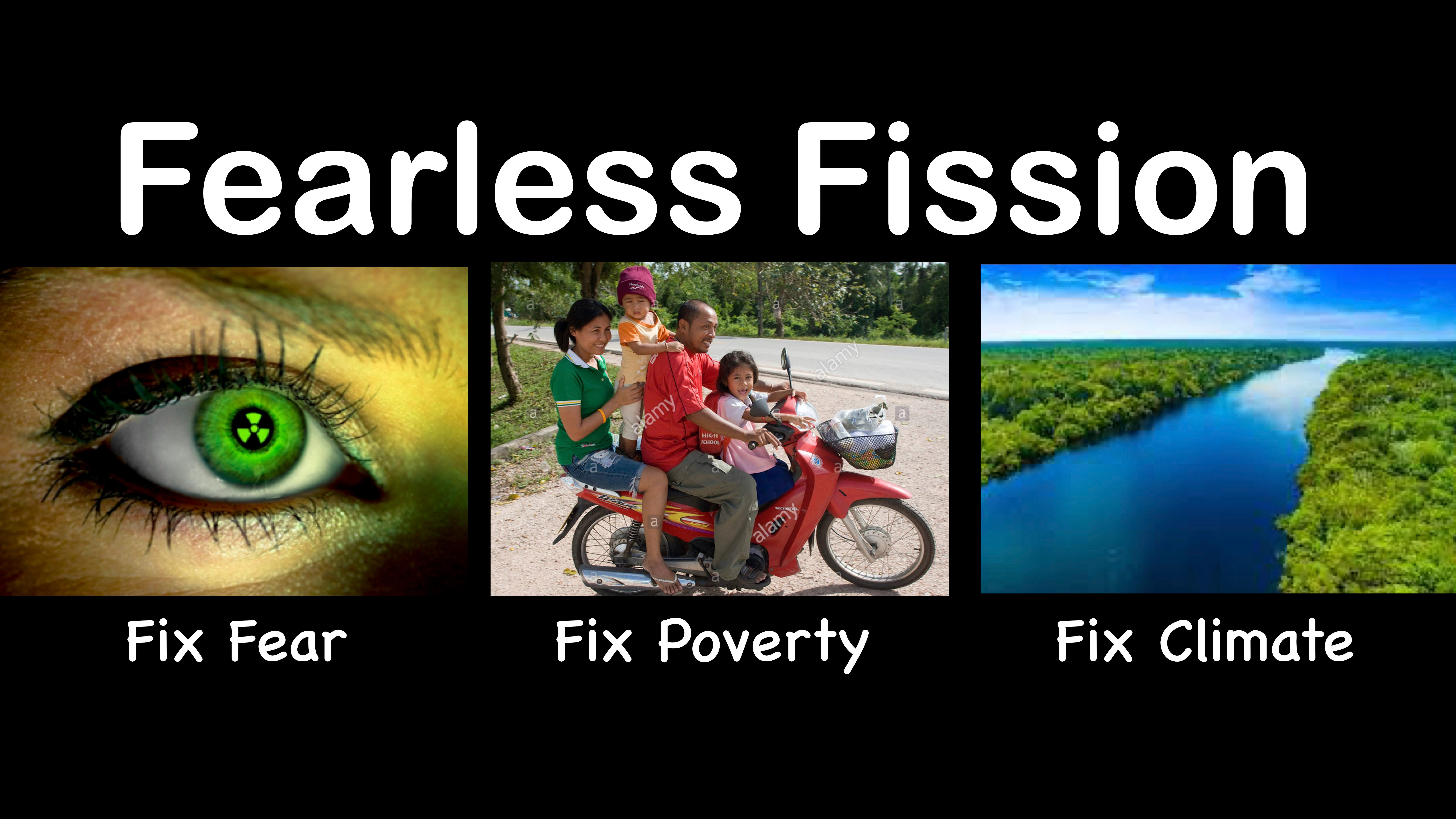
Last century’s nuclear power plants generated electricity costing 3¢/kWh in current dollars. The new, $36 billion AP1000 fission plants are so expensive their electricity costs 15¢/kWh. New builders promise to reduce construction costs, but they look at the wrong benchmark, not the competition.
Natural gas power plants.are the largest, fastest growing source of US electricity. They.generate electricity costing about 5¢/kWh. Nuclear power must be price-competitive to succeed.
Why is fission power so expensive? Regulations and non‑governmental organizations, driven by “safetyism,” have pushed nuclear costs to uncompetitive levels. At the root of this over‑caution is radiation fear.
People fear radiation. Many believe that radiation from nuclear power plants causes cancer. Radiation safety regulators set limits to a thousandth of what might be harmful, then claim even lower radiation exposures may possibly cause cancer. People are spooked because radiation is invisible and radiation induced cancers take 20 years to develop.
This “common knowledge” that all radiation may cause cancer overwhelms people’s ability to discuss nuclear power rationally. The word “radiation” in headlines reliably amplifies fear. As a result, regulators prioritize preventing any radiation release, at almost any cost.
Non governmental organizations such as Environmental Defense Fund actively oppose nuclear power, together using some of their combined $1.3 billion annual revenue to create more fear, to attract more donations. Fear sells!
Nuclear Regulatory Commission staffers magnify fear, guided by beliefs and historical policies rather than scientifically observing actual radiation harm. NRC warned US citizens to stay at least 50 miles away from the 2011 Fukushima accident area for 8 months after the meltdown, though no one there was harmed by radiation.
Japan’s fearful government bureaucrats evacuated nearby residents hurriedly, leading to the deaths of over 1000 elderly, sick, and displaced persons. In reality, no citizens were harmed by radiation. All could have safely sheltered in place.
Groundwater flowing through the damaged Fukushima reactors was captured and treated to remove radioactive isotopes, except for tritium (³H). Many people feared that releasing this slightly radioactive water would pollute the ocean. In fact, you would need to drink about 11 gallons per day of the undiluted tritiated water for its radiation to be harmful—long before that, drinking 11 gallons of plain water in a day would be lethal.
Rather than siding with a single party, successful politicians rally more voters by highlighting a common enemy. Governor Shumlin of Vermont spread fear of radiation from Vermont Yankee nuclear power plant. It provided enough electricity to power the entire state, with no CO2 emissions. Shumlin was elected governor; the plant was closed thereafter.

This photo symbolizes the wealth of families who emerge from the energy poverty of poor nations. Per capita electric power use in North America averages 1,500 watts, 600 in China, 130 in India, and only 20 in poor countries of Sub-Saharan Africa. (One cellphone charger uses 20 watts.)
Buying a motorcycle requires earning money from a well-paying job in industry, commerce, or another productive sector. Reliable, affordable, ample electric power is key to improving economic productivity and creating jobs.
Just as nations and industries compete, so must their energy sources. Mozambique’’s billion dollar Mozal aluminum smelter was recently shuttered, losing 5,000 jobs, because it could not secure 1 GW of electric power at a breakeven cost near 5¢/kWh.
Fission power can fix energy poverty — if we first cut the cost of fear..

The environment pictured above is what we want to preserve. Burning fossil fuels for energy is currently affordable, with a large, competitive industry behind it, and natural gas is now the largest source of US electric power. However, the CO₂ emitted from fossil fuels traps infrared radiation and strengthens the greenhouse effect, contributing to global warming and climate change. [(Some, such as William Happer, argue that further CO₂ increases would add little additional warming, but this remains a minority view.)
Burning coal to generate electricity requires mining massive quantities of coal, disturbing landscapes, and discarding rivers of waste and ash into our environment.
Nuclear power emits no CO2. The uranium is a million times more energy dense that fossil fuels, so uranium mining pollution is minimal.
For fission to displace coal globally, it must become cheaper than coal‑fired power; otherwise, countries will keep building coal plants and emitting even more CO2.
In a sense, these fixes are easy.
Fear: We need only unharness ourselves from radiation fear and unscientific regulatory policies. We then let competitive forces reduce the now high cost of electricity from nuclear power. The US can lead.
Poverty: Many developing nations can import new nuclear plants, build energy‑dependent productive industries, create jobs, and raise living standards.
Climate: Nuclear electricity can directly displace fossil‑fueled generation, cutting roughly one‑third of global CO₂ emissions. Over time, new “electro‑stack” technologies such as electric vehicles can replace many other petroleum uses.
Comments
Nothing yet. Say the first thing.
Sign in to join the conversation.