
I realized last year that with all the effort, time and money being thrown at veteran suicide prevention in the U.S. with little effect, we’re trying to solve the wrong problem.
I started my work in the veteran community about seven years ago because, quite frankly, I needed a new mission and purpose. I had recently quit my stable teaching job as a high school science teacher and was struggling with my own undiagnosed mental health issues. I’ll spare you the details, as I’ve discussed this before here and on my show, but the main thing I gleaned from all that I’ve done is this: suicide prevention has nothing to do with talk therapy and psych drugs.
Stick with me. By the end of this, you’ll understand why you still feel like garbage after doing everything they told you to do and the one thing that actually fixes it.
We’ve all seen the numbers.
22 a day in the U.S.
1 a week in Canada.
And those are conservative estimates. Canada has only recently reported these numbers, and by their own admission, it’s likely way higher because it doesn’t account for reservists who’ve retired.
America and Canada have very similar problems: a devastatingly high suicide rate among their veteran populations. Way higher than civilians, comparatively — and the civilian rate is already very high. Suicide is the second-leading cause of death among younger adults in both Canada and the United States, behind unintentional injuries.
For context, Canada is the only G7 NATO country that doesn’t have a dedicated medical program for veterans. Yes, you read that correctly. We have to get in line with everyone else. Did I mention our healthcare system is in full collapse and a quarter of all Canadians don’t have a family doctor?
So Canada has no statistics on veterans and no national effort to end veteran suicide. The U.S., by comparison, has a massive VA medical system and very public efforts to end veteran suicide. Conservative back-of-napkin math puts VA suicide-prevention spend north of $3B since 2010. The problem? The suicide rate hasn’t improved. Depending on how you measure it, it got worse.
And Canada? Forget about it. There’s literally no data on veteran suicide prevention programs because there aren’t any.
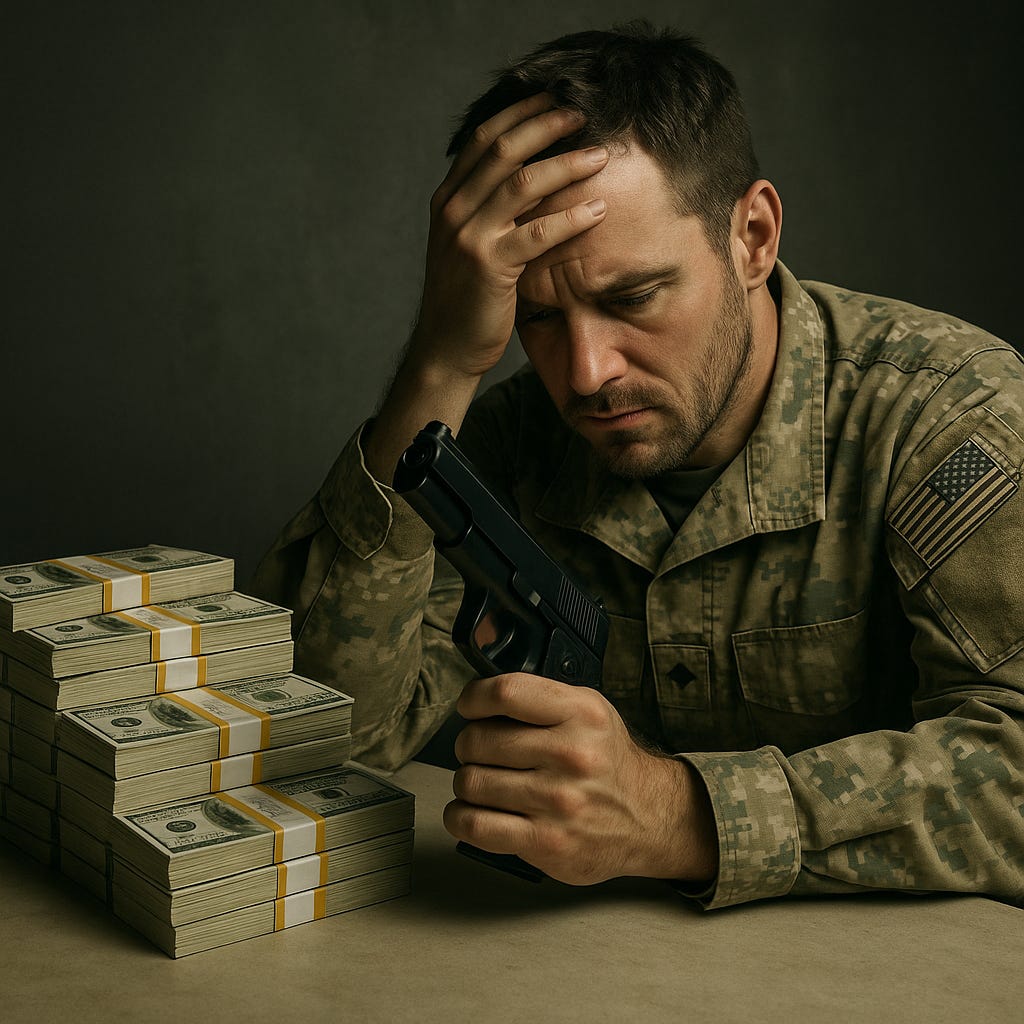
I’m a scientist by training. Biochemist, to be precise. You don’t have to be a classically trained scientist to recognize when your hypothesis is wrong. If you spend $3B over 16 years and see no improvement in the thing you’re trying to improve, you have enough empirical evidence to go back to your original hypothesis and confidently say it’s not the correct one.
The current hypothesis is that veterans are dealing with serious mental health problems from their time in the GWOT — that the horrors of war have left the veteran population unable to cope with its psychological trauma, and that’s what’s driving suicide.
This is clearly incorrect. The data proves it.
So what’s the culprit?
Let me posit a novel hypothesis: it’s a mitochondrial dysfunction problem.
Remember your middle school days? If you had a good teacher (like me…) you’ll remember that the mitochondria are the “power plants” of the cell. They take water, oxygen and glucose and transform them into ATP — our body’s energy currency.
If you don’t make ATP, you die. If your body can’t make ATP efficiently, you slow down — A LOT.
But what slows down ATP production?
Heavy metal toxicity
Chronic stress
Parasitic infections
Mild traumatic brain injury (mTBI)
That’s just the short list. Every single one of these relates to service. Is it any wonder we’re experiencing mitochondrial dysfunction?
Picture a typical GWOT veteran. 44 years old, a couple of kids, one destroyed knee, herniated discs and a mental health condition. He complains about brain fog, anger issues, inability to focus, poor sex drive and a growing waistline. The doctor hears these valid complaints and decides on the spot that it must be PTSD, then prescribes SSRIs and a therapist. He’s following his SOPs to make sure “care” is provided and the veteran doesn’t commit suicide that day.
At no point did the doctor order a blood panel or ask about sleep, nutrition, exercise habits or combat exposures. He’s making a diagnosis on subjective evidence. I’ve yet to talk to a single veteran prescribed SSRIs who had the side effects properly explained or a blood panel ordered.
Every one of that veteran’s symptoms can be explained by the mitochondrial dysfunction hypothesis.
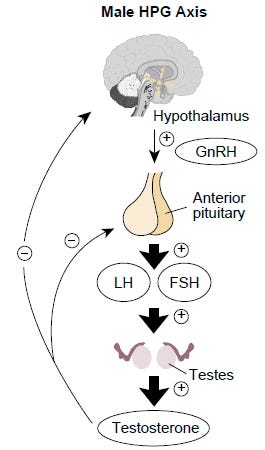
Take low testosterone — same symptoms as above. Low T happens because the Leydig cells in your testicles don’t have enough ATP to run the synthesis reaction. Go upstream: the hormone that signals those cells, luteinizing hormone, is made in the pituitary gland — and if the pituitary’s mitochondria are struggling, you don’t make enough LH. Go further upstream: if your hypothalamus is damaged from years of sleep deprivation or too many shockwave blasts to the melon, it can’t make ATP efficiently either.
One upstream issue — a damaged hypothalamus — cascades into a dozen downstream problems that show up as “mental health” issues. In reality it’s a biochemistry problem. And biochemistry problems can be fixed.
Here’s the hope.
If you’ve been wondering why your mental health issues aren’t resolving even though you’ve done the work, seen the shrink, taken the meds, it’s likely for the reasons above.
The good news: you are 100% in control of improving your mitochondrial health. And you already know how. You’ve been doing it since the day you joined the military. It’s why we trained so hard and ate so well. It’s the reason for the death runs, the ruck marches, the time under the bar. We built our mitochondrial capacity through exercise.
Exercise more, build more mitochondria. That’s the whole point: more mitochondria means more energy to burn later. Same goes for sleep, cold exposure and sunlight.
Simple? Yes. Easy? No — because if it were easy, you’d have done it already.
That’s exactly why I built Veterans Getting Fit AF.
It’s a free community of 600+ vets from all over the world attacking our specific health issues together. Sharing the latest research, sharing wins, and building real plans instead of white-knuckling it alone. Day 1, we hand you a 7-day Body Audit Baseline so you know exactly where your recovery is leaking before you fix a single thing.
It’s free. It’s growing stronger every day. And you’re not alone out there.
👉 Join Veterans Getting Fit AF
One more thing. In September, I’m opening something for the vets who want to go past the free community and actually rebuild their engine from the ground up. The people already inside Fit AF get first access. If that’s you, get in now so you’re on the list when it drops.
Train Hard, Fight Easy,
Dave
hardtokill.org
P.S. — The 600 aren’t waiting on the VA to fix this. Neither should you. Join free, run your 7-day Body Audit, and see what “under-recovered” instead of “broken” actually feels like. → Join Veterans Getting Fit AF
Comments
Nothing yet. Say the first thing.
Sign in to join the conversation.