
On 2nd August 1990, more than 100,000 Iraqi troops poured over the border into Kuwait, rapidly overwhelming the small Gulf state. The invasion marked a turning point in U.S. policy; after years of supporting Baghdad and resisting sanctions against Saddam Hussein’s regime, the Bush administration abruptly reversed course and mobilised international opposition to Iraqi aggression.
In the days following the invasion, Washington imposed sweeping sanctions on Iraq, whilst President Bush engaged in intensive diplomacy and moved to protect neighbouring Gulf states. Speaking with King Fahd of Saudi Arabia on 4th August, Bush declared:
“The Amir of Kuwait asked us for military intervention, but Iraqi troops had already occupied Kuwait City and there was nothing U.S. troops could do…Maybe we can help him down the line, but now we can help Saudi Arabia.”
The immediate test for the United States, however, was not of its military strength, but of the Bush administration’s ability to build an international coalition through diplomacy.
President Bush takes a firm stance:
At a National Security Council meeting on 5th August 1990, intelligence officials debated the likelihood that Iraqi forces would push across the Saudi border. After hearing the evidence, Chairman of the Joint Chiefs of Staff Colin Powell concluded, “we would need to see more missiles, logistics and tanks to conclude an invasion is imminent.”
Once it became clear that Iraq was unlikely to advance beyond Kuwait, attention returned to consolidating international opposition against Saddam, and National Security Advisor Brent Scowcroft asserted:
“As for diplomacy, the president has been very active, and gotten good support from the Allies, the G-7, and Japan.”
Although encouraged by the unified international response, Bush remained sceptical that diplomacy and sanctions would force Saddam to withdraw. In an NSC meeting the previous day, Bush had enquired about possible military options to repel Iraqi forces, and he once again implied that force might be necessary:
“My sense is that Iraq does not believe we will act. Saddam is riding an emotional high. Maybe if he sees it is not business as usual he will change.”
Perhaps reluctant to resort to force, Secretary of the Treasury Nicholas Brady asked, “why not get someone to talk to Saddam, possibly Mitterrand?” French President François Mitterrand had supported collective action through the United Nations, but also maintained distance from Washington to preserve France’s independent role in world affairs. Bush rejected Brady’s suggestion and insisted, “Our solidarity would crumble if we are seen talking to Saddam.” Preserving the unity of the international response was not Bush’s only motive. After a decade of failed efforts to restrain Saddam’s regime, Bush believed negotiating would weaken U.S. credibility and he came to view further diplomacy as appeasement. The president therefore remarked:
“I am interested in the ability of our F-16s to destroy his tanks. Knocking them out would send a strong signal…we are dealing with a mad-man who has shown he will kill.”
Military strikes were ultimately postponed, as Bush recognised that unilateral intervention would undermine international legitimacy and alienate more cautious allies. Instead, Washington focused on maintaining unity in the U.N. Security Council and building a coalition through bilateral diplomacy. In the meantime, U.S. forces were deployed to Saudi Arabia as a defensive measure under Operation Desert Shield.
Building legitimacy for military intervention:
As Washington focused on coalition-building, it had to manage differences with Moscow, which favoured a negotiated settlement. Despite the continued collapse of the Eastern Bloc and the fall of the Berlin Wall in 1989, the Cold War had not formally ended, and U.S.-Soviet relations remained crucial during the Gulf crisis.
Secretary of State James Baker therefore remained in close contact with Soviet Foreign Minister Eduard Shevardnadze. On 7th August, Baker informed Shevardnadze of the decision to deploy U.S. troops to the region, stating they were ‘purely for Saudi Arabia’s defensive needs’. Noting that the decision had already been taken, however, Shevardnadze ‘wondered what he was being consulted about’, and ‘reminded the Secretary of their airport conversation in which he had asked the Secretary not to rely on military force’. Baker defended the decision, asserting:
‘The U.S. does not intend to strike at Iraq, but the U.S. reserves the right to protect its citizens, and to defend Saudi Arabia and the free flow of oil.’
The conversation once again highlighted the risk of unilateral action, and the Bush administration subsequently placed greater urgency on securing Soviet support for military intervention.
The Helsinki Summit:
In September 1990, President Bush and Soviet leader Mikhail Gorbachev held bilateral talks at the Helsinki Summit. With Gorbachev preoccupied by domestic political reform, economic decline, and growing unrest across the Soviet Union, Bush was negotiating from a position of strength when he declared:
“I know it is not easy for you due to your long standing relations with Iraq. But I think there is an opportunity to have develop out of this tragedy a new world order. But the bottom line for a new world order must be that Saddam Hussein cannot be allowed to profit from his aggression.”
Gorbachev agreed that the crisis was “a test of the new process we are going through in world affairs, and of a new U.S.-Soviet Union relationship”. He also reiterated his commitment to securing an Iraqi withdrawal, but warned:
“I think we all, especially you, are under great pressure to be decisive. I agree, but if that means military action, therein lies danger…if [Saddam] is backed into a corner, it will be more costly for us all. We need to give him some daylight.”
Unlike Bush, the Soviets maintained that a negotiated settlement remained possible, one which allowed Saddam to withdraw without losing face. To demonstrate Baghdad’s willingness to negotiate, Moscow could point toward Saddam’s proposal linking Iraq’s withdrawal from Kuwait to Israeli withdrawal from the occupied territories. Washington, however, dismissed this attempt at linkage, arguing that it would reward Iraqi aggression. Others simply viewed Saddam’s initiative as a delaying tactic, designed to drive a wedge between members of the growing coalition.
If Saddam’s diplomacy aimed to fracture the coalition, those hopes were dashed by late October following Soviet envoy Evgeny Primakov’s visit to Iraq. A cable from the U.S. Embassy in Baghdad to Secretary of State Baker claimed that Iraq’s ‘efforts to pry the Soviets and the French away from the consensus have been an abject failure.’ The cable concluded, ‘Primakov’s visit may well be a catalyst to permit us to seize the initiative again.’
This post is public, feel free to share it.
Washington increases pressure on Moscow:
With the United States holding the U.N. Security Council presidency in November, Washington was eager to capitalise on the information from its embassy in Baghdad. Baker therefore travelled to Moscow where he lobbied Gorbachev to support measures that would, “sanction the use of all means necessary” to enforce U.N. resolutions. Baker explained:
“This way Saddam Hussein will be completely clear that if he does not leave, then we have enough will in order to choose the option of using force…The image of Americans and Russians fighting side by side would make a very strong impression.”
Seeking a compromise with the Soviets, Baker proposed a clear deadline for Iraqi withdrawal several months in the future. The delay would give sanctions and diplomacy more time to succeed, whilst demonstrating that coalition members were not pursuing “premature or reckless actions”. Only if Iraq failed to comply by the deadline would force be authorised, at which time Baker claimed, “we will have to act because otherwise people will lose their respect for us.”
Gorbachev praised Baker’s efforts, but declared that a “political settlement” remained Moscow’s top priority. He ended the meeting by remarking, “We will think about these serious considerations that you have laid out…there will be no separate steps behind your back.”
Bush holds direct talks with Gorbachev:
At the Conference on Security and Cooperation in Europe – held eleven days after Baker’s Moscow trip – Bush once again pressed Gorbachev to support Washington’s Gulf strategy, arguing:
“I do not see any other way to persuade [Saddam] that he must do what the entire world demands of him…In terms of cruelty, he is right up there with Hitler…This is why I am asking you to help me.”
Although Gorbachev insisted that he “wanted to avoid blood”, he finally accepted Washington’s structure for a “two-tier resolution”. Iraq would first be given a delayed deadline for withdrawal, allowing Saddam “one last chance to change his mind”. During the period the ultimatum was in force, Gorbachev suggested that both Washington and Moscow “meet with the Iraqi leadership at some level…and present them with our demands.” The Soviet leader felt it was reasonable to give Saddam:
“Until the middle of January. After that, it would be permitted to use all appropriate means, and there would be no need for passing one more resolution.”
Gorbachev’s concession reflected a belief that the credible threat of force, coupled with a clear timetable, might still secure an Iraqi withdrawal. Washington on the other hand, had obtained the crucial support it needed, and on 29th November, the U.N. adopted resolution 678, giving member states the authority to use ‘all necessary means’ to liberate Kuwait.
One last chance for peace?
The day after resolution 678 was adopted – and in keeping with Gorbachev’s call for diplomatic engagement – the Bush administration proposed talks between Iraqi Foreign Minister Tariq Aziz and Secretary of State Baker. Although Saddam accepted the offer, he repeatedly delayed a meeting. Meanwhile, on 19th December, Secretary of Defense Dick Cheney and Colin Powell arrived in Saudi Arabia for a briefing on the coalition’s finalised military plans.
With over 500,000 coalition troops stationed in Saudi Arabia, Baghdad eventually proposed talks for 12th January 1991, but this date was swiftly rejected by Washington as too close to the U.N. deadline. Instead, a meeting between Baker and Aziz was finally held in Geneva on 9th January, but after seven hours of discussions it was clear that neither side was willing to compromise. Gorbachev, who had advocated a political settlement, later remarked in a telephone conversation with François Mitterrand:
“It was not possible to avoid military actions in the final stage…the Hussein regime demonstrated its ambitions, showed an unwillingness to compromise, and issued threats to everybody and especially to the Americans.”
Operation Desert Storm:
On 15th January, Iraq missed the U.N. deadline to withdraw from Kuwait. That same day, President Bush issued National Security Directive 54, which stated that sanctions had failed to end Iraq’s occupation, and ‘there is no persuasive evidence that they will do so in a timely manner.’ Prolonging the crisis would therefore:
‘Threaten the political cohesion of the coalition of countries arrayed against Iraq, allow for continued brutalization of the Kuwaiti people and destruction of their country, and cause added damage to the U.S. and world economies.’
Two days later, Operation Desert Storm began, and a campaign spearheaded by the U.S. Air Force rapidly overwhelmed Iraqi military and command centre targets. In just two years, the Bush administration had gone from resisting efforts to sanction Iraq, to leading the largest military coalition assembled since the Second World War against Saddam’s forces.
The beginning of the end for Saddam:
It had taken the invasion of Kuwait in August 1990, for Washington to finally accept that Saddam could not serve as a pragmatic regional partner. After a decade of supporting Iraq as a counterweight to Iran, relations with Baghdad collapsed almost overnight.
For President Bush, Iraq’s invasion of Kuwait not only disrupted regional stability and global oil markets, but it also challenged the emerging post-Cold War order that the U.S. looked set to lead. The longer Iraq was allowed to occupy Kuwait and defy international pressure led by Washington, the greater the damage to U.S. credibility, and the risk of encouraging aggression elsewhere.
Although the Gulf War ended in a swift and decisive coalition victory, the call was given not to advance on Baghdad and remove Saddam from power. Nevertheless, the conflict cemented Iraq’s position as a pariah state, and set off a chain of events that culminated in Saddam’s eventual demise more than a decade later – once again, at the hands of U.S. troops.
Bibliography:
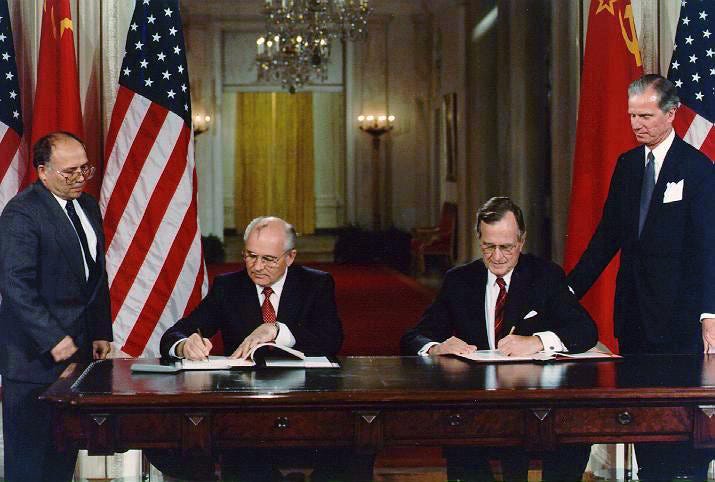
*Photo source: Public domain, via Wikimedia Commons. (No author attributed.)
Primary Sources:
National Security Council meeting, 5th August 1990, National Security Archive.
Summary of TelCon, Secretary of State Baker to Soviet Foreign Minister Eduard Shevardnadze, 7th August 1990, National Security Archive.
Memorandum of conversation, Bush and Gorbachev, 9th September 1990, National Security Archive.
Cable from U.S. Embassy in Baghdad to Secretary of State Baker, 29th October 1990, National Security Archive.
Memorandum of conversation, Gorbachev with Secretary of State Baker, 8th November 1990, National Security Archive.
Memorandum of conversation between Bush and Gorbachev, 19th November 1990, National Security Archive.
Memorandum of conversation between Gorbachev and Francois Mitterrand, 18th January 1991, National Security Archive.
National Security Directive 54, 15th January 1991, National Security Archive.
Secondary Sources:
Fredman. Z, ‘Shoring up Iraq, 1983-1990: Washington and the Chemical Weapons Controversy’, Diplomacy and Statecraft, Volume 23, Issue 3.
Gugliotta. G, “At War, Iraq Courted U.S. into Economic Embrace,” The Washington Post, 16th September 1990.
Hallaj, M. “U.S. Gulf Policy: Going the extra mile for war.” Arab Studies Quarterly, vol. 13, no. 1/2, 1991.
Halliday. F, ‘The Gulf War 1990-1991 and the study of international relations.’ Review of international studies, Vol. 20, Issue 2, 1994.
Karabell. Z, “Backfire: US Policy toward Iraq, 1988-2 August 1990.” Middle East Journal, vol. 49, no. 1, 1995
Kelly. M.J, ‘”Never Again?” German Chemical Corporation Complicity in the Kurdish Genocide’, Berkeley Journal of International Law, Vol. 31, Issue 2, 2013, p. 349
Sassoon. J, ‘The East German Ministry for State Security and Iraq, 1968-1989’, Journal of Cold War Studies, Vol. 16, No. 1, 2014.
Wood, P. C. “François Mitterrand and the Persian Gulf War: The Search for Influence.” French Politics and Society, vol. 10, no. 3, 1992.
No posts
Comments
Nothing yet. Say the first thing.
Sign in to join the conversation.