
Welcome to The Happy Theologian.
Grace and peace to you from God our Father and the Lord Jesus Christ.
Will Rogers once said, “Ten men in our country could buy the whole world and ten million can’t buy enough to eat.”
The economic system in this country has enabled people to improve their lives more than in any other country. Yet, it is still flawed. People are struggling with affordability, as wealth and influence frequently shape systems that don’t serve everyone equally.
This is not an essay about economic systems and the pros and cons. It is a thoughtful look at how, as Christians, we are to live under such circumstances.
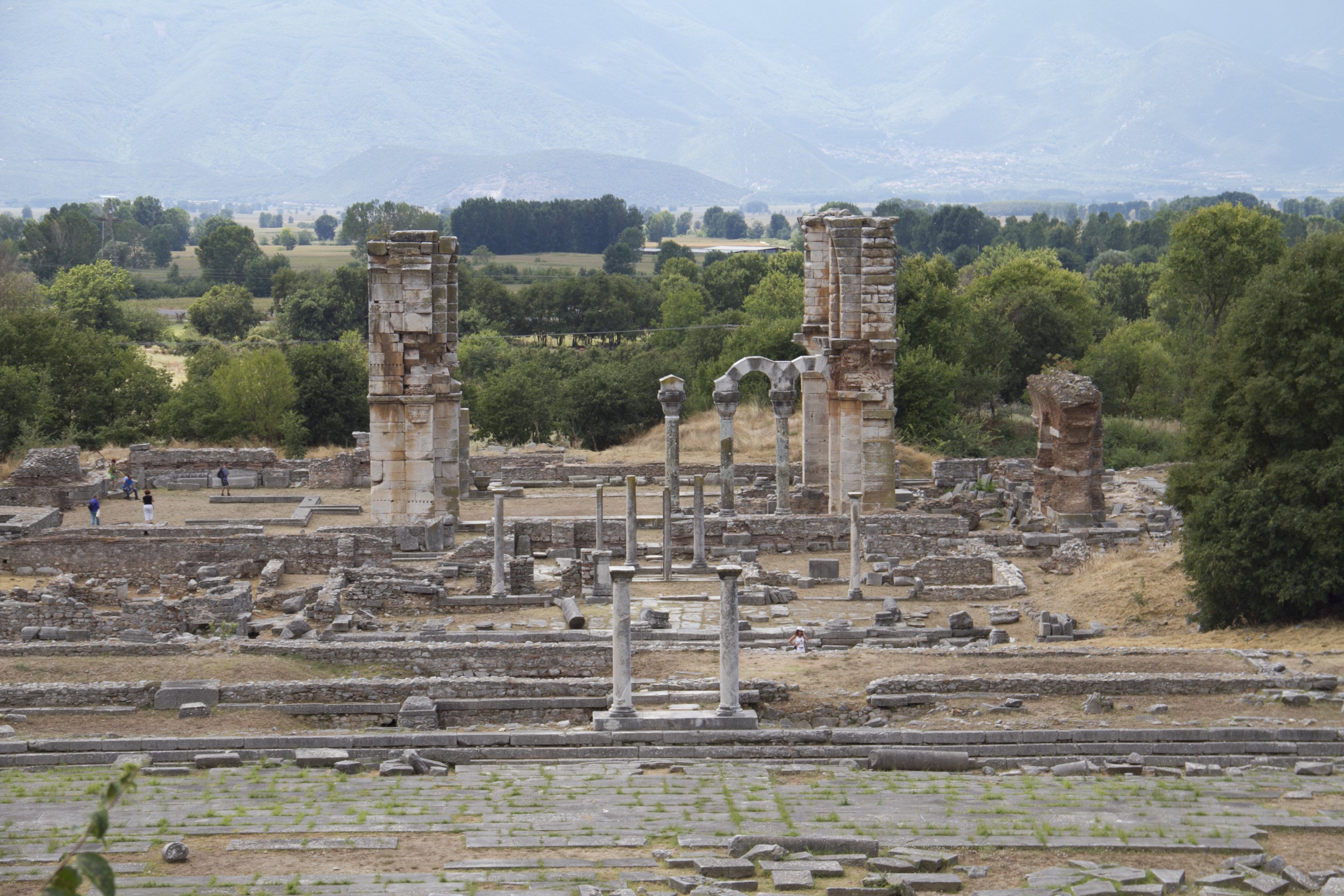
For that, we can look at Paul’s letter to the Philippians. Philippi wasn’t much different than many cities in this country. It was a competitive environment sustained by the Roman ideal of superiority. Messages across the city stressed the Roman view of its military and economic supremacy.
There was competition among citizens for honor or social status in every arena of life. The behavior led people to try to knock others out of the race to the top. No doubt the competitive nature found its way into the church.
Paul, however, had a better way for them: humility. This wasn’t an unknown concept to the Romans. They just didn’t think much of it. They considered it a sign of weakness and inferiority and not part of the “Rome first” paradigm. That kind of humility had no place in Roman ideals of strength.
In Philippians 2:3-4, Paul writes, “Do nothing out of selfish ambition or vain conceit. Rather, in humility value others above yourselves, not looking to your own interests but each of you to the interests of the others.” Humility is not allowing yourself to be treated as a “doormat,” but instead it is self-forgetfulness that allows us to focus on the needs of each other. Jesus, by his death, burial, and resurrection, flipped the social ladder upside-down. It creates a community where others are valued above self. As Nijay Gupta writes, “If we all defer to each other, it subverts a stratified system where everyone pushes to be ‘first.”
Paul points us to this because Jesus embodied it. Paul writes in verses 5-8, “In your relationships with one another, have the same mindset as Christ Jesus: Who, being in very nature God, did not consider equality with God something to be used to his own advantage; rather, he made himself nothing by taking the very nature of a servant, being made in human likeness. And being found in appearance as a man, he humbled himself by becoming obedient to death, even death on a cross!”
Jeannine Brown says, “This downward descent by choice could presumably heighten the audience’s emotions towards Christ, as he is portrayed as the epitome of self-giving.” Immediately after this, Paul says that because of Christ’s obedience, God has exalted him (Jesus) to the highest place in verse 9. In other words, Christ was exalted by God after his descent, revealing the pattern of God’s kingdom. That’s how ladder movement works, to borrow a pop-culture reference, in the “upside-down.”
Not everyone in the Roman Empire was keen on the idea of treating each other as equals. Pliny the Younger wrote, “For to level and confound the different orders of mankind, is far from producing an equality among them; it is, in truth, the most unequal thing imaginable.” Such is the response from those already at the top when they feel their wealth, influence, and social standing threatened. The instinct hasn’t changed.
So how do we actually live this way? Paul tells us to “do everything without grumbling or arguing” (v14) and to “value others above yourselves” (v3). I admit these are things my flesh doesn’t like to do. But we aren’t alone in the struggle, as God is working in us (v13).
If we are obedient, we will shine like the stars (v15). We will be bright lights shining forth into the darkness around us. Find places where systems are letting people down or taking advantage of them, and advocate for them. In a world climbing over itself, Christians climb down. If we have Christ, may it be seen in how we live.
Blessings.
NOTES:
Barth, Karl, Bruce L. McCormack, and Francis Watson. The Epistle to the Philippians. 40th anniversary ed. Louisville: Westminster John Knox Press, 2002.
Bromiley, Geoffrey W., ed. The International Standard Bible Encyclopedia, Revised. Wm. B. Eerdmans, 1979–1988.
Brown, Jeannine K. Philippians : An Introduction and Commentary. Downer’s Grove, IL: IVP Academic, an imprint InterVarsity Press, 2022.
Cross, F. L., and Elizabeth A. Livingstone, eds. The Oxford Dictionary of the Christian Church. Oxford; New York: Oxford University Press, 2005.
Gupta, Nijay K. Reading Philippians : A Theological Introduction. Eugene, Oregon: Cascade Books, 2020.
Loewen, James W. Lies My Teacher Told Me: Everything Your American History Textbook Got Wrong. The New Press, 2018.
Melick, Richard R. Philippians, Colossians, Philemon. Vol. 32. The New American Commentary. Nashville: Broadman & Holman Publishers, 1991.
Pliny, Letters, Vols. 1 & 2, ed. T. E. Page et al., trans. William Melmoth, vol. 2, The Loeb Classical Library (London; New York: William Heinemann; The Macmillan Co., 1931), 185.
Wright, Tom. Paul for Everyone: The Prison Letters: Ephesians, Philippians, Colossians, and Philemon. London: Society for Promoting Christian Knowledge, 2004.
Thanks for reading The Happy Theologian! This post is public so feel free to share it.
Comments
Nothing yet. Say the first thing.
Sign in to join the conversation.