
Slow happiness is not about escaping your life.
It is about living your actual life at a pace where you can notice what is good, care for your body, hear your own thoughts, and stop turning every quiet moment into content, noise, or productivity.
This daily system is intentionally small.
No complicated tracking.
No perfection required.
No dramatic reinvention.
No “optimize your whole life before breakfast” nonsense.
Just a week of slow happiness.
Before the day gets loud, begin with this sentence:
I am grateful for...
Write down or say out loud 2 to 3 things.
They can be big things:
My family
My health
Having meaningful work
A safe place to live
They can also be tiny things:
Good coffee
A warm shower
A quiet morning
A student who smiled yesterday
A song you forgot you loved
The point is not to force yourself into cheerfulness. The point is to train your attention to begin the day by noticing what is already here.
Slow happiness begins before the world starts asking for you.
Fill a water bottle before you leave for work, or take a full one with you on the drive.
Sip throughout the day.
Refill it at least one more time.
That’s it.
This is not a hydration competition. You do not need a gallon jug with motivational time stamps yelling at you all day.
Just make water easier to choose.
Slow happiness lives in the body first. A tired, dry, over-caffeinated body is not usually the best place for joy to land.
A few times during the day, go to the bathroom without your phone.
Revolutionary, I know.
But this tiny practice matters because it creates small pockets of mental white space. No scrolling. No checking. No replying. No tiny glowing rectangle demanding one more crumb of your attention.
Just a break.
An actual break.
For one or two minutes, you are not consuming anything, reacting to anything, or performing anything.
You are simply being.
That counts.
Find a quiet spot to eat lunch.
For me, that means closing my classroom door.
For someone else, it might mean sitting in the car, finding a bench, stepping away from the break room, or eating outside.
A little music is fine if it helps you relax.
The goal is not silence as punishment. The goal is quiet as restoration.
Eat without turning lunch into another meeting, another scroll session, another catch-up sprint, or another productivity pocket.
Let lunch be lunch.
A quiet lunch is a small rebellion against a noisy day.
Walk for 30 minutes.
Do not measure the distance.
Do not worry about your pace.
Do not turn it into a workout unless you want to.
Just walk for the full 30 minutes.
I do mine on a treadmill. You can do yours outside, around the block, through a park, in your neighborhood, or wherever makes sense.
Earbuds are optional.
Music, podcast, silence, nature sounds, treadmill hum: all acceptable.
The only rule is this:
Walk the full 30 minutes without making it about achievement.
Not every good thing needs a metric.
At the end of the day, ask yourself:
What happened today that was good?
Write down or say three good things.
They do not have to be spectacular.
They can be:
A good conversation
A decent meal
A problem that got solved
A quiet moment
A student who finally understood something
A laugh
A walk
A text from someone you love
Getting through a hard day without making it harder
This practice matters because it changes the emotional doorway you walk through before sleep.
Instead of ending the day replaying what went wrong, what you forgot, who annoyed you, or what is waiting tomorrow, you end the day remembering that some good was present too.
Not all good days feel good all day.
Sometimes you have to go back and collect the good from the corners.
These are not daily. That is what makes them sustainable.
Pick two morning drives each week with no podcast, no radio, no audiobook, no phone call.
Just you and your thoughts.
Let your brain stretch out a little before the day starts tugging at it.
You might think through the day. You might pray. You might rehearse a conversation. You might notice the sky. You might sit in mental mush for 20 minutes.
All of it counts.
Pick two afternoon drives each week for quiet on the way home.
Choose days when you did not do drive-in solitude.
This gives you another small transition between work and home.
No need to process everything perfectly. No need to solve your whole life between the parking lot and the driveway.
Just let the day settle before you walk into the next part of your life.
Some days, happiness starts by arriving home less full of noise.
Here’s one possible version:
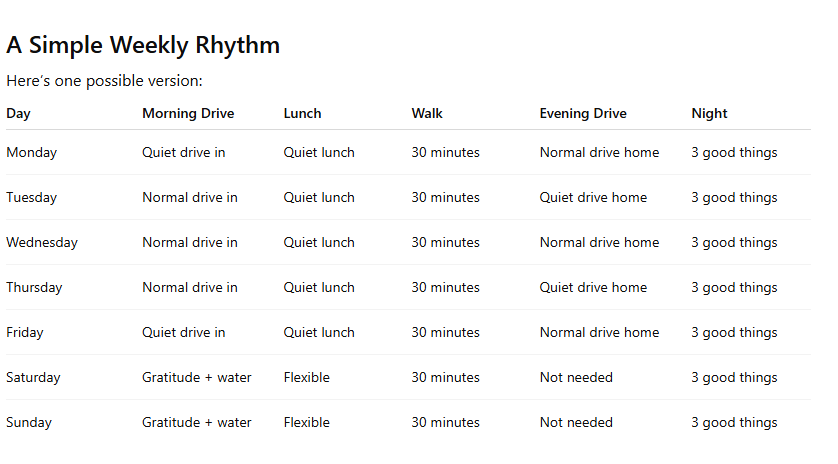
Daily anchors:
Morning: gratitude and water
During the day: phone-free bathroom breaks and quiet lunch
Movement: 30-minute walk
Evening: 3 good things
Weekly: two quiet drives in, two quiet drives home
Start with gratitude, move with water and walking, protect small pockets of quiet, and end the day by gathering three good things.
For one week, do not try to become happier.
Try to become more available to the happiness already hiding inside your regular life.
Each day:
Begin with 2 to 3 things you are grateful for.
Carry water and refill it once.
Take a few bathroom breaks without your phone.
Eat one quiet lunch.
Walk for 30 minutes without measuring distance.
End the day with 3 good things.
Choose two quiet drives to work and two quiet drives home each week.
That’s it.
That is a week of slow happiness.
Not a transformation sprint.
Not a productivity system wearing a wellness costume.
A rhythm.
A return.
A quieter way to remember that your life is still happening while you are living it.
Comments
Nothing yet. Say the first thing.
Sign in to join the conversation.