
UN organizations and humanitarian workers around the world observed the World Humanitarian Day, honoring UN personnel killed in Baghdad in 2003 and all humanitarian workers killed and harmed to this day.
Despite repeated promises from the international community, humanitarians continue to come under attack, with over 1,000 aid workers killed in the past three years alone.
On World Humanitarian Day, 19 August, UN called to end these violations and the impunity that allows them.
UN Secretary-General António Guterres has paid tribute to humanitarian workers killed in the 2003 bombing of the United Nations headquarters in Baghdad. Guterres laid a wreath at a memorial plaque at UN headquarters, followed by a minute of silence and remarks honoring UN and humanitarian personnel who have been killed or injured while serving others
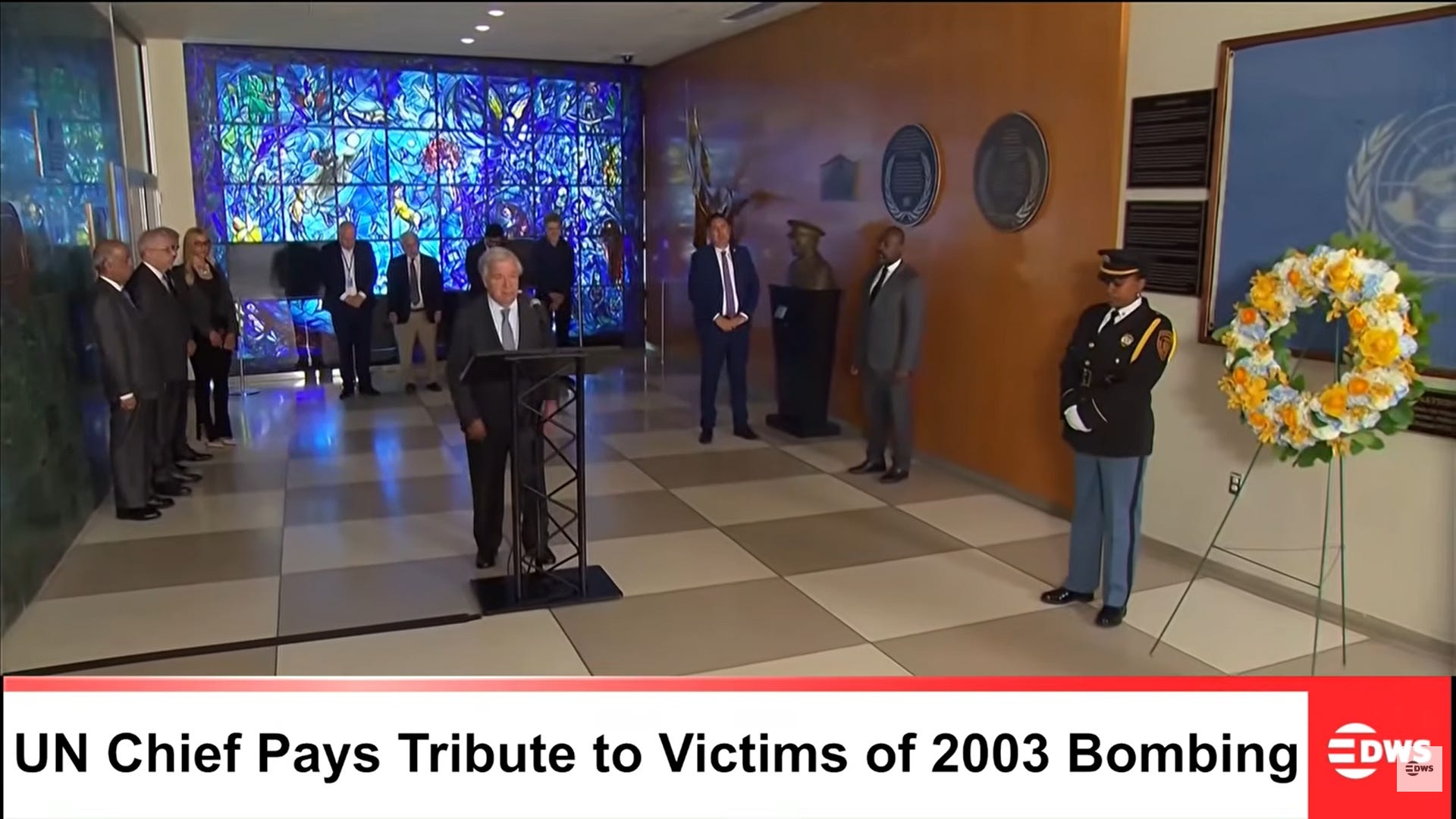
António Guterres at the memorial ceremony in front of the Marc Chagall stained-glass Peace Window, UN Headquarters in New York. Still from UN video.
Guterres' wreath-laying ceremony comes as the United Nations continues to remember the risks faced by humanitarian workers around the world.
The August 19, 2003 bombing of the UN headquarters at Baghdad's Canal Hotel killed 22 people, including Sérgio Vieira de Mello, the UN's top representative in Iraq at the time. The attack became one of the defining tragedies in the history of UN humanitarian operations. Five years later, the United Nations General Assembly adopted a resolution designating 19 August as World Humanitarian Day (WHD) which recognizes humanitarian and UN personnel who have lost their lives while serving communities affected by conflict and crisis.
On 19 August, UN Geneva held a commemorative event in the memory of those who paid the utmost sacrifice in line of duty and to honor the invaluable contribution of humanitarian workers. WHD is a campaign by the United Nations Office for the Coordination of Humanitarian Affairs (OCHA).
Each year, WHD focuses on a theme, bringing together partners from across the humanitarian system to advocate for the survival, well-being and dignity of people affected by crises, and for the safety and security of aid workers. This year, the demand is to act early before warning signs become casualty lists.
So far in 2026, 82 aid workers have been killed, 97 injured and 39 kidnapped around the world. Tom Fletcher, UN Humanitarian Affairs and Emergency Relief Coordinator states:
More than 1,000 aid workers have been killed in just three years and that is utterly unacceptable. But just calling it out will not protect the next aid worker. States must uphold international humanitarian law and use every tool to protect civilians and our colleagues. And for those who break the rules, there must be real consequences.
According to UN News, humanitarian organizations are also confronting a rapidly changing battlefield, where cheap and adaptable armed drones are putting lethal capabilities into more hands and allowing explosive attacks to reach deeper into towns and cities.
In Sudan, armed drones were responsible for 80 per cent of civilian deaths in the first four months of 2026, striking places including markets and health facilities, according to OCHA.
In Ukraine, drones killed 80 civilians in April this year alone. In Russia, drone attacks have also killed civilians and damaged civilian infrastructure.
In Colombia, attacks involving weaponized drones quadrupled between 2024 and 2025.
Aid workers are increasingly being caught in the same threat. Health and aid workers are increasingly targeted. The World Health Organization, WHO, has recorded 639 attacks on healthcare this year already.
In March, an aid worker was killed when a drone struck a residential building in the Democratic Republic of the Congo. In Ukraine, four humanitarian convoys were hit by attacks in a single week in May.
Weaponized drones have become the new face of an old danger: the deliberate or reckless destruction of civilian life. The technology may change, but the laws of war do not.
Statement by Commissioners Kaja Kallas, High Representative for Foreign Affairs, and Hadja Lahbib:
On World Humanitarian Day, we honor the extraordinary courage of aid workers who put themselves in harm’s way every day to deliver food, water, shelter, and medical care to people in desperate need. Their dedication — often in places where the world has looked away — is one of humanity’s most powerful expressions of solidarity.
The scale of global humanitarian suffering today is staggering. In Sudan, one of the world’s worst humanitarian crises continues to claim lives and displace millions, while humanitarian access is routinely blocked. In Gaza, destruction and suffering continue on a catastrophic scale. In Ukraine, Russia’s war of aggression has created humanitarian needs that reverberate far beyond the country’s borders, disrupting food supply chains and pushing vulnerable communities deeper into crisis across Africa and the Middle East. From the Horn of Africa to the Sahel, from Afghanistan to Myanmar, humanitarian crises continue to unfold with far too little global attention.
The European Union is one of the world’s largest humanitarian donors, and we are determined to stay the course. But funding alone is not enough. We must continue our humanitarian diplomacy to advocate for rapid, safe and unimpeded humanitarian access, so that aid workers can reach those in need.
Through its Protect Aid Workers rapid-response programme, the EU provides immediate support to local humanitarian workers under attack. This support is vital: local aid workers account for 90% of those targeted, while often lacking the protections available to international staff. In 2025, the programme has assisted 782 aid workers across 25 countries.
Comments
Nothing yet. Say the first thing.
Sign in to join the conversation.