
The EU Pact on Migration and Asylum has been in force since 12 June and some issues have now turned up. The Pact overhauled the EU's migration and asylum policies and for the first time, the EU has a comprehensive migration and asylum framework in place. Stronger external border protection, clearer asylum rules, and a better balance between solidarity and responsibility.
One of the main objectives was to relieve the burden on frontline countries like Italy. But now, thousands of returns from other EU countries are looming. At the same time, it is unclear whether the new procedures at the external borders will work.
With the activation of the Pact on 12 June, the Dublin procedure was reactivated. According to that, Italy is responsible for handling the cases of thousands of migrants because they first entered the EU there. This mechanism had been suspended for years to relieve the burden on Italy as one of the main points of entry into the EU. However, due to the reactivation, Italy must now expect 10,000 migrants to be returned from other European countries.
Germany was the first country to announce it would resume deportations. Switzerland, Austria, the Netherlands, Finland, Sweden, and Ireland followed suit. La Repubblica writes today, that at least those transferred to the Netherlands since June 12 will be returned to Italy. Prime Minister Giorgia Meloni has come under pressure from both domestic opposition and EU member states that continue to announce they are greenlighting procedures for transferring migrants. The secretary of the opposition Democratic Party Elly Schlein called the suspension of Schengen for Spain ‘a resounding boomerang’ for Meloni, who, on the contrary, maintains that
Schengen and the Migration and Asylum Pact are two completely different things and have nothing to do with each other.
It is precisely the new pact that marks a positive turning point for Italy in the management of so-called ‘Dubliner’ migrants. The new rules provide much greater protection for first-entry countries in terms of asylum requests, and with the strengthening of the safe third country principle advocated by Italy, it will be easier to implement expedited repatriations.
Earlier, Hungary has announced it will not accept migrants sent from other EU countries, continuing its ‘zero tolerance’ policy from Orbán times. The Hungarian government says it will only provide technical assistance to the most exposed countries.
France, on the other hand, does not currently intend to join the countries transferring Dubliners to Italy. The Spanish government has identified the solidarity mechanisms provided for by the Pact as the way to address the issue.
Now, re-activation of the Dublin regulation is only a minor aspect of the Pact. It just happens to set in earlier than the other reforms. Italy should be allowed to reject migrants at the border, including asylum seekers, and refer them to processing in third countries outside EU. This would alleviate the pressure. Further, returns of rejected asylum seekers and criminals should be supported by a joint effort, yet to be established. None of these are in force yet, and the Italian government is increasingly frustrated by the many obstacles in their way, from the justice system (including in Italy itself), from lack of political support from other countries, and from what they may conceive as direct counter-initiatives from Spain and Germany.
Italy is refusing to accept the return of migrants refugees and is demanding compensation for the boat refugees brought to Italy by German NGOs. However, the Pact does not provide for such compensation. See earlier post on NGO boat actions.
Italy and Germany are now struggling to reach an amicable agreement, according to tagesschau, and a meeting between German Interior Minister Alexander Dobrindt and his Italian counterpart Matteo Piantedosi could take place in the coming days. Contrary to what Meloni claims, Italy could be disadvantaged by the new Common Asylum System. This is not only because the Dublin rules are being applied again.
Prerequisites for accelerated asylum procedures foreseen by the Pact are not yet in place, contrary to expectations by Italy and others. The accelerated procedures are intended to relieve the burden on countries like Italy and Greece, last a maximum of 12 weeks, and primarily apply to cases where a swift rejection is likely – especially people from so-called safe countries of origin. But this will only work with countries that have bilateral return agreements, which do not yet exist.
The Spanish government estimates that 2,500 minors and some 2,500 potential asylum seekers remain in the autonomous city of Ceuta. Those 5,000 migrants may have to be transferred to the Spanish mainland for asylum processing. At the Trampolín beach alone, thousands of Sub-Saharan African migrants have gathered again, after having been removed and the beach cleaned on 20 August. In a parking area, dubbed the ‘holding area’, other thousands of North African Maghreb migrants are still gathered, according to El Pais. Local residents have started to insist the migrants are placed in controlled facilities to prevent them from camping in the streets.
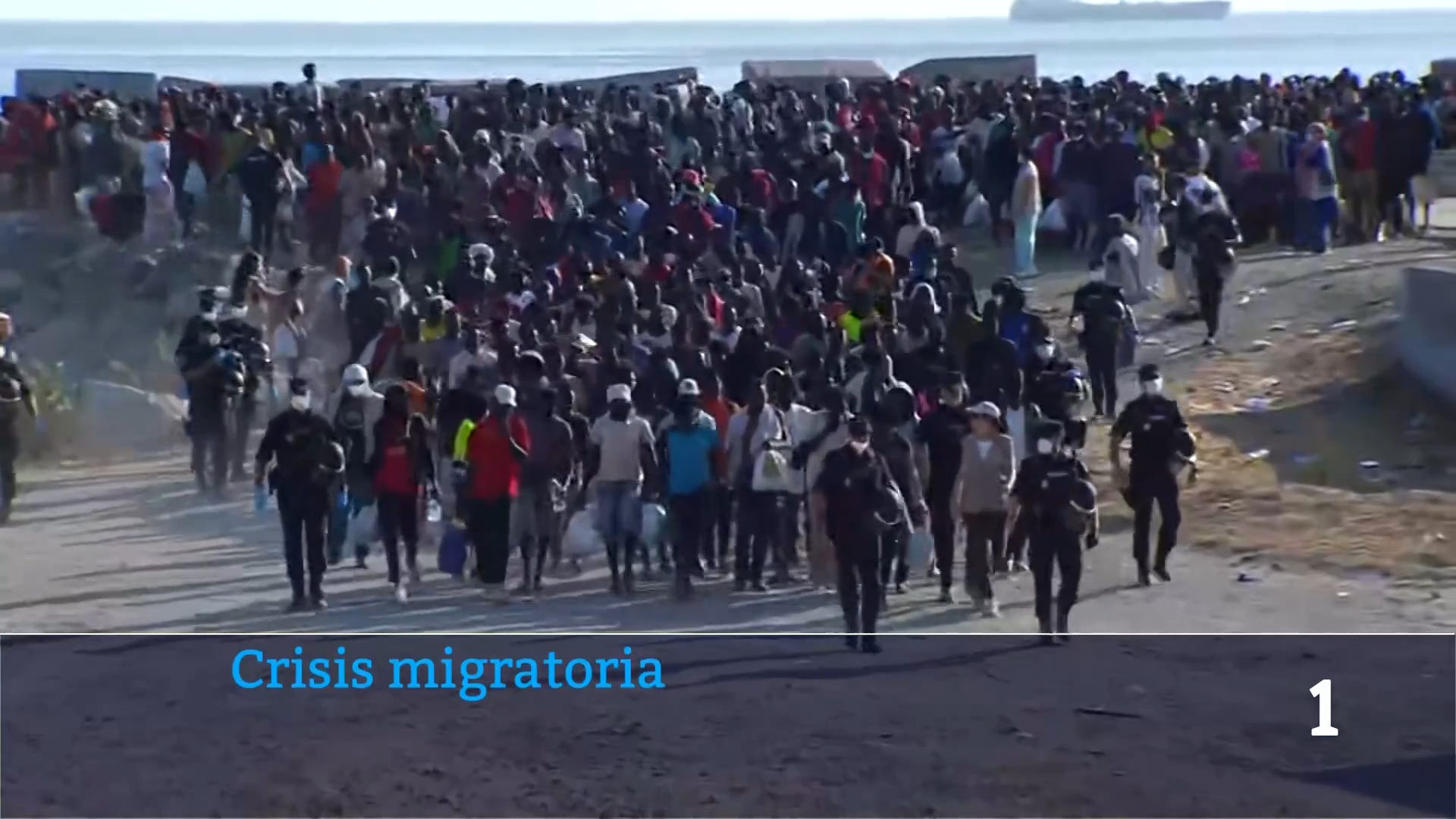
Migrants being temporarily expelled from Trampolín Beach in Ceuta. Still from tve
Especially the minors, and girls, are of concern to the government that is finally attempting to build a solution to protect them from harsh conditions and abuse.
Reports also say that the mafia is already making money out of the misery. The National Police has arrested five alleged members of two criminal groups in recent days who were charging up to 9,000 euro to undocumented migrants who wanted to clandestinely cross the Strait of Gibraltar to reach the Andalusian coast, the Ministry of the Interior reported on Friday.
Regarding the figures, eurostat and Frontex numbers say that Spain has much higher legal immigration than Italy, but lower illegal immigration than Italy. The debate confrontation between the two countries is particularly striking since the migration pact was intended to counter this type of controversy, in particular.
Spain did take a preemptively bold step early this year, though, with announcing that up to half a million unregistered migrant workers, mainly in agriculture, could become eligible for up to five years residence and work permit. This was according to an executive order by the socialist government, issued as a royal decree without parliamentary decision. Spain being part of Schengen means these new residents are subsequently free to travel to and work in other EU countries. This is part of the tension regarding the Ceuta incident and the Spanish authorities’ handling of it.
An estimated 80,000 illegals entering Ceuta in a few days is more than all illegal arrivals in Italy during 2025 from the Mediterranean route. Most were returned to Morocco, but thousands remain and the pressure on the Ceuta border remains potentially very high, leading to Italy and others worrying, in light of the pro-immigration stance of the Spanish government demonstrated earlier in the year.
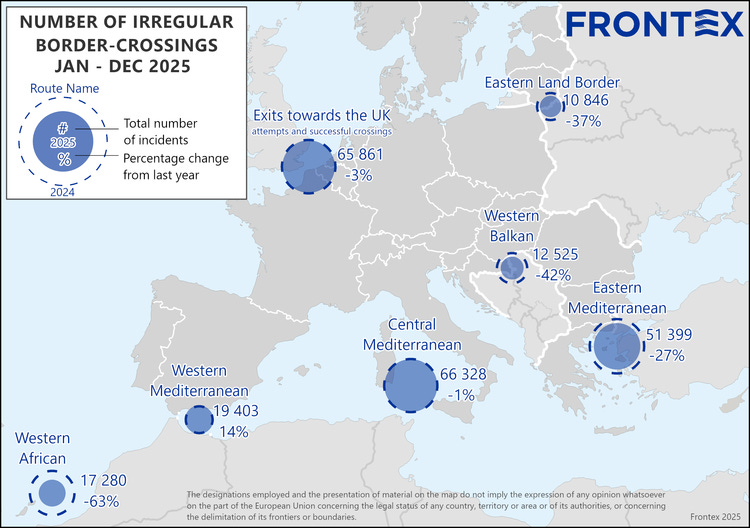
Graphic from Frontex yearly report.
Comments
Nothing yet. Say the first thing.
Sign in to join the conversation.