
Russia and China are investing in developing the Northeast Passage cargo ship route. The safest time of passing is late summer, meaning mid-August to late September, where the constant assistance of ice brakers is not needed. Yesterday, the container ship Dubai Tower was loading in the port of Ningbo-Zhoushan in China and getting ready for departing on the 20-day trip to Felixstowe in England. This is close to half of the normal route through the Suez Canal, which mostly takes about 37 days for large container ships. However, many shipowners are since long choosing the much longer route South of Africa, to avoid risk of attacks by Houthis in the Red Sea. The South Africa route adds another 10-14 days sailing time.
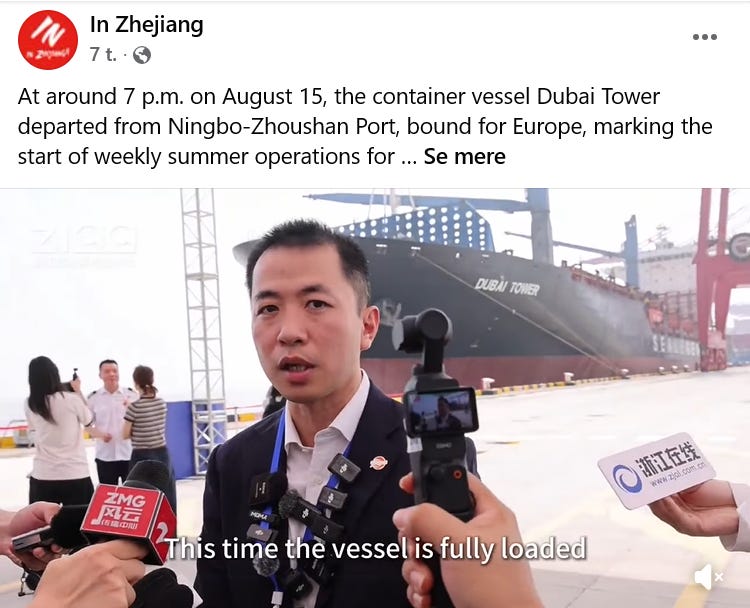
The Chinese news media In Zhejiang writes on Facebook:
On Aug 15, the Dubai Tower, a container vessel serving the China-Europe Arctic Express, was loading containers at Ningbo-Zhoushan Port. The vessel is scheduled to depart that evening or in the early hours of the following day, bound for Europe via the Arctic’s Northeast Passage.
The route takes around 20 days one way, nearly halving the transit time compared with the traditional route via the Suez Canal. At least eight sailings are planned for this year, marking the start of a new phase of weekly summer service for the China-Europe Arctic Express.
Last year, the company sent a single container vessel through the same route to Europe, successfully arriving but at the time only with a small token load of containers. Supposedly, this was the proof of concept. This year, the summer service is commercially operating with 8 planned trips in total.
However, at writing time, the vessel seems to be still moored in the Shanghai harbor area, according to data from marinetraffic.com.
Earlier in August, the Norwegian media The Barents Observer based in Kirkenes reported that a large group of sanctioned tankers were preparing for ice convoy on the Northern Sea Route which is the longest stretch of the Northeast Passage through Russian waters. At least nine sanctioned tankers and four cargo vessels were drifting in the Northeastern part of the Kara Sea further East from the Barents Sea to the North of Norway. They appeared to be waiting for nuclear icebreakers to escort them though the difficult parts of the route.
It was potentially the largest convoy ever to engage in commercial transit of the Northern Sea Route, however in the Eastern direction, with destinations in Asia. Among the ships were the oil tankers Jupiter, Vostochny Prospect, and Saga. Also included was the container ship Tenda, which was recorded as en route to South Korea.
The Vostochny Prospect and the Jupiter have double hulls designed for arctic sailing in sea ice, but the Saga has no such ice protection, and it is an older ship from 2006. The Saga is a mid-sized oil tanker with a length of 182 m long a gross tonnage of 27,357. All the tankers are likely carrying oil extracted from Russian Arctic fields. The Tenda also has no ice-class protection.
Like with all other sanctioned oil tankers from the Russian shadow fleet, it is a major environmental concern that they are old and unsafe while also not properly covered by insurance because of sanctions. In the especially sensitive Arctic environment, this sort of risk-taking is basically inexcusable.
Even with high summer passed and the ice expected to have retreated to minimum cover for the year, there is still sea ice cover present on the Northern Sea Route, and particularly in the far end of the East Siberian Sea, a belt of multi-year ice has accumulated.
The Northeastern Passage provides Russia with an alternative route to markets in Asia and beyond, safe from intervention by ‘unfriendly’ countries and out of reach (so far) of Ukrainian drone attacks. But this again comes at the cost of high risky due to changing weather and complex sea ice conditions. Russia sees it as a valid and much needed way of sending oil and gas to China, now that other alternatives are increasingly under pressure or rendered impossible.
Comments
Nothing yet. Say the first thing.
Sign in to join the conversation.