
At the end of a glorious day hanging out at galleries, antique shops and the pub with friend and historian Matt Allen1 we walked to the station at Blackheath in the Blue Mountains for Matt to get the train back to the city. We were confronted with this glorious mural representing a bushranger named Govett, leaping off the cliff with gun in hand and bags of gold strapped to his horse. How gleeful is he? Ecstatic with ‘you’ll never catch me alive’ liberation - short-lived though (what with gravity and the considerable depth of the valley) his life or liberty from here on must surely be. Also RIP horsey.
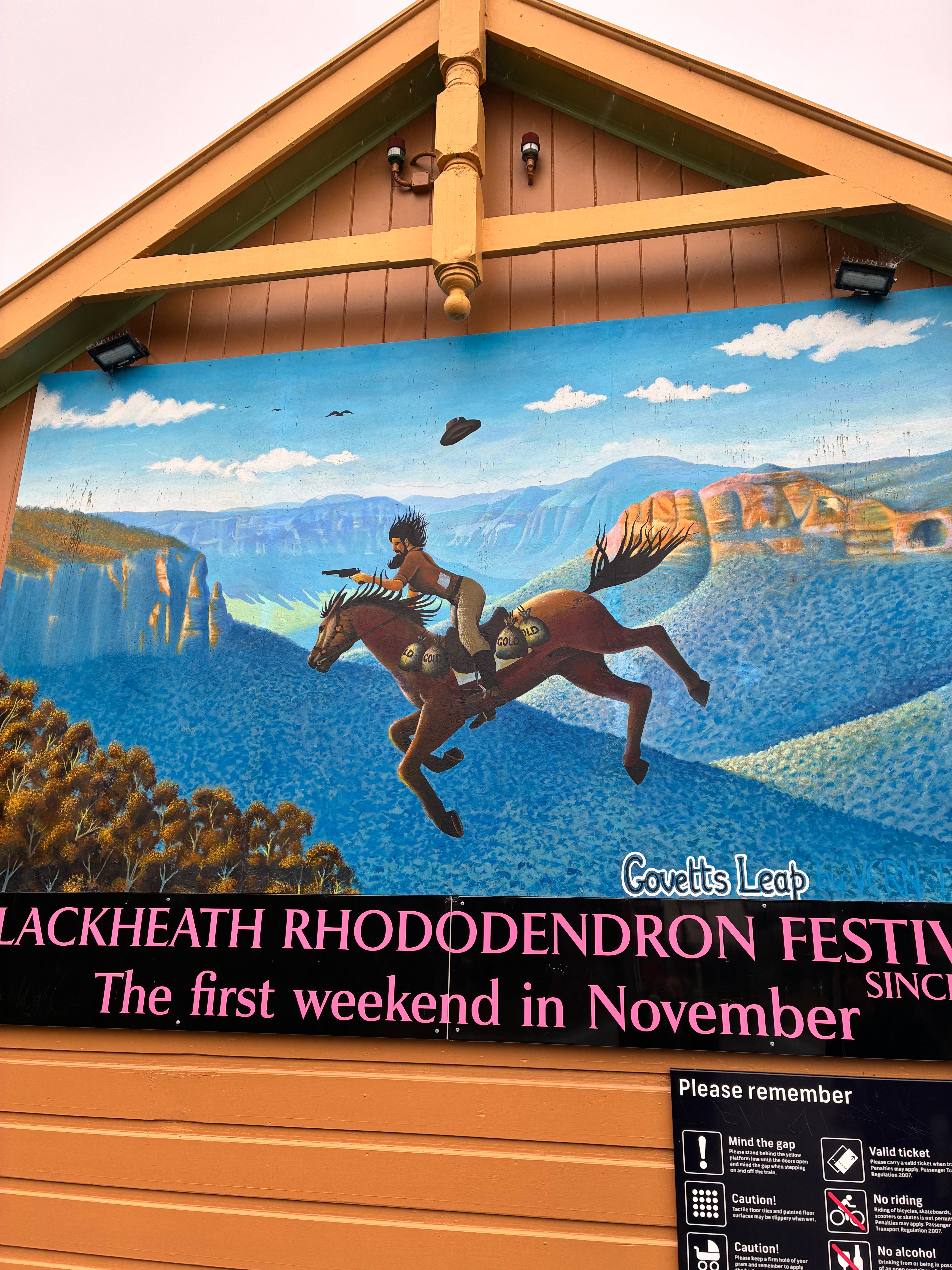
Image: mural of Govett’s Leap at Blackheath railway station.
That is not a period weapon, sed Matt, ever expert on colonial Australia. And I dunno, I answered. If I were carrying bags of gold I don’t reckon I’d label them with GOLD in big black letters.
Here is a statue of the bushranger Govett, also in Blackheath, where he appears to be in the act of leaping.
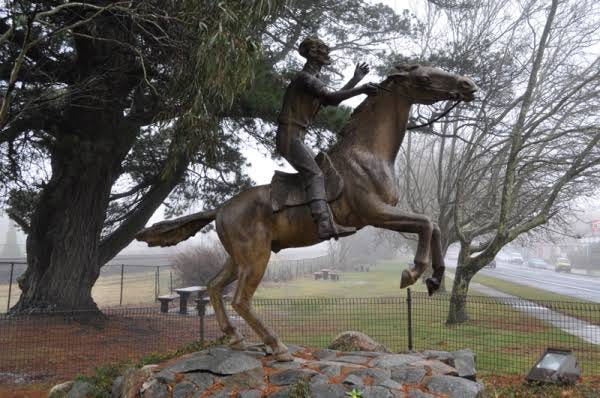
Image: Statue of “Govett” in the act of leaping.
One suspects deliberate historical inaccuracy in the mural of Govett leaping (perhaps unlike the statue ), because William Romaine Govett was not in fact a bushranger.
Govett was actually a soft, kinda pudgy young man whose visit to Blackheath was not to escape the law, but to work as a surveyor. He started this job at 20 years old, in 1827.
Surveyors, of course, were necessary to building the infrastructure that would eventually enable the influx of gold miners and settlers whose occupation of Wiradjuri land to the west of the Blue Mountains would consolidate colonial military efforts against a recent uprising by Wiradjuri warriors, coordinated with other Aboriginal groups up and down Australia’s east coast.
Govett died in England at 41 years of age, just before the Australian gold rush made considerable use of survey efforts like his. His wife was still alive, however, when the apocryphal story emerged of a bushranger called Govett leaping over a cliff in the Blue Mountains, trying to escape the law.
Govett’s Leap, in fact (like the nearby Witch’s Leap) uses a Scottish word for cliff: leap. It was not intended for actual leaping, nor named after someone who did.2
![William Romaine Govett, 1843 / [C.] Day](https://substackcdn.com/image/fetch/$s_!FqDF!,f_auto,q_auto:good,fl_progressive:steep/https%3A%2F%2Fsubstack-post-media.s3.amazonaws.com%2Fpublic%2Fimages%2F9cdf53fc-56ed-4240-838f-dff5ba53bac5_700x870.jpeg "William Romaine Govett, 1843 / [C.] Day")
Image: This is the real Govett. Image from SLNSW.
Govett’s Leap is mythical, in the sense that it didn’t happen but that it also represents something real. This whole ‘you’ll never take me alive’ thing is part of Australian bushranger lore. It might not be true, but also isn’t all bullshit. The logic of the whip that literally governed New South Wales from its inception, continued after convict transportation. This week I was in the NSW State Records reading about appointing police officers who would escort gold from the gold fields to Sydney. Obviously police files see all police as honourable people, even though the newspapers report them randomly terrorising groups of Chinese gold miners. I did see a file where police character was evaluated. Lazy approaches to 1850s paperwork just wrote “good” for them all, but more assiduous officers described them as “very superior”, “excellent”, “indifferent” and, occasionally, “bad”.
The police ledger also listed their previous occupations. Among the former farmers, bakers and clerks there were an awful lot of former soldiers: perhaps not surprising for a penal colony. Since the former occupation of a significant portion of the New South Wales non-Indigenous population was ‘convict’, relations between police and what was coming to pass for society was constituted by the state’s desire to have a monopoly over violence.
This matters to the way the gold was transported from the gold fields to what we would soon start to call the city of Sydney. As soon as gold was being violently extracted from the bed of what had been a beautiful creek at Ophir, near Orange, the Colonial Architect was compelled to procure a suitable carriage and an iron safe with three keys to be disbursed according to a specified system of rank and redundancy. Government procurement systems in 1851, I was surprised to see, was surprisingly similar to what it is now.
Having thus acquired the equipment and appointed police escorts, the government’s next job was to built a mint, ensuring the standardisation of the gold that would eventually underpin currency both in the colonies and ‘at home’, in London. That is a story for another post.
For now, we must follow the police escort. Archivists have retained some of the receipts and receipt books used by the Sergeant responsible for the gold escort. He collected a bag of gold, sometimes two, from the gold seller and hand him a receipt showing the weight of the gold. The names of gold sellers were repeated, regularly. This receipt book only had four receipts of gold collected from Chinese miners, on a field that we know had hundreds of Chinese people. Developing colonial ideas about the hierarchy of humans seems as present in the gold transport run by the colonial government as it was in racist violence by white miners against Chinese people, on the gold fields.
For the first few years of the gold rush, when the gold Sergeant got to Sydney there were a bewildering array of people to whom each bag of gold must be delivered, often the manager of one of the handful of colonial (or, increasingly, but never overwhelmingly, British banks) that had set up in Sydney. Slowly some of these deliveries were to the Master of the Mint - as time passed, the Deputy Master would do. As the mint became more established, almost all of the deliveries were to the mint, which must have been a relief. Then, as far as I could tell, he would head straight back again, hand over the proceeds of the gold sale, unless the mint or the man was instructed to have it deposited in a bank. Deposits were relatively rare before this, the preserve of Scrooge McDuck types whose specie amounted to something one could dive into, so this amounts to an interesting moment in banking practice that results from a growing acceptance of deposits as pretty good stuff in the hierarchy of money.
Perhaps understandably, the bosses of a colony recently peopled by those they deemed to be criminals, were a bit anxious about the safety of the gold. It shows the ways that the hierarchy of humans was linked to the hierarchy of money: property holders, including the owners of the gold, were as humans deemed more valuable, in need (like the gold) of state investment in the infrastructure that would enable them to continue accumulating wealth.
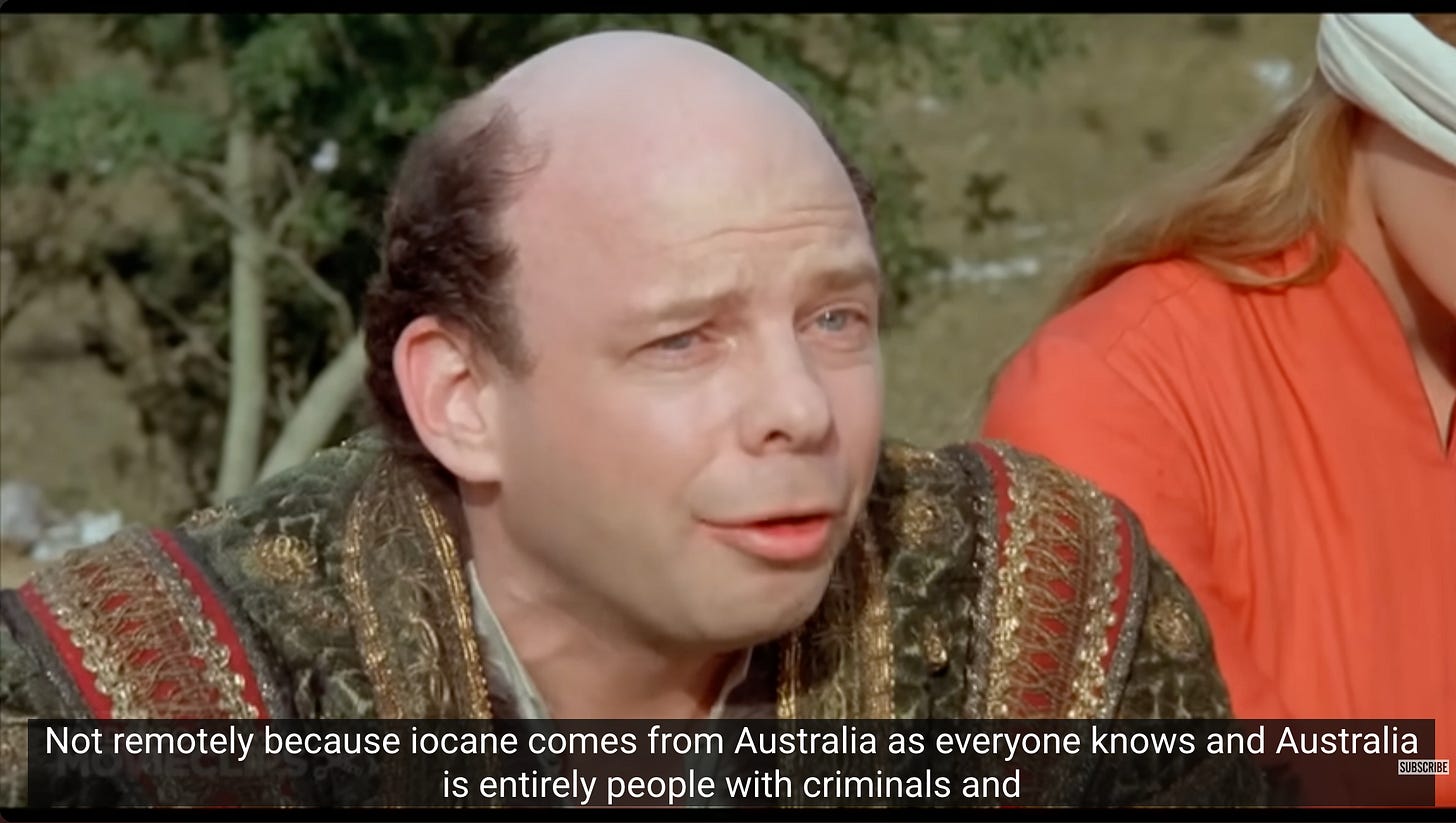
Image: That bit of the Princess Bride where Australia is described as entirely peopled with criminals.
The trips were often insufficiently eventful to be worthy of more than a note saying what date the Sergeant collected x oz. of gold from the gold field to transport to Sydney. In less populated areas where he felt there was more risk of being held up by bushrangers, the gold escort Sergeant would seek an armed escort. If the area was quite populated, he would let those fellas go and do something else and continue with just the carriage driver. We know this because on at least one occasion that was a mistake.
Sergeant David McClure was on the good list in the colonial police gold escort ledger. In the early days he escorted most of the gold from the Western Goldfields (jurisdictions defined by whether they are along the Northern, Southern or Western road out of Sydney), which included those around two hours’ drive west of where I now live in the Blue Mountains, collecting gold from Bathurst, Orange, Gulgong, Sofala and what would become Hill End. Sergeant McClure did this for years, approximately every 2-3 weeks. On one trip, When he got to Little Hartley at the western foot of the Blue Mountains, he knew himself to be in a fairly populous area, so let the armed guards go.
Between Little Hartley and Big Hartley, a distance hardly noticeable by car, the escort carriage was attacked by a gang of bushrangers. Two horses were killed (RIP horseys) and Sergeant McClure’s face was scratched by a bullet. But he kept his head and escaped without further harm to him or the gold - a protracted court case followed, but I got bored following it and can’t yet tell you what happened to the perpetrators. I’ll figure it out before I write a book about it. Really.
What we do know, however, is that what with having unsuccessfully held up the gold carriage at the bottom of the mountain, these bushrangers did not take the bags of gold over a cliff, regardless of whether it was called ‘leap’. Certainly not one of them was called Govett.
But the leap with gold over the cliff is still present, isn’t it, as an indicator of the type of liberation that one might seek from a heavy-handed government weighed down by soldiers who at times had a tendency to violent oppression of a citizenry that may have been characterised as too ex-convict, too Irish or Catholic, and certainly in too many shamefully racist instances, too Chinese.
The leap, even in error, speaks of liberation from poverty, backbreaking work, unearned authority, or the whip.
This liberation, either via gold, or by never being caught alive, was mythical. But, like all myths of those who were oppressed and/or joyfully wicked, it was also kinda real.
F*cking Capitalism.
Thanks for reading F*cking Capitalism! This post is public so feel free to share it.
This post (completed hurriedly, apologies for errors) is part of my research as the CH Currey Memorial Fellow for 2026 at the State Library of NSW.
The Marxist archaeologist Vere Gordon Childe (Indiana Jones’ favourite) probably died by leaping from Govett’s Leap, though some say he fell. Perhaps that is why they did not change the name to Childe’s Leap?
No posts
Comments
Nothing yet. Say the first thing.
Sign in to join the conversation.