
This piece is in partnership with Hinge #HingePartner
Some people think that to keep romance alive, one must hide parts of oneself from your partner. Pocket the less desirable aspects; sweep the perfectionist or people-pleasing tendencies out of view. Play pretend, in other words: pretend you’re still dating as opposed to long-married, pretend you’re strangers, pretend you’re not quite as complex and unappealing and difficult to live with as you actually are (because – let’s be honest – all humans are). I used to think this, too. And I still do, to some extent. But there’s something markedly different about my relationship to any I’ve had before, and that’s an unsaid, un-written yet ever-present commitment, by both of us, to say the thing.
My partner isn’t exactly known for his brutal honesty: he’s kind, and warm, and has so many friends that it’s sometimes hard to keep track. He will tell you the truth, if you ask him for it. He’s honest, yes, but it’s not like he trundles over social etiquette to say something no one else does (a trait that, I think we can all agree, is quite frankly obnoxious). And I’m the same: I’m honest to my friends, of course. I struggle with lying – even the white kinds – I have a sort of moral anxiety that means that anything other than truthfulness feels morally incorrect. But I, too, observe social mores. Which is to say: I’m not sure that this ‘say the thing’ dynamic is a him thing, or a me thing – but it does seem to be an us thing. It has developed, quite organically, alongside our relationship.
I can trace it back, I think, to a year and a half after we met and fell in love, when two things happened at once: the UK went into lockdown, and I had surgery to remove a (benign) tumour from my jaw. These things happened in succession, within days. My parents came to pick me up from the hospital, and drive me back down to Devon; he came too. If you want to test a relationship, I suggest scheduling surgery and then immediately entering into lockdown. If you really want to test it, add living with parents into the mix. It was probably at this point that the mist of romance dissolved to reveal something underneath: something solid, unflinching and smooth as marble.
There is something incredibly humbling about recovering from surgery, whenever it is, but doing so with a new-ish partner says a huge amount about you, them, and the relationship. After he saw me vomit up a vegan chocolate pudding whilst crying because it hurt my mouth so much to open it, something shifted. ‘Is this disgusting?’ I remember saying, half asleep, smelling of vomit and sweat. ‘Yes,’ he said, kissing me on my forehead: ‘but I love you anyway.’
I remember one time, voicing my innermost insecurity, the one nestled somewhere deep in my abdomen: ‘what if we fall out of love?.’ We were walking on a clifftop, one of those unrelenting cold days, the sea a silver glint on the horizon, the wind a kind of punishment, making my eyes water. I had to project as I said it, almost shouting against the wind. My heart was beating in my throat; it was too early to say this, too early to show him the anxiety that coiled within me. But he didn’t even stop walking. His response shocked the anxiety right out of me: he laughed. I said: ‘what are you laughing about? I’m serious.’ He continued laughing, his head thrown back, childlike. He took my hand, then, and pulled me in, whispered in my ear: ‘do you ever stop worrying?’ I shook my head, and he gripped me tighter. If someone saw us from the beach below, they’d only be able to make out one figure. ‘I will never stop loving you,’ he said.
From then on, and without ever saying it, we’ve been unflinchingly – and unapologetically – honest with each other. We’ve ‘said the thing’ at every single juncture, from the big (I worry I’m going to die before you / what you said back there really hurt me ) to the miniscule (you have something in your teeth / did you just fart?), and everything in between. We don’t hold back; we don’t fudge the truth. We tell each other how we feel, when we feel it. And then, invariably, we move on.
That was six years ago. Now, we live together. We have a little cat called Crumpet and a tall plant called Dorothea and a disco ball that refracts tiny shards of light across our living room. We’ve watched so many of our friends get engaged and gone to a myriad of magical, wonderfully unique weddings (as I’m writing this, I have one this Saturday and one the Saturday after, which are very different in every way except they both will have a ceilidh). And we love it. He’s helped his friends pick out – and sometimes even design – rings, and I’ve counselled mine through the aptly termed ‘engagement purgatory,’ as they wait for a proposal and, at for occasional meaningful points get their nails done, ‘just in case’.
But personally, I’ve always known that – though I do want to get married – I didn’t want a traditional proposal. Years ago, I asked my partner what he thought, and it turned out he didn’t either. So when we went to Rome last year, we fell into chatting about what to do instead. We were sitting al fresco sharing fresh pasta, the world was sepia-toned (as it is on a summer evening in Rome), love floating in the air like mist. We talked for a short time about how to get engaged (Venice, October), and the conversation quickly divulged into all the details of an imaginary wedding. We laughed so much I had to go and sort out my mascara in the restaurant’s cramped bathroom. I don’t think anything was actually very funny: I think we were just high on life, and love, and potential.
A few months later, we arrived in The Floating City. We wanted to find somewhere we could come back to, so we spent the first couple of days exploring. After a while, we found a pier that jutted out into the grand canal. We went there a few times, sitting out in the morning, watching Venetians with their boats of supplies: bananas in one, toilet paper piled high in another. We found a tiny coffee shop and took our soya cappuccinos out, one morning, with the intention that yes, today was the day.
On the pier, we had to wait. It seems that the moment we’d decided to get engaged was the exact moment that four American tourists also discovered our pier.
We stood, sipping our coffees, watching the waves crash against the walls, the boats weave their way past each other with seemingly no order whatsoever. And then, when the pier was finally ours again, time seemed to slow. This is what I’d always wanted, and yet, as we turned to face each other, I wondered if we were doing the right thing. Was there a reason that everyone else did it another way? Was I missing out on something? The surprise, the excitement, the romantic gesture of it all? Was I going to regret this?
He took my hand, as these thoughts swirled, and took me right to the edge of the pier, where the water meets the wood.
There, he took my other hand in his, said: ‘so, is it time?’ And I know this might sound cliché, but in that moment, looking into his grey-green eyes, the thoughts seemed to dissolve, and I was left with something real: his fingers, on mine, men shouting in the distance as they directed gondolas around corners, the water lapping softly at our feet. The knowledge that to choose one path, one must give up the other: that this is the path we’d chosen, together, and that - although not everyone would understand it - it felt right to us. ‘‘Yes,’ I said, ‘I think it’s time.’
‘Shall we get married?’. It was a statement, really, not quite a question. He took a ring – one we’d chosen together – from his inside pocket, slid it onto my finger. I simply could not stop beaming.
You might think, at this point, how is that more special than a traditional engagement? And to that I would say: it’s not. I don’t compare it to a traditional engagement; it’s just what we wanted, at the time. And to us, it felt incredibly special.
As we were leaving the pier, an empty boat pulled in, and we watched as some men came out and started loading it with bin bags. Ah, we realised, laughing, it was quite literally a bin-pier; that’s why it was so empty. Somehow, this detail only made it more magical.
We spent the rest of the day in a dream: drifting from bridge to bridge, taking photos in our minds of the blue-green waters, of each other. Some days feel as though you’re looking back on them, as you live them: as though they’re already seeped in honey-toned nostalgia, as though you’re longing to go back whilst still in the moment. That was one of those days. I will spend the rest of my life wishing I could go back; grateful that it happened.
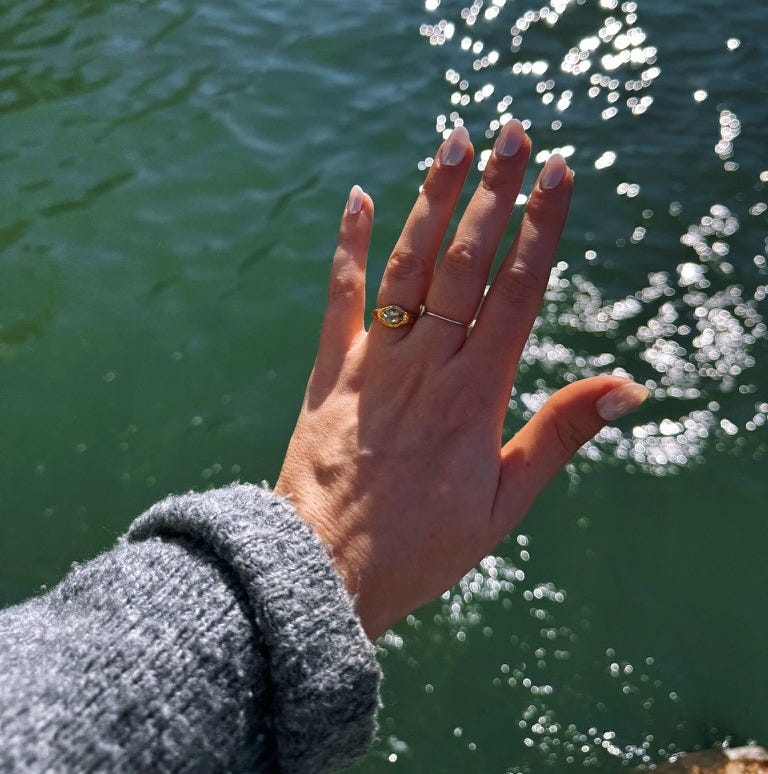
And here endeth the story. Because isn’t that how all love stories end? With a ring, a proposal, a commitment to marriage?
But that’s not how life – or love – works.
Love is complicated and messy and hard to get your head around; it requires years of patience and a constant commitment to holding compassion for this person who was once a stranger and who now is your emergency contact.
It’s no wonder that almost all of literature (and pop music, and a lot of art) is an attempt to understand it; to put it into words, or paint. And as our culture shifts and meet-cutes go from coffee shops to phone taps (hello, Hinge), so too do stories adapt to portray what it’s like to date, to fall in love, and to stay in love in the modern world. And personally, whilst there’s a place for rom coms on Saturday nights with popcorn and a fuzzy blanket (my idea of a good time, to be honest), I’m personally more drawn to stories that portray the complexity of love; the gritty underbelly. Writers that subvert the traditional rom-com dynamic and portray a kind of emotional honesty about how it really feels to fall in love: how intimidating, how terrifying it is to fall into what seems like endless empty space, hoping your beloved might catch you.
Which is partly why I wanted to partner with Hinge for their third edition of No Ordinary Love, for which several acclaimed writers have written true stories about real couples who were faced with a choice to either ‘say the thing’ – or not. It’s a wonderful exploration of modern dating culture, through a literary lens. My favourite is called ‘Thou Shalt Play It Cool’, by Raven Smith, a story that subverts the cat-and-mouse game of modern day dating as the protagonist, Elena, chooses to say the thing, and come clean about how she actually feels. I love how realistic it is (to quote the story: ‘Michael and Elena weren’t polite people on a first date; they were actual people who happened to be on their first date’); how on-paper unromantic (disgusting mushroom dish; not kissing after the first date; awkwardness and playing it cool) transforms into something incredibly romantic: getting beneath the surface of things with long, sprawling conversations, saying things they wouldn’t normally say to other people, radical honesty. The story follows Michael and Elena as they unpeel layers and break habits, transforming from the selves that performed versions of themselves to just being themselves. And this, to me, is the epitome of romance.
There’s something so refreshing about how these stories are written about real people: they’re about as close to genuine, every-day true love stories as it’s possible to get in 2026. Here’s a link to read more, or you can listen to them on Spotify here.
I guess romance is however you define it. And, for me, it’s choosing to get engaged, together, instead of following a more traditional path. It’s planning an engagement in the most beautiful city in the world, to choose a ring, and to enter the pier – as we’ll enter our wedding – side by side, aware that there’s no such thing as perfection (which is why it doesn’t matter that our floating engagement happened at the Venetian equivalent of the skips).
It’s saying whatever’s on my mind – however big or small – and knowing I’ll be loved, regardless.
No posts
Comments
Nothing yet. Say the first thing.
Sign in to join the conversation.