
Last year, I attended a Pride and Prejudice-themed bachelorette party. Yes, it was as lovely as it sounds, complete with a picnic in the park, croquet and wonderful women wearing lovely dresses.
The experience prompted me to remember a simpler time in life, where I had one ambition, one dream, one hope: I wanted to be a pioneer.
What do I mean by pioneer, you may ask?
Simply, I wanted to be Laura Ingalls from Little House on the Prairie. I wanted to wear long dresses with two petticoats. I wanted to churn butter. I wanted ride in a covered wagon. And I GREATLY desired to own a spinning wheel so that I could make my own yarn. Some things I took into my own hands for my clothing of choice was indeed a pioneer costume dress with a matching sun bonnet. I did not see it as a costume though. In my nine year old mind, being a pioneer was a lifestyle choice.
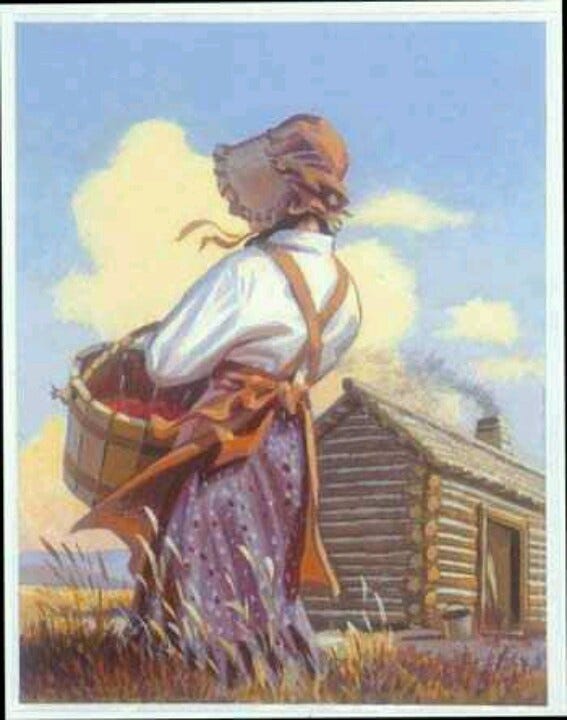
So many of us have that ache to return to the past. As technology moves faster, we want to move slower. The fancier and “smarter” things become, the more we crave returning to tactile processes for everything from education to how we cook in our own homes. Western culture has now been deemed “post-Christian”— those who still hold onto Christian values long for a time when most everyone was Christian, or at least held the Christian moral standards like in the pioneer days. Look at where post-modernism has brought us— to quote one of my favorite modern day minstrels, Noah Gundersen:
“It's hard living in the 21st century
Everything comes with a price
It's hard living in the age of anxiety
So I got some pills prescribed
I know that it's part of the problem
But there's only so much I can take.”
We turn to the past. We hold it up as an example of what the world should be, could be if only people would turn back to the old ways. Yes, tear down the cities; we should all be pioneers once again, living off the land and the fruits of our own sweat and tears.
Is that really what would fix this mess?
I recently finished reading Prairie Fires, which is an actual biography of Laura Ingalls Wilder. Maybe it was because I first read them at age six, but I did not realize until reading the biography that the Little House on the Prairie series were fiction, despite Wilder’s often confusing remarks that everything in the stories was true. It was very eye opening to read the historical context of the romanticized stories. In correspondence, personal notes and more, Ingalls made it very clear that her life growing up was one of desperation, and that most pioneers were forced into impossible situations where crime, starvation and insanity surrounded them. At least one of the “Little Houses” was built illegally by Pa Ingalls on land where the family was squatting. The local reverend that is much adored in the books and tv series was actually a scammer who abandoned his wife. I had such a strong impression of the courage and independence of the pioneers, but found myself faced with the fact that most of them were heavily in debt and were unable to feed themselves. This is not the image of the good, simple life of homesteading that I have long associated with Little House of the Prairie.
Reality meets reality. Life is hard, past, present and future. There is no one generation or culture that has all the answers. However, I don’t want to sound like I am joining the chorus of de-constructers as they tear down every culture, value system or institution that has ever existed. I firmly believe that the past holds wisdom that does indeed apply to our modern plight. Maybe I just feel like conservative discourse often minimizes that even when we were considered a Christian culture, many people did not live out Christian virtues. The sins of those generations were perhaps more hidden than those of our day and age.
In one of his first homilies, Pope Leo said that every generation is faced with its own unique set of challenges and temptations.1 Yes, we are faced with a lot in the 21st century. No, the pioneers did not have to deal with addictive hand held devices stealing our contentment, nor the lab grown food-like items that are constantly pushed into our grocery carts, slowly tearing our bodies down. They had their own struggles. But despite the imperfections of the Ingalls family and other homesteaders, they persevered. They formed tight-knit communities. They reveled in the small joys of life, like maple sugar candy and wild violets.2
They faced their challenges, looking to the future.
The courage.
The community.
The appreciation of simple things.
These are not just romanticized ideals, but wisdom that we can carry as we face the struggles of our own time.
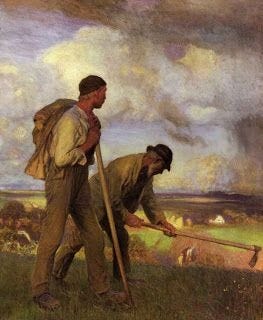
Pope Benedict said there is “the consoling reality that in every generation saints are born. Through all the sadness, the negative aspects of history, we see the birth of forces for reform and renewal because the newness of God is inexhaustible and always gives new strength.”3
So you may find me in my kitchen, gleefully making ancestral homemade saurkraut4, while also being very grateful for my dishwasher. You may find me praying ancient prayers, with friends who drive an hour in a car to join me in my home. I am hopeful that as we learn form the past, its glories and mistakes, we find renewal and strength for our day. By God’s grace, we are called to be pioneers of 21st century sanctity, with or without a butter churn.
Thanks for reading searching for shalom! This post is public so feel free to share it.
It was in a YouTube video, which I can no longer find.
Both of these are gleefully described in the Little House books
https://todayscatholic.org/god-constantly-calls-saints-to-renew-the-church-pope-says/
https://ancestralkitchen.com/2020/04/17/super-simple-sauerkraut/
Comments
Nothing yet. Say the first thing.
Sign in to join the conversation.