
H3 at Resolution 9 gives you hexagons with an average edge length of ~174m and an area of ~0.105 km². When you execute a k-ring(cell, 1) query, you get 7 cells (the origin + 6 neighbors). k-ring(cell, 2) yields 19 cells.
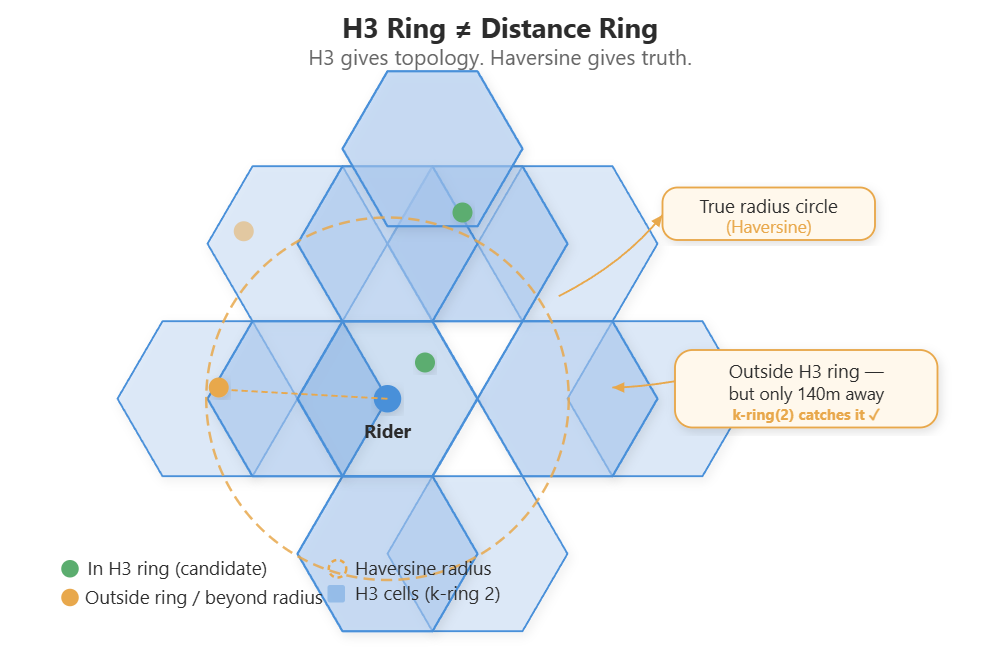
Here is what every engineer misunderstands: H3 cells are not circles. They are irregular hexagons tiling a sphere. Two drivers at distance 190m can be in adjacent cells (ring 1) while a third driver at 140m can be in a non-adjacent cell depending on the orientation of the hexagon grid relative to the rider’s position. H3 ring index is a topological hop count, not a Euclidian distance bound.
This is not a bug. It is the explicit trade-off H3 makes: approximate spatial indexing in O(1) to enable prefix-scan-friendly key design in RocksDB. The lesson here: H3 prunes the candidate set. Haversine ranks it.
A standard Kafka Streams implementation using the DSL would look something like this:
This is a disaster. Here’s the physics of why:
Problem 1 — Full KTable join is O(N). The DSL’s
KStream-KTable joiniterates the entire driver table for every rider event. At 50,000 online drivers and 3,000 rider events/sec, you perform 150,000,000 Haversine calls per second on a single StreamThread. Theprocess-latency-avgmetric climbs from 2ms to 800ms within seconds. The consumer group falls behind. Kafka triggers a rebalance. You are now debugging a thundering herd at 2AM.Problem 2 — Haversine is CPU-bound transcendental math. Each call requires
Math.asin,Math.sqrt,Math.sin,Math.cos— all floating-point operations. Doing this unfiltered on the StreamThread (which also runs yourpoll()loop) starves Kafka’s heartbeat sender. The broker marks the consumer dead. Another rebalance.Problem 3 — No spatial locality. The DSL join has no concept of “drivers near this rider.” It scans drivers in key-hash order — completely random spatial access. You cannot exploit RocksDB’s block cache locality because there is no spatial clustering in your key design.
Comments
Nothing yet. Say the first thing.
Sign in to join the conversation.