
A rider opens the app in SoMa, San Francisco. Their GPS resolves to H3 cell
8928308280fffffat resolution 9 (≈105m edge length, ≈0.1 km²). There are zero available drivers in that exact cell right now — the nearest driver is two blocks over, sitting in cell89283082807ffff. Your matching engine returns nothing. The rider sees a spinner. They close the app.This is the empty-cell problem, and it is not an edge case. At any given second, the majority of H3 resolution-9 cells in a city are empty. You cannot match on exact cell identity. You need K-Ring search — expand outward ring by ring until you find candidates, then rank by actual distance.
The algorithm is simple. The implementation at 3,000+ events/second is not.
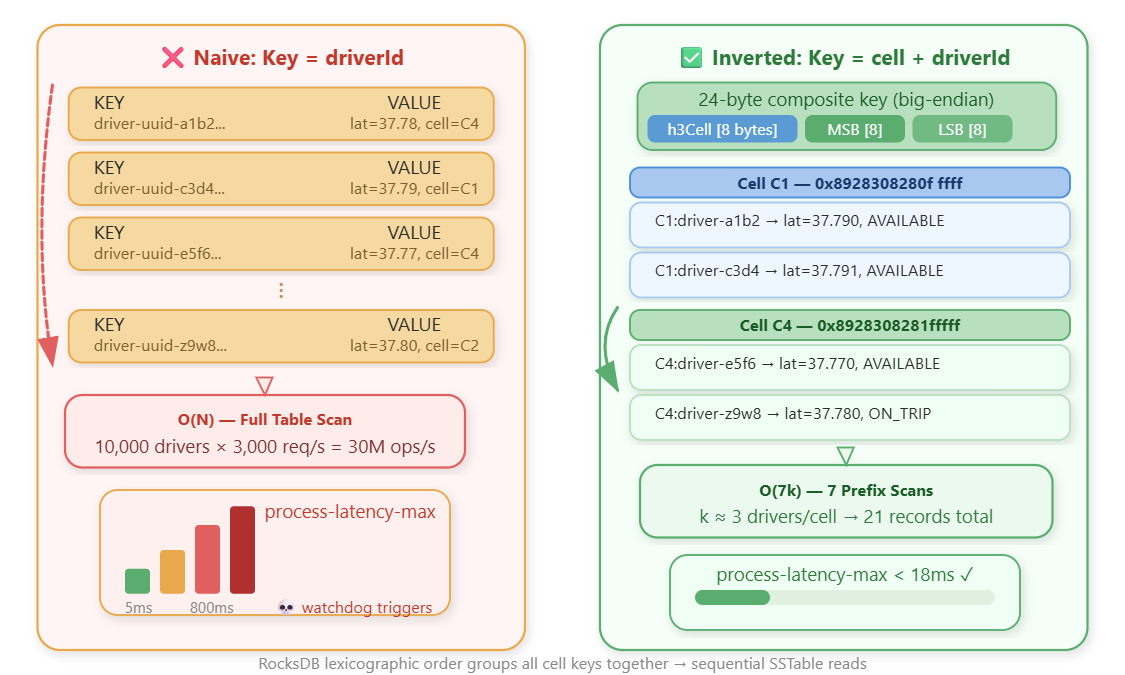
A standard developer, coming from a CRUD background, models the driver state naturally: keyed by driver ID.
KTable<String, DriverLocation> // key = "driver-uuid-abc123"When a rider request arrives at H3 cell
C, they compute the k=1 ring — 7 cells — then scan the entire KTable to find drivers whosecurrentCellis in that set:
This is O(N) where N is total active drivers. At 10,000 drivers and 3,000 rider requests/second:
30 million comparisons/second on a single
StreamThreadEach
driverStore.all()call forces a RocksDB iterator over every SSTable segmentThe
process-latency-maxmetric spikes to 800ms+Kafka consumer group falls behind;
records-lag-maxgrows unboundedThe
StreamThreadwatchdog triggers a rebalance — your topology restarts mid-matchThe root cause is a key design mismatch. The natural primary key (
driverId) is wrong for your access pattern. You never ask “give me the location of driver X” during matching. You ask “give me all available drivers in cells {C₀, C₁, C₂, C₃, C₄, C₅, C₆}”. Your key structure must answer that question in O(1) prefix reads.
Comments
Nothing yet. Say the first thing.
Sign in to join the conversation.