
Hello everyone!
The debate over the product operating model (POM) has a data problem. Most of us, including me, argue from the organizations we know.
When I interviewed Marty Cagan, see the article below, he called a Scrum team “quite amateur compared to a professional product team.” I later called the theater version of the shift from Scrum/Agile to POM product washing, a form of “transformation by reprinting business cards.” Consultants generalize from their clients and bloggers from their respondents.
I have not seen a dataset showing what changed across several hundred organizations after they moved beyond Scrum as they had practiced it. That is what this survey is for. And it takes only three minutes.
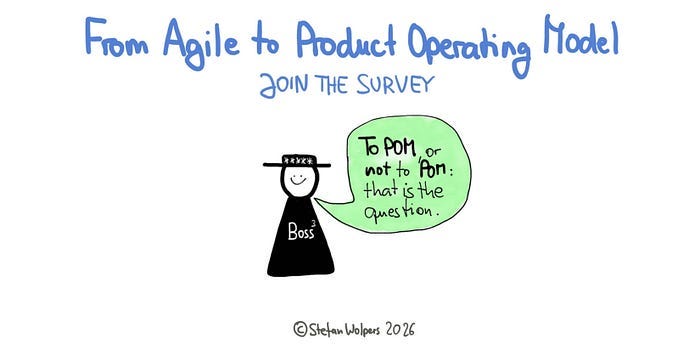
📈 Take the survey now: From Agile to a Product Operating Model: What Is Actually Changing?
🗞 Shall I notify you about articles like this one? Awesome! You can sign up here for the ‘Food for Agile Thought’ newsletter and join 35,000-plus subscribers.
🎓 Join Stefan in one of his upcoming training classes!
Organizations are moving away from “good enough Agile,” while AI reduces the cost of producing software. That change seems uneven, as engineering is hardly free, but a team today can, indeed, build the wrong thing faster and with fewer people, provided a valid credit card is available.
Making product decisions, or having product sense, therefore, matters more than ever.
A POM is supposed to move those decisions closer to customers and give teams problems to solve rather than feature lists to deliver. “Product washing” produces different results: roles are renamed, Scrum events disappear, and approval power stays with the same stakeholders as before.
We have strong opinions about which version is more common. Too bad, we have little comparable data. This is why I ask you to invest 3 minutes of your time and join the “From Agile to the Product Operating Model: What Is Actually Changing?” survey.
The survey asks, for example:
Who is pushing the move toward a product operating model, and what role does AI play?
What changed in delivery speed, customer value, business results, and team morale since switching to a product operating model?
What happened to Scrum or agile events: abandoned, repurposed, or relabeled?
Who decides what gets built today: leaders assigning features or teams investigating problems?
When nobody knows whether an idea is worth building, what settles the question: debate, research, a disposable prototype, or simply shipping it, now that agentic coding has become affordable?
📈 Take the survey now: From Agile to a Product Operating Model: What Is Actually Changing?
I encourage you to take part in the “From Agile to the Product Operating Model: What Is Actually Changing?” survey if you work in or around product development as a product owner, product manager, Scrum master/agile coach, project manager, developer, designer, (product) leader, or consultant.
Your organization does not need to be adopting a product operating model. The survey includes a short route for organizations that are not making that move, and I want those responses, too. (The product operating model already has enough cheerleaders.)
I am particularly interested in organizations that tried a product operating model and later abandoned or reversed the change. Failed experiments rarely appear in conference talks, but they may tell us more than another transformation success story.
The survey is anonymous and requires no registration. I will publish the results openly on this blog; the resulting report will be free to everyone.
📈 The survey closes on 2026–08–10 — please join your peers: From Agile to a Product Operating Model: What Is Actually Changing?
Also, please forward this post to someone whose organization runs a product operating model, or claims to do so.
Product Washing: The Pitfalls of a Superficial Product Operating Model Transformation.
Why Leaders Believe the Product Operating Model Will Succeed Where Agile Initiatives Failed.
Marty Cagan on the Product Operating Model and Scrum’s Future.
Product Team Empowerment Anti-Patterns.
👆 Stefan Wolpers: The Scrum Anti-Patterns Guide (Amazon advertisement.)
Upcoming classes and events:
🖥 🇩🇪 August 25–26, 2026 — Live Virtual Class: Professional Scrum Product Owner Training (PSPO I; German)
🖥 💯 🇬🇧 August 27-September 17 — Live Virtual Cohort: AI4Agile BootCamp #8 (English)
🖥 💯 🇬🇧 Sep 28–29 — Live Virtual Class: The A3 Delegation System Founding Workshop (English)
🖥 🇩🇪 Sep 30-Oct 1, 2026 — Live Virtual Class: Professional Scrum Product Owner Training (PSPO I; German)
👉 See all upcoming classes here
Now available on the Age-of-Product YouTube channel to improve learning, for example, about AI’s Labor Market Impact:
Stop Writing Prompts. Let AI Do It for You — Hack #01, AI4Agile Online Course v2.
Check Your AI’s Plan Before — Hack #7, AI4Agile Online Course v2.
From Product Requirements to Experiments to Learnings — Supported by Generative AI.
Never Accept an LLM’s First Offer — Improve GenAI’s Usefulness w/ Feedback Loops and Challenges.
Also:
📅 Join 6,000-plus peers of the Hands-on Agile Meetup group
🐦 Follow me on Twitter and subscribe to my blog, Age of Product
💬 Alternatively, join 20,000-plus peers of the Slack team “Hands-on Agile” for free.
Comments
Nothing yet. Say the first thing.
Sign in to join the conversation.