
Hello everyone!
Welcome to the 553rd edition of the Food for Agile Thought newsletter, shared with 35,462 peers.
This week, Henrik Mårtensson dismantles seven dangerous Agile myths, showing that fat-tailed cycle-time data invalidates the use of story points. Teresa Torres and Petra Wille question whether support tickets can replace story-based interviews, while Roman Pichler pushes visions beyond feature lists toward purpose. Turning to AI, Laura Summers finds LLM-assisted coding replaces building satisfaction with supervision fatigue, Benedict Evans sees foundation models becoming commodities, and Satya Nadella urges firms to own their learning loops before providers capture proprietary knowledge.
Next, John Cutler reframes software assets through a portfolio lens, asking whether AI makes you faster or moves you faster in the wrong direction. George Sivulka and Arvind Narayanan both place the bottleneck in management, not model capability. On the human side, Sean Goedecke redefines engineering politics as knowing who holds power and making contributions visible, while Steven Sinofsky compares Chicago Law School’s AI ban to Harvard’s 1982 computer ban, arguing such restrictions never last.
Lastly, Pavel Samsonov argues that product empathy rings hollow without respect, a gap LLMs deepen by pushing error correction onto users. Thomas Squeo and Matt Kamelman trace enterprise AI failure to missing governance, not weak models. Susan MacKenty Brady, Stuart Kliman, and Leslie Smith name four leadership traps quietly eroding trust. Finally, Dave Rooney rethinks story slicing when AI handles large tasks, and Tristan Kromer notes AI accelerates experiments but cannot pick the right question.
Sooner or later, a CFO will ask what your AI use actually returns. “It saves me time” will not survive that meeting.
The first wave of AI adoption rewarded practitioners who learned to prompt. That skill still matters, and this course still teaches it. The second wave rewards something rarer: people who can turn individual AI use into knowledge that survives departures, spend that can be explained and steered, and output that organizations can trust. That work is process design and change management. You have been doing both for years, on harder problems than this.
EXCLUSIVE: The new A3 Delegation Lifecycle System with all Templates to make sense of delegating work to AI models.
The AI 4 Agile Online Course v3 is in English. 🇬🇧
What You Will Get:
✅ 16+ hours of self-paced video modules ✅ A cohort-hardened, proven course design ✅ Learn to 10x your effectiveness with AI; your stakeholder will be grateful ✅ Apply AI to classic use cases of “Agile” ✅ The A3 Framework, A3 Handoff Canvas, AI Definition of Done, and Delegation Retrospective as working handouts ✅ The complete MegaBrain.io case package across both acts ✅ All texts, slides, prompts, graphics; you name it ✅ Access custom GPTs, including the “Scrum Anti-Patterns Guide GTP” ✅ Guaranteed: Lifetime access to v3 ✅ AI4Agile Foundation Certificate: 40 questions in 45 minutes.

👉 Please note: The course will be available for $149 from July 20 to 27, 2026! (After that, $249.) 👈
🎓 Join the Waitlist now and be the first to know: The AI4Agile Online Course v3 — July 20, 2026, at $149 — No Coding Required!
Did you miss the previous Food for Agile Thought issue 552?
🎓 Join Stefan in one of his upcoming training classes!
Henrik Mårtensson tackles seven persistent agile myths, including ‘agile is a mindset,’ ‘the manifesto contains all you need,’ and ‘Agile equals Scrum.’ Using real project data, they show that estimates and story points fail because software development cycle times follow fat-tailed distributions rather than normal ones. Skills beat slogans.
Source: Dangerous Myths and Misconceptions about Agile Software Development
Author: Henrik Mårtensson
Teresa Torres and Petra Wille discuss why not all product evidence is equal: low-effort signals, like support tickets, can feel informative but rarely tell teams what to build without story-based interviews.
Source: 🎙️ Quality of Evidence
Authors: Teresa Torres and Petra Wille
Roman Pichler suggests that product visions fail when they describe features or business goals instead of stating a true purpose, and recommends using emotionally resonant language co-created in collaborative workshops.
Source: How to Create a Truly Inspiring Product Vision
Author: Roman Pichler
Pavel Samsonov suggests that empathy and delight in product design ring hollow without respect, and that LLMs amplify this problem by removing user control and shifting the burden of error-checking onto people.
Source: Empathy and delight mean nothing when the software is disrespectful
Author: Pavel A. Samsonov
John Cutler proposes a portfolio lens for software assets (incubate, compound, refinance, liquidate) and suggests the real AI question is not whether it makes you faster, but in which direction.
Source: Incubate, Compound, Refinance, Liquidate
Author: John Cutler
Laura Summers proposes that LLM-assisted programming is both useful and destabilizing: it automates the satisfying parts of coding while replacing them with the exhausting cognitive load of supervising mostly-correct output.
Source: Pydantic: The Human-in-the-Loop is Tired
Benedict Evans proposes that every visible market dynamic points toward foundation models becoming low-margin commodity infrastructure, and that sustainable pricing power would require something to change we cannot yet see.
Source: Ways to think about token pricing
Author: Benedict Evans
George Sivulka proposes that AI agent workforces fail the same way human ones do: most token spend is wasted on loops, and the real bottleneck is management, not model capability.
Author: George Sivulka
Arvind Narayanan proposes that AI is transformative but will not replace workers anytime soon, as real bottlenecks lie in organizational adaptation, reliability gaps, and evaluation, not in model capability alone.
Source: What will be left for us to work on?
Author: Arvind Narayanan
Thomas Squeo and Matt Kamelman propose that enterprise AI fails not because of weak models but because organizations lack an ‘organizational harness’: the governance layer to delegate, control, and learn from agentic work at scale.
Source: ThoughtWorks: The operating system for enterprise AI
Thanks for reading Hands-on Agile by Stefan Wolpers! This post is public so feel free to share it.
The job market’s shifting. Agile roles are under pressure. AI tools are everywhere. But here’s the truth: the Agile professionals who learn how to work with AI, not against it, will be the ones leading the next wave of high-impact teams. Therefore, Stefan created the AI4Agile BootCamp.
So, become the professional recruiters‘ first call for „AI‑powered Agile.“ Be among the first to master practical AI applications for Scrum Masters, Agile Coaches, Product Owners, Product Managers, and Project Managers. The AI4Agile BootCamp is in English.
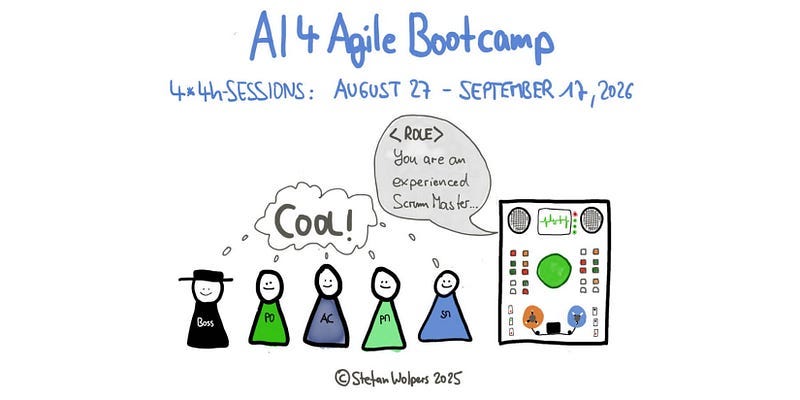
Learn more: 🖥 💯 🇬🇧 AI4Agile BootCamp #8, August 27 — September 17, 2026.
Customer Voice: “Last week, I finished the 𝗔𝗜 𝗳𝗼𝗿 𝗔𝗴𝗶𝗹𝗲 𝗣𝗿𝗮𝗰𝘁𝗶𝘁𝗶𝗼𝗻𝗲𝗿𝘀 course. And I’m mutating… It started on the train. I was scrolling through my messages, half-distracted, when a newsletter from Stefan Wolpers popped up. Stefan, a deep thinker with a hands-on attitude, was launching a new course. A pilot cohort. The mission: explore how AI can actually support us as agile practitioners. I couldn’t resist. I tapped: “𝘚𝘪𝘨𝘯 𝘶𝘱”. What followed were four bi-weekly sessions. Four intense afternoons. Full of exploration, experimentation, and practice. […] At the beginning, Stefan said that 𝘫𝘶𝘴𝘵 𝘴𝘪𝘨𝘯𝘪𝘯𝘨 𝘶𝘱 𝘢𝘭𝘳𝘦𝘢𝘥𝘺 𝘱𝘶𝘵𝘴 𝘶𝘴 𝘢𝘩𝘦𝘢𝘥 𝘰𝘧 𝘮𝘢𝘯𝘺 𝘱𝘳𝘢𝘤𝘵𝘪𝘵𝘪𝘰𝘯𝘦𝘳𝘴. That sounded like a big statement. But somewhere along the way, I noticed a shift… an emerging superpower in how I approach my tasks with AI.⚡And now, as my AI-mutation continues, I catch myself wondering: 💭 𝘏𝘰𝘸 𝘥𝘰 𝘐 𝘶𝘴𝘦 𝘈𝘐 𝘵𝘰 𝘴𝘢𝘷𝘦 𝘵𝘩𝘦 𝘢𝘨𝘪𝘭𝘦 𝘸𝘰𝘳𝘭𝘥?” (Ilya Zaytsev, Leading Agility at HUGO BOSS.)
Satya Nadella warns that enterprises risk leaking proprietary knowledge to AI providers through everyday usage and proposes that firms must control their own learning loops, evals, and model outputs to protect their competitive edge.
Source: The Reverse Information Paradox
Author: Satya Nadella
Susan MacKenty Brady, Stuart Kliman, and Leslie Smith identify four leadership traps that silently erode trust in diverse teams: certainty, saying one thing while doing another, emotional reactivity, and self-justification.
Source: Harvard Business Review: 4 Hidden Traps of Team Dynamics
Sean Goedecke proposes that ‘playing politics’ for software engineers is not about scheming but about knowing who holds power, avoiding unnecessary conflicts with them, and making your contributions visible to the right people.
Source: What does ‘playing politics’ mean for software engineers?
Author: Sean Goedecke
Your team already has rules for using AI. Some live in templates, some in habits, exceptions, and one person’s memory. The AI Working Agreement puts the decisions that matter in one place: what the team delegates to AI, what stays human, what must be reviewed, what never enters a model, who owns which workflow, and how the agreement changes. Write it, and a new colleague can read your team’s AI decisions on their first day, while the decisions stay when someone leaves.

Thesis: Team-level AI governance fails more from uncodified judgment than from missing policies. The AI Working Agreement turns scattered AI decisions into one inspectable artifact, so a team can onboard people, survive departures, and challenge its own habits before those habits harden into risk.
Learn more: You Already Have an AI Working Agreement. Write It Down.
Share Hands-on Agile by Stefan Wolpers
Steven Sinofsky draws parallels between Chicago Law School’s recent ban on AI and Harvard’s 1982 ban on computers, and suggests that preemptive restrictions on transformative tools have never survived contact with reality.
Source: Banning AI in Law School: We’ve Seen This Before
Author: Steven Sinofsky
Dave Rooney suggests that AI coding tools change the story-slicing calculus: when inputs and outputs are well known, one large story delivered with LLM help can beat twelve thin slices.
Source: Rethinking ‘Small’
Author: Dave Rooney
Tristan Kromer proposes that AI can accelerate the running of experiments, but cannot choose the right question to test. Picking the wrong question remains the single most common reason founders get useless data.
Source: Kromatic: Before You Run the Experiment, Pick the Right Question
Author: Tristan Kromer
Upcoming classes and events:
🖥 💯 🇬🇧 July 20 — Self-Paced Online Course: AI 4 Agile Course v3 — Master AI for Agile Practitioners (English; Self-paced Online Course)
🖥 💯 🇬🇧 July 23 — Meetup: HoA 76: Where Are Your Decisions to Avoid AI Debt? (English)
🖥 🇩🇪 August 25–26, 2026 — Live Virtual Class: Professional Scrum Product Owner Training (PSPO I; German)
🖥 💯 🇬🇧 August 27-September 17 — Live Virtual Cohort: AI4Agile BootCamp #8 (English)
🖥 🇩🇪 Sep 30-Oct 1, 2026 — Live Virtual Class: Professional Scrum Product Owner Training (PSPO I; German)
👉 See all upcoming classes here
Now available on the Age-of-Product YouTube channel to improve learning, for example, about AI’s Labor Market Impact:
Stop Writing Prompts. Let AI Do It for You — Hack #01, AI4Agile Online Course v2.
Check Your AI’s Plan Before — Hack #7, AI4Agile Online Course v2.
From Product Requirements to Experiments to Learnings — Supported by Generative AI.
Never Accept an LLM’s First Offer — Improve GenAI’s Usefulness w/ Feedback Loops and Challenges.
Also:
📅 Join 6,000-plus peers of the Hands-on Agile Meetup group
🐦 Follow me on Twitter and subscribe to my blog, Age of Product
💬 Alternatively, join 20,000-plus peers of the Slack team “Hands-on Agile” for free.
Comments
Nothing yet. Say the first thing.
Sign in to join the conversation.