
Frederick Douglass understood this nearly two centuries ago:
Power concedes nothing without a demand. It never did, and it never will.
Now the robots are showing up.
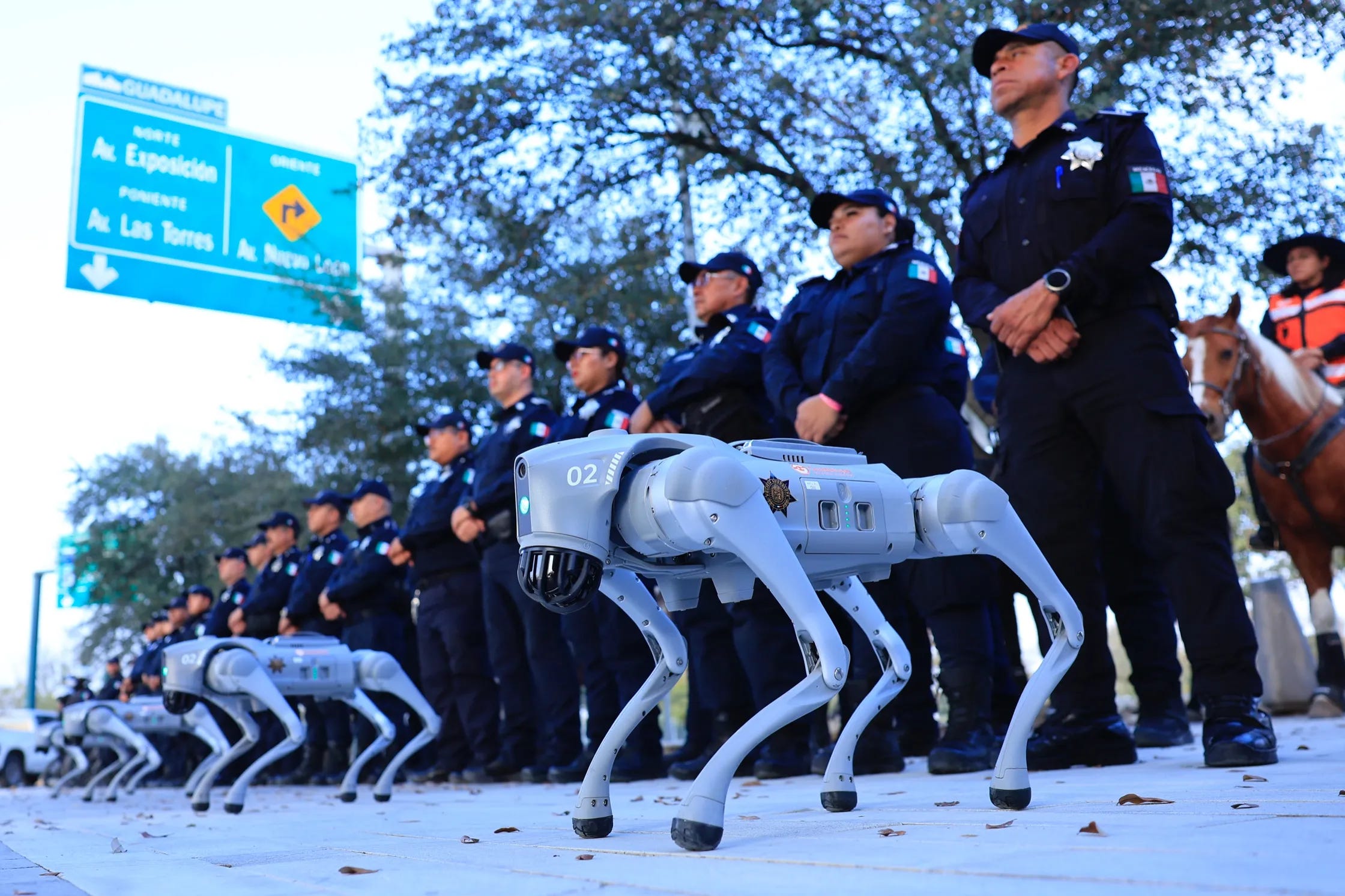
At the World Cup in Mexico this summer, surveillance robots patrolled the stadiums. Machines made of aluminum and high-strength plastic, equipped with facial recognition, behavior analysis systems, and cameras sending live video to a central command center. They could move at speeds of up to 20 kilometers per hour. Their purpose was to identify agitation in a crowd before the crowd even knew it was becoming agitated.
The New York Times called them cute. The reporter referred to them as creatures. They were given the name K9. Children were encouraged to approach them. The public response was described as warm.
This is how normalization works. You give the machine a friendly name. You let it be photographed with smiling fans. You describe it as a dog rather than a surveillance apparatus. You repeat the language until the language becomes the reality.
K9’s rapid acceptance is the real story here. A machine built to detect agitation needed only a name, a photo, and a few curious children. The children did the work no engineer could do. They allowed the machine to belong.
Those in power have always understood: there are far more of us than there are of them. History is filled with moments when that became important. People rose up. Orders went unanswered. Soldiers stood with their neighbors instead of their commanders.
The robot may offer those in power a solution in the 21st century. An autonomous force follows instructions with consistency.
Every face becomes data.
A robot moves through a crowd of neighbors, parents, and children and processes them all the same way: information to analyze. Machines don’t question orders in the way human beings can.
London shows the same architecture spreading. On May 16, 2026, the Metropolitan Police ran live facial recognition at two demonstrations, scanning roughly 80,000 faces against a police database in a single day. One woman was arrested for covering her face at the protest where the cameras ran. By year’s end, the Met plans permanent cameras across the West End and Soho, an expanding infrastructure built to grow well past its current footprint.
A face scanned in May stays scanned in June. It sits in a database, waiting to be matched against the next protest, and the one after that. The crowd disperses. The record remains.
A single scan captures a moment. The database keeps a life.
London and Guadalupe are not the same city. They are the same idea.
Each piece, alone, can be defended as necessary. Together, they reveal a pattern: making collective action harder before collective action becomes necessary.
We are living inside something still taking shape. A cage. One robot. One camera. One algorithm at a time. By the time we recognize the bars, they are already in place.
Power concedes nothing without a demand.
The first demand is attention. To the names we give machines. To the comfort we grant them. To the ordinary afternoons they enter.
Pay attention. The cage is being built now.
No posts
Comments
Nothing yet. Say the first thing.
Sign in to join the conversation.