
Hi, folks!
Today I want to share a recent article by some… joker.
Ancap Joker doesn’t post a whole lot but when he does there are usually good nuggets of truth or wisdom to be found in his pieces. This one has several. Enjoy!
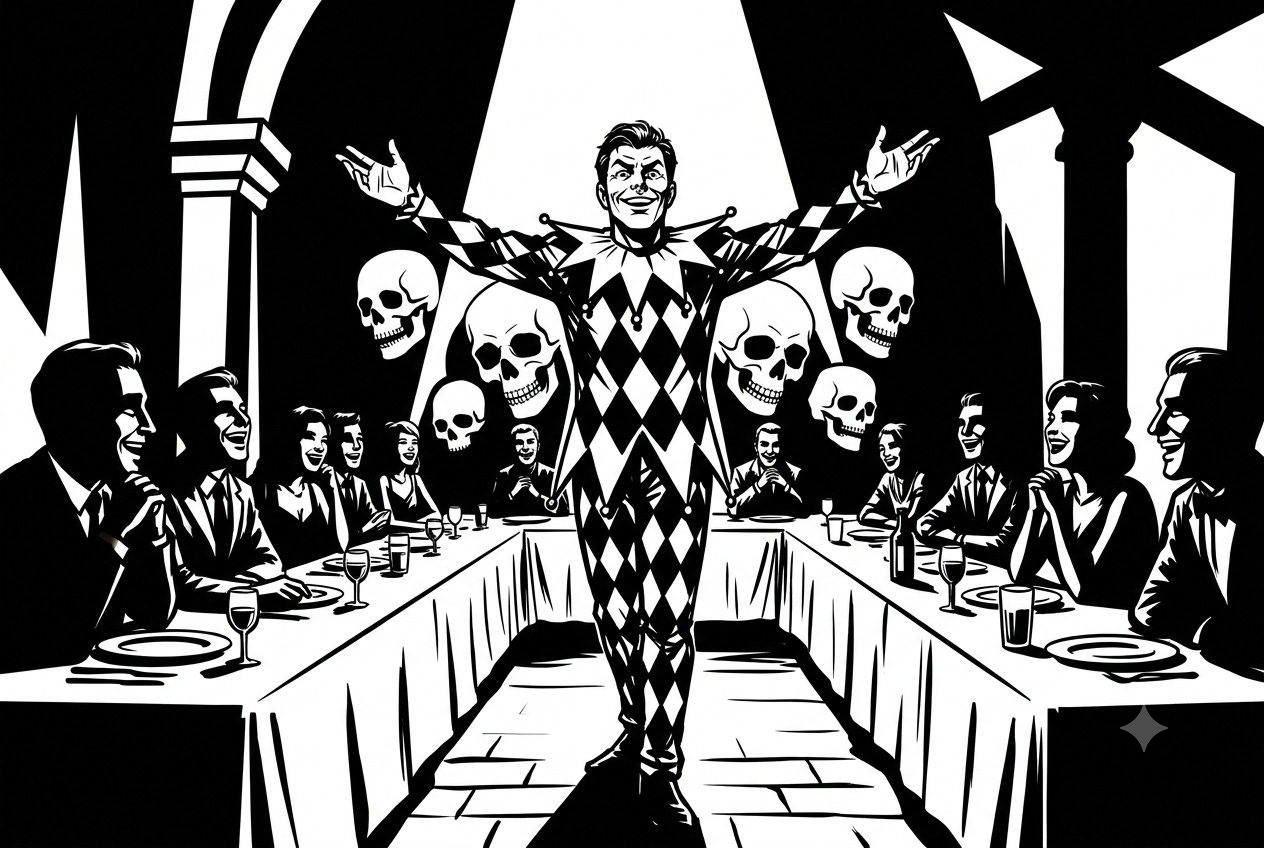
Wanna hear a joke? Socialism. Wanna hear another one? Socialists.
They want a fairer, more equal world, and they won’t spare any body to get there. Socialism is worse than getting stabbed. We’re right. They win.
Right now, a charismatic professor named Richard Wolff is sitting in a classroom explaining to an audience of millions—that the twentieth century’s hundred-million-corpse experiment doesn’t count: that wasn’t socialism, it was state capitalism, and the real thing is the panacea for the world’s illnesses. And the people listening aren’t the gullible or the uneducated. Quite the opposite.
Far from me saying that socialism isn’t funny: the joke is bulletproof. The body count is on our side, the economics is on our side, a century of natural experiments from Berlin to the Korean DMZ is on our side, and we are losing the room to a man whose entire act is “Trust me”.
I take jokes very seriously, and we have here a real puzzle, where are the laughs? I refuse to make the case for libertarianism. Other people have done a great job, definitely much better than I could; it would be a sidetrack for this piece. Read the 60 pages of Anatomy of the State yourself (Appendix has more recommendations), and if you’re really interested I can answer DMs. For now, all you need to know is that their delusional ends don’t justify their wicked means.
And yet there they are—some of the smartest people in the room, PhDs, Ivy league graduates—still buying the act, still certain of the people’s revolution or the sugar-free version: democratic socialism.
These aren’t stupid people. If they were stupid there’d be nothing to explain. Smart yet gripped. So the question isn’t whether we’re right or not; it’s why being right changes so little. The answer starts with how a belief is actually held.
The deeper a belief sits, the more a person has staked on it and the more it costs them to give it up. That cost is what you’re actually up against when your arguments bounce, and it’s why one that converts a person bounces off another.
So picture the belief as a well. I’ll take four thinkers and each one maps one depth, and the deeper it sits the more the person has sunk into it, so the more it costs to climb back out, and the less likely an argument will land. This is a look under the hood at how dumb beliefs are actually held by smart people.
Start at the surface, Jonathan Haidt’s Moral Foundations Theory says we don’t reason our way to our politics and then feel accordingly. We feel first—the moral intuition fires in milliseconds—and the rational part of us scrambles afterward to justify where we already went. Different people, different settings.
Progressives weight care, equality and fairness above the rest, so a world of large inequalities reads to them as ongoing harm, at the level of raw perception, before any argument runs. They think the government is caring, or that the government is us, or some other commie nonsense. They don’t see “the coldest of all cold monsters”.
Moral intuitions are a real powerhouse, so build on their instinct, validate their feelings, then rip the Band-aid. Show them that the policy they favor is funded by a threat they’d never endorse if it were taken to its breaking point—that the compassion they feel is being collected at gunpoint two steps downstream—some might move, most will think about it. The instinct guards the door. Come at it head-on and it fires first, and you get dismissed before you even have a chance to get heard.
One layer down, there is another barrier. Now there’s an audience.
Rob Henderson’s luxury beliefs: ideas that grant status to the people who hold them while the costs land on people who can’t afford them. The position polls well in the faculty lounge and badly in the neighborhood that absorbs the consequences. And like any good that signals status, it has to stay scarce to keep its value, in this case it has to stay radical. Last year’s radical position can become this year’s embarrassing moderation, because once everyone can hold it, it no longer marks you out. Socialism, given its track record, never falls out of flavor.
The person here has staked standing on the belief. Their friends hold it, their professional circle assumes it, and to be seen abandoning it is to walk into the lounge next week as the one who went soft, or worse, went right. Who cares that a carbon tax will hurt the poorest in society? You got your reputation on the line.
The cost is real, but it’s external. It lives in other people’s eyes, not in their own. And that gives this layer an escape hatch the deeper ones don’t have, because a belief you hold for the audience can come apart from the performance of it. They can change their mind in private and keep nodding along in public, defect quietly while staying compliant where it’s watched. People do this constantly and comfortably; holding one view and performing another is one of the most ordinary things a social animal does. You’re not asking them to lose their friends. You’re asking them to think differently behind a face that can go on performing. To be fair, most people are not really comfortable with this, they’d rather fool themselves. Anyway, plant the seed and let it grow out of sight.
Down again and the belief goes inward. Now there’s no audience to fool, because the person who’d have to be convinced is a true believer.
Robert Nozick’s essay “Why Do Intellectuals Oppose Capitalism?” is about twelve pages. There’s no reason not to read it. The argument: school runs on verbal-symbolic merit. The child who is best with words is told, every day for twenty years, by every authority he respects, that he is the most deserving person in the room. Then he graduates into a market that does not care about words, should’ve got that STEM degree. The market rewards what strangers will voluntarily pay for, and strangers will pay more for the man who fixes the air conditioner than for the lady who lectures on intersectionality, insufferable. So the most verbally gifted cohort we produce walks out of the most prestige-soaked environment we’ve ever built and runs straight into a system that demotes them. It’s not their fault. It’s the system’s fault. And the system is screwed up enough that this is not a far-fetched idea.
Everyone knows the world is sick, so pick your poison: if the system is rigged, what hypothetical system will value my abilities? Marxism is one of the most verbally sophisticated theories built for explaining why our system is unjust at the root. Anyone can picture himself the Chairman. And people whose entire lives were propped up by the education system now realize their abilities are valued in socialism, as is everything, for the record.
The layer isn’t sealed. Sometimes you reach them sideways, by granting the grievance is real before you touch the doctrine built on top of it. They just need to feel useful and valued.
The bottom.
Eric Voegelin’s claim is that Marxism was never an economic theory at all. It’s a religion in secular dress, with the full architecture of salvation: a Fall (capitalism), an Elect (the proletariat, or in practice its self-appointed vanguard), a body of saving knowledge you must read the right books and achieve the right consciousness to possess, and a heaven to be built here on earth: what Voegelin called immanentizing the eschaton.
Once you see this, the puzzle of the famines dissolves. You can’t refute a salvation narrative by pointing at its atrocities. “Real socialism has never been tried” isn’t a debating trick someone invented to frustrate you. It’s the load-bearing wall of the whole structure: the move by which every faith survives its own history.
Socialism is not one belief. It’s where their meaning comes from. Read socialists, drink with socialists, go to socialist church on Sunday. They won’t change their mind, they have their own tradition. They hold the keys to paradise, everyone else is lost in the darkness.
We now have a map of what we’re actually up against: the thing standing behind the argument at each depth, deciding in advance what your argument gets to mean.
The map kills one fantasy: that the right argument flips anyone honest. The ideologue at the head of the table is the prestige scalp, and a frontal proof is the tool his depth was built to repel. The quiet person two seats down isn’t defending anything at all.
I’m not saying the entrenched person is worthless, or stupid. So you don’t write them off. You plant the seed at every depth. A calm sentence costs you almost nothing. The seed won’t sprout on the spot. Let go of the need to win the exchange. Calm seed-planting beats heated arguments. Don’t hold your breath. You might never see your seeds sprout, but that doesn’t mean they won’t.
Everyone remembers Twelve Angry Men as a monument to reasoned persuasion: one calm man with the truth talks eleven hostile jurors around. Watch it again and the actual mechanism is colder and more useful than that. Fonda’s juror almost never flips anyone by direct confrontation. He turns one uneasy vote first—the cheapest one in the room, the one already half-uncomfortable—and after that the room doesn’t change man by man through argument. It changes as the weight in the room shifts. Holding out gets more expensive as the consensus moves, and jurors fold to the new balance, not to a new fact. And the last holdout, Juror 3, doesn’t yield to logic at all: his position was never about the evidence, it was something personal. He breaks only when he’s the lone man standing against a room that has already turned. Of course, this is a two-hour movie, and changing the room won’t happen in this short of a time frame.
But the strategy is solid. Talk, see who gets moved, approach carefully. The ground will shift. And then, the Cathedral moves, or crumbles, either way is fine. Spreading the word through the whole room does what no single duel can. The Cathedral doesn’t fall to argument; it falls when the ground underneath it moves, and the ground is everyone else. So the libertarian who spends every dinner locked in single combat with the smartest socialist at the table has it exactly inverted: he’s the juror trying to argue Juror 3 down directly while ignoring the nine votes that would have turned the room and, eventually, turned Juror 3 for him.
I’ve even got a live demonstration on the deepest layer, our own side, which is worth telling. For a while, Hoppe’s argumentation ethics became a fixture in the libertarian Discord servers I lived in. People took visible pride in being able to run the derivation. The word that always appeared was irrefutable. And here’s the tell that it had gone the Voegelin route: doubting it got socially expensive, while on the other side of the aisle was Bob Murphy the entire time. You can say Bob is wrong, you can’t say he’s an idiot or not a real libertarian. The room treated it as not only a closed question but a taboo to question. That’s what the bottom of the well looks like from the inside: a belief that had quietly stopped being about the argument and started being about belonging to a select group of people that achieved gnosis.
You work the whole room—every depth of it—and you stop expecting the same delivery to land the same way on all of them.
Throw seeds everywhere. And, one day, even the enlightened may find that the sky they were holding up is being held up fine by something else, and quietly step down, not argued out of the faith, just no longer surrounded by it.
So say it plainly, and say it to everyone. You were never only fighting their reasons. Don’t hold your breath. You win a room one seat at a time.
Now if you’ll excuse me, I have to go patiently, strategically, unglamorously work on my act.
Wanna hear a joke...
—Joker
Comments
Nothing yet. Say the first thing.
Sign in to join the conversation.