
Another list, circulates. This time it is an online list of businesses in Toronto that should be boycotted because they are “Zionist”.
What next? On the first night of Hanukkah in western, temperate Sydney, Australia, far away from the Middle East, there is a massacre. Jews who gathered on the beach to dance and pray and light candles. Shot down in the name of Islam. 15 dead, more than 40 injured. Who can celebrate the great victory of the Maccabees after that?
The face of Matilda, 10-year-old Jewish, Ukrainian-would-be-Australian girl, shot dead on the beach, haunts me. In the pictures, she smiles joyfully, buck toothed and delighted. Her parents brought her from war-torn Kiev for a life free from Russian drones. She too is on a list. A list of dead Jews.
At the neighborhood dog park, I kibbitz with Iranian Sonny. He runs an idiosyncratic pomegranate-themed juice and frozen treat shop decorated with horse saddles and sticky-note tributes to the store’s greatness. The frozen slushie concoctions are an amazing combination of tart and sweet. I’m a regular. Sonny always tries to give me my order for free, but I never let him.
His shop is part of a larger family business started by his parents when they came to Canada after the Iranian revolution. Now Sonny is worried that the shop might close. He alludes to strange happenings, shadowy figures. I press him for details.
Sonny’s dog, a tiny brown poodle thing with a coat of light brown curls leaps nonstop at Sonny’s hand as he passionately gesticulates. Sonny tells me that his Iranian friend had shots fired at his Toronto gym. It was a warning to stop saying bad things about the Islamic regime. In the meantime, Sonny is getting bizarre calls at the shop warning him not to support the mullahs.
“I don’t support them,” he says incredulously. It’s true. Bobby has had a “Women, Life, Freedom” sign in the window of his shop since the death of Mahsa Amini, young Kurdish woman disappeared from this planet by the murderous Islamic theocracy.
So why are they telling Bobby not to support the theocracy? He shrugs. “All our product comes from my country,” Bobby tells me. Maybe they think he’s in with the Mullahs because he imports from Iran? Who knows. We live in Canada, where everything and nothing is as clear as mud. A land of immigrants, land of long running shadowy disputes imported into the diaspora for the express purpose of muddying the waters. Anyway, he might have to close. If things keep going the way they are going. He won’t be able to get the Persian pomegranate juice. That’s the stuff. The stuff that keeps the customers coming back.
We both silent, standing there together. It’s April but it feels like March. The wind blows cold. It’s been four years since the amoral “morality police” beat Mahsa to death, a young woman my older daughter’s age. That set off a wave of frustrated protests, one that led to the most terrible reprisals, thousands shot dead on the streets, thousands more disappeared, arrested then executed.
Two years later comes October 7, several thousand more civilians, mostly young women, murdered. In the name of religion, death and dictators, the innocent are raped, mutilated, and horrifically killed. And so, war. War for both of our ancestral homelands, countries neither of us had a chance to grow up in.
“Grrrrr,” announces Bobby’s tiny dog. Out of nowhere he leaps over a passing German Shepard.
Bobby brightens. “He never stops jumping that one!”
My brother calls. He is being discharged from the hospital. They have not found the exact cause of the brain bleed, which is a good thing. His brain no longer bleeds. He’s a bit foggy on the details of his life and times, which is maybe, for now, not necessarily a bad thing. His daughter has come home to visit. He promises her he is going to eat healthy, exercise, and de-stress. She sighs and makes him a sandwich.
On X, I attempt to confront a far-left “activist”, part of the group who establishes a “registry” listing Canadian citizens who have been or are in the IDF, the Israeli Army, the only thing that protects more than half of the world’s Jews from instant annihilation by its hostile neighbors.
We don’t care about your stupid list, I tell him. Soon one of my brother’s kids will appear on the list. He’s in marketing in Tel Aviv. His company works with child-star-turned-daytime –talk-show host Drew Barrymore to promote a cell phone game to middle-aged stay-at-home moms with disposable incomes and time on their hands.
I find out that the guy with the registry is based in Montreal. I also find out that he’s now working on a list of Jewish summer camps, schools and synagogues. Besides being a completely deranged hater of the Jewish people, he is sitting in my personal Jerusalem, Montreal, at once defiling my childhood memories and attacking my future.
Why not just do a list of Jews? I ask him. Then it would be easier to round us up for “re-education?” The more I “X”, the angrier I feel. I want to hurt this man. I am not a violent person. It’s increasingly obvious to me, however, that I could be. In the right circumstances. If, say, my family was being threatened. My family is being threatened.
I have to go walk the dog, make dinner, help the kid with her homework. Reluctantly, I sign off. When I return the next day, I see that I have been banned. X has banned me. No reason or explanation is provided. The Montrealer who makes lists of Jews, however, has not been banned. He’s adding new subscribers from all over the world every single day.
In the early morning hours, I thrash through a bad dream. I’m helping some young kids. I don’t know these kids. But I’m helping them forget that they are in some kind of dire situation. I’m playing with them, distracting them. But then one wants to go home. I tell him no, but he absolutely insists. Fed up, I take this kid by the hand. We wander through a large complex before coming to an apartment. The apartment, I just know, belongs to a friend of mine from high school. In real life, Charlie, who I’m still in touch with, is a Rabbi who grew up in a family that, though of Jewish roots, did not participate in any Jewish rituals or holidays.
In the dream I enter Charlie’s apartment only to meet my long-deceased grandfather, Zadie Avrham. My Zadie who fled to Russia from Poland just ahead of the NAZIs, then fled the USSR to Canada to give my mother and eventually me a truly free life. We hug and I feel his whiskers brush against my soft cheek like they did when I was a boy. I’m so happy to see him. Charlie then takes me for a tour of the apartment. It turns out to be an enormous room filled with shelves holding records. Not files. I’m talking about vinyl records, LPs.
The room begins to tremble and shake. We are under attack. Records spill off the shelves. Everyone is shouting, screaming. I jump out of the way just in time to avoid a wave of LPs crashing down on me. The next thing I know, there are gunmen running toward us, firing their machine guns. The kid, hit, slumps sideways. I’m going to be killed, I know. In a desperate bid to avoid the bullets spraying toward me, I dive into a chaos of whirling records.
I wake up. I’m falling. In real life, I’m falling.
My wife, from a distance, from far away: “What’s going on? Hal?”
Her voice reaches through layers of dream state confusion. I’m lying on the ground in the narrow space between the wall and the bed, wedged against my book-stuffed night table.
“Hal?”
I push myself up. The back of my head pulses. I must have hit it on the way down. I probe for blood. I’m okay. I had a dream. Records. Records and bullets. Diving to get out of the way of the kaffiyeh clad terrorists.
“I fell out of bed,” I tell my wife, myself.
Disoriented, I look at my phone. It’s almost 6am. 5:58 am on October 7, 2025.
Though every bat mitzvah is special, this one feels like an act of defiance. My brother, exercising and even considering a diet, comes up to read two prayers that were not read at mine, or his, or my older daughter’s bat mitzvahs. He reads, first, the prayer for the hostages taken by Hamas. Second, he read the prayer for the soldiers of Israel fighting to bring the hostages home.
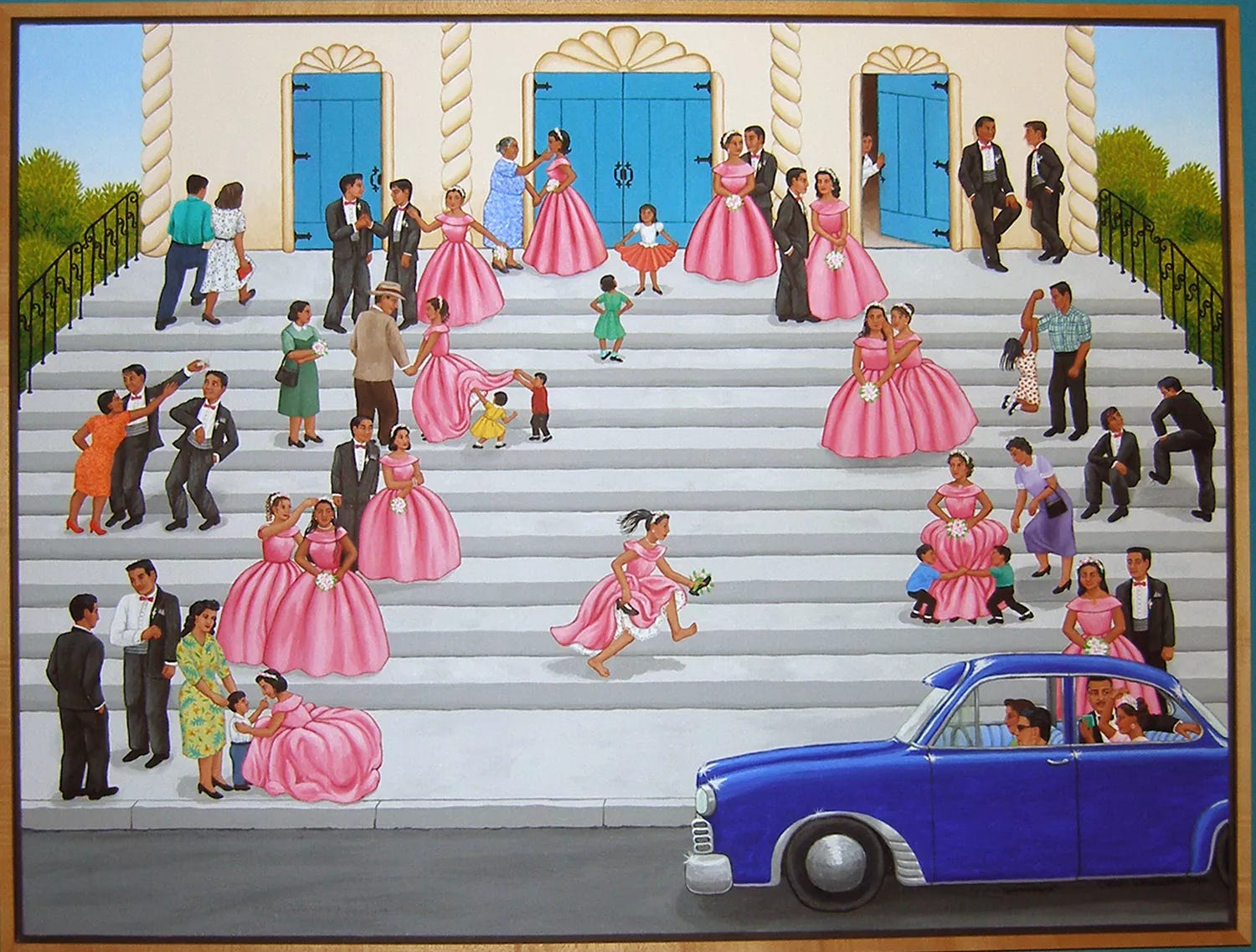
Big deal, grunts the dybbuk who lives on my shoulder. Just another quinceañera-sweet-something with a little bible thrown in. But by the time she manages to totter up to the bema on her big-girl high-heels and read from the Torah—the rabbi inviting people like my neighbors the Leungs from Hong Kong to come up and take a look at the handwritten scroll before my daughter begins to read—it really does feel like a big deal. It feels like the biggest deal in the world.
After reading from the torah my daughter, hair coiffed, perfectly applied makeup glimmering, speaks about her parsha (her assigned portion of the Torah). She talks about the various commands God gave Moses as the tribes, the once enslaved escapees from Egypt, took their circuitous, prolonged journey through the desert toward the land of Israel.
As they trekked along on a journey part penitence, part preparation, they were educated in the ways they would have to behave if they wanted to set up the first Jewish state. The proscribed behaviour was a complicated mix of legalese and spiritual engagement. It reads somewhat, uh, stilted, to the youth of today who generally aren’t familiar with animal sacrifice or ancient grains that don’t come in a cereal box. “Today,” my daughter points out, gamely attempting the bat mitzvah tradition of trying to give the dusty, mostly tedious text new life in the far less strange land of Canada, “we still have expectations put upon us if we want to call ourselves Jewish.” Like the proto-Jews of Egypt, you can’t just say you are Jewish. You have obligations. There is a code, a way of being. The rabbi chants and I think about everything my daughter, her sister, and my nephews and nieces have already been through. Young people who will have to find their way through this strange new world.
I visit Israel. It’s two and half years after October 7, a time of quiet, however momentary. The Gaza war has ground to an unsteady ceasefire. Operation Rising Lion has just concluded, and Operation Roaring Lion is a storm cloud on the horizon. Thinking about this, I’m picturing a room of spotty twentysomething IDF conscripts tasked by their gravely serious Corporal with the assignment of coming up with catchy names and accompanying logos. Despite the seeming winding down of things, everywhere you go, everywhere you look, there are posters. All the posters show one name, one face: Ran Gvili, 24 years old, the final hostage. Ran was a police officer, closer to my older daughter’s age then mine. Suddenly confronted with a horde of frenzied terrorists running at him, he did his best to fight back. He was among the 251 dead and living Israelis dragged back to Gaza. His body, one of the first to arrive, is now the last to remain, the last to leave. Where are Ran’s remains? What’s become of him?
At the Nova site I stand, trying to imagine it, the infinite impossible search for one last body. The site is much changed. There is a paved area to accommodate vehicles. Mourners. There aren’t many on this sunny but cool mid-week winter day in the desert. A young man says a prayer in front of the monument to another young man. He looks like he is going to cry. It rained the last few days. Winter rains. There are pools of water. The youngster mourning the loss of his friend or brother or lover stands in mud. Patches of low-slung greenery, weeds and grasses and clinging shrubs. On October 7, it would have been dry and dusty, the hills in the distance dotted dun. Hot and dry in the waning days of the long Israeli summer that gets rolling by April and is in full force and full heat from May to practically November. Across from the Nova site itself, there are trees planted now, planted and staked, one for each person who lost their life. Desert into forest. 378 trees still in their infancy, not unlike most of the people who were massacred at this peaceful, still spot in the desert. The trees will grow to maturity. The dancers will not.
The Nova site itself consists primarily of makeshift tributes to the dead, now in their twenties forever. There are signs describing them, signs with pictures, with their favourite sayings, stories of who they were, of how they were, what hopes and aspirations they had. So much left undone. The young women are mostly the same age of my wife when she was on Kibbutz in the desert. They are the age of Kid #1, who has yet to visit Israel, though she could easily have been one of the dancers and revellers, high on life and possibility and the bloom of the desert sun illuminating the long, glorious night. It had been cold at the end, the desert sand cool on their feet, the dark air flirting with the coming winter’s shadow. But then the sun came up and everyone cheered and stretched their long tanned summery limbs toward the emerging warm light.
The fall starts with Kid #2 starting at a Toronto public high school. Though at another public school they “accidentally” played the Canadian national anthem in Arabic on the first anniversary of the October 7th massacre, nothing of that sort has happened at her school, at least not yet.
So far none of her teachers have used graphics of evil Hebrews to illustrate a math or history lesson. Is it just a matter of time? At the University of Toronto School of Dentistry, a professor shows an illustration of a figure bound in an Israeli flag tied with rope. The man’s head, painted in the colours of the Palestinian flag, hangs down in desperate sorrow. The image appears next to an explanation of the “strangulation theory” of dental pulp. The next slide shows a man with a hooked nose in a pool of money, meant, apparently, to illustrate the principle of “immunity.”
With our encouragement, Kid #2 joins The Jewish Club. She returns from the first meeting and reports, with approval, that all they did was eat pizza (kosher) and hang out.
Since there aren’t many members, Kid #2 starts bringing her friends with her. They aren’t Jewish, but who cares? They tag along to ‘support’ ie. eat pizza. One friend whose parents are apparently quite “liberal” tells Kid #2 she is unsure of her presence there, as she doesn’t want to signal any kind of agreement with what Israel is doing: “You know, the war and everything.”
The teacher overseeing Jewish Club tries to get a conversation going. Is everybody okay? He notes that since October 7, there has been a lot of antisemitism in Toronto. Faltering discussion ensues. Kid #2’s leftie friend leans over to whisper in her ear—“What’s October 7?”
No posts
Comments
Nothing yet. Say the first thing.
Sign in to join the conversation.