
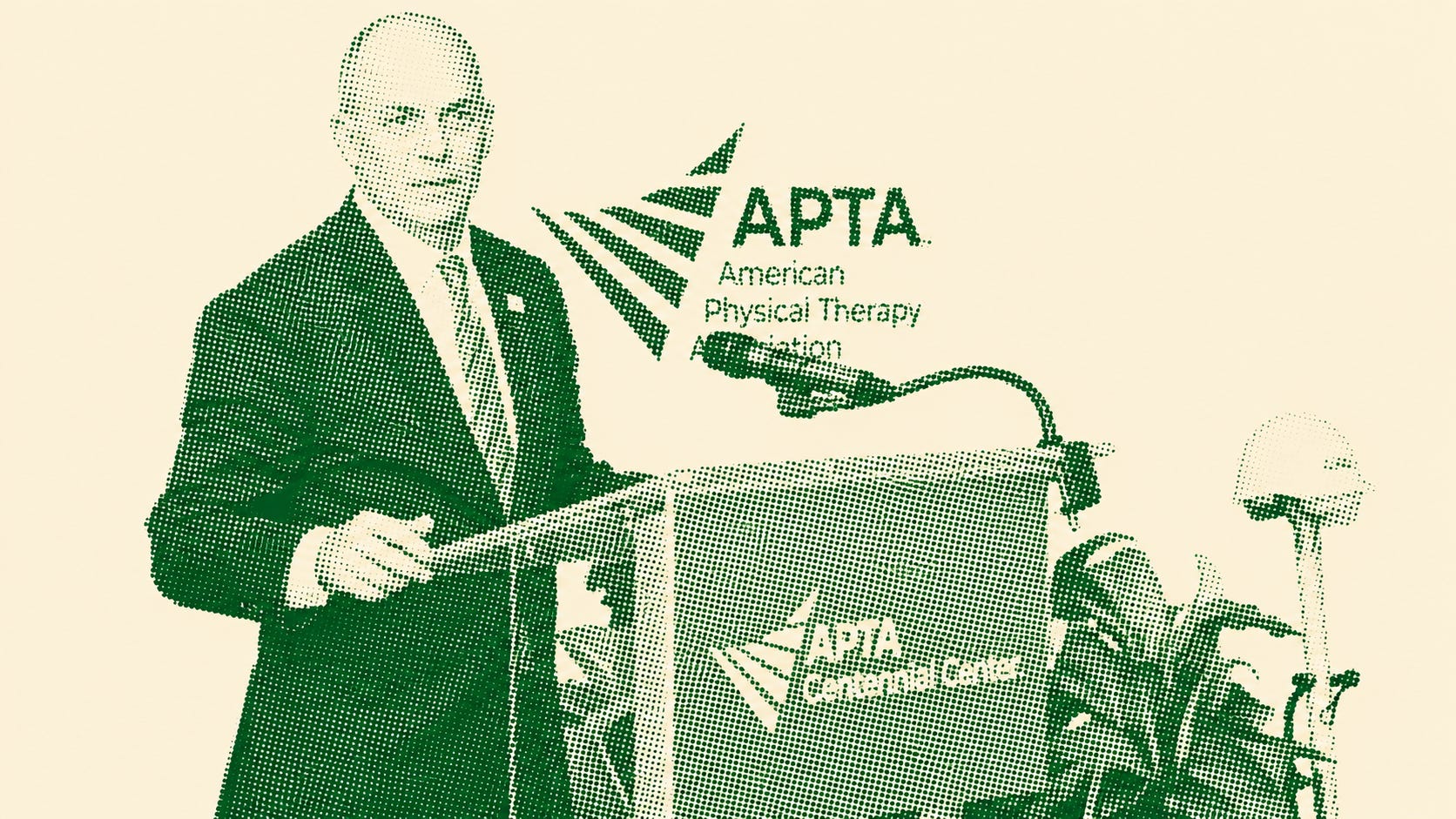
Justin Moore has one of the widest vantage points in all of Physical Therapy. He's gone from treating patients to leading the organization that speaks for the entire profession. He sees the pressure PTs are under as clearly as anyone, and he's still one of the most optimistic voices about where the profession is headed. We sat down to talk about the profession everyone keeps betting on, the limits of a payment model built in 1994, and why the future depends on scaling expertise without burning out the people who deliver it.
ben.barron: Mr. Moore. What’s going on?
justin.moore: How are you doing, sir?
ben.barron: Good. Sounds like you’ve been a busy guy, traveling all over.
justin.moore: May was brutal. Healthcare meetings around the country, and then a last-minute meeting in Halifax, Nova Scotia. Beautiful coast. Looks a lot like Acadia, the only other place I've seen like it.
ben.barron: I love Acadia. My wife and I have been several times, it's one of my favorite places.
ben.barron: Here's where I'd like to start. It's easy for us as an industry, and you and I are both PTs, so we can make fun of ourselves a little, to talk about reimbursement cuts and the labor shortage and burnout the same way we have for 20 years. What I'm more interested in is the headwinds we haven't even thought about yet. Or the green shoots that might help us go after the challenges we know are real.
justin.moore: There’s a lot to discuss there because at the end of the day, Physical Therapy sits at a nexus. We're hanging on to the practice models we've always had, with all the payment challenges and administrative burdens and labor stress that come with them, or we're trying to jump, to leapfrog, into the new models that are really what we all joined the profession for.
justin.moore: Treating patients with the care they need, when they need it, the way they need it. But our payment models are based on hanging on to the past. So how do you reach for the potential that's ahead of you when you've got to deliver a paycheck on Friday, and you've got to participate with the insurers because the largest employer in your community is all under UnitedHealthcare? That's the dilemma we're in.
ben.barron: Fair to say, then. I think I've heard you say this before, but the headwinds we're facing, in no particular order, are compressed margins and workforce issues, which ties into rising demand.
ben.barron: If we had decreasing demand and a decreasing workforce, that's less of an issue. But we've got an increasing demand curve and a flat or decreasing workforce. Is there a third, or is it two?
justin.moore: Decreasing margins and payment is one. Labor stress and burnout, just do we have enough people to see the patients we already have, is two. And three is the antiquated model of practice itself. Whether that’s payment policy that gives you things like the eight-minute rule, or that limits your ability to delegate services to another practitioner. The third stress is that our model of care is antiquated, and we've got a pretty strong dependency on it.
justin.moore: I always think of it as a paradox. The stress we’re under is real, and we’re probably one of the most over-regulated, over-managed, over-scrutinized healthcare services out there. But on the other side of the page, we’re also the profession everyone keeps betting on to play a bigger, higher-value role in the future. So how do both of those things exist at the same time?
ben.barron: Can we pause there for a second, Justin? Give me a concrete example of how we’re under pressure and over-regulated on one hand. I think I know where you’re going on the people betting on us, but I’d love to hear the pressure side specifically.
justin.moore: Yeah. I think it comes back to our DNA. Under payment policy, we’re defined as a service, not a profession. It’s not unique to PT, but in healthcare, if you’re defined as a service, you get managed like one. You manage throughput, you create barriers, you contain cost or restrict the access, because a service is an efficiency model. If instead you’re a profession, billing at the visit level and based on outcomes, you’re an effectiveness model. So we've got to make that transition. That's the paradox.
justin.moore: All that stress and regulation and micromanagement is one side of the coin. The other side is that we should be utilized far more readily across every system. You've seen it in the literature, whether it's Julie Fritz's work or the economic value of PT report. The evidence is that we have a greater return on investment than most healthcare services. So why are we regulated at the base level we are, when we know the value equation should be to our advantage?
ben.barron: Let me say that back in a different way to make sure I’ve got it. PT has been built as a services business, meaning the economic model that pays therapists is based on services. The more service you provide, in units or visits, the more revenue, or the more expense, depending on which side of the ledger you’re on.
ben.barron: And because of that, throughput and efficiency become the lever everyone reaches for, whether you’re the provider or the payer. Create barriers, create friction, slow it down. Whereas if we went to the other model you mentioned, the effectiveness model…
justin.moore: Right. The effectiveness model would be based around the care at a visit. How do you treat the patient for what they need that day? That's how physicians are paid, primary care at the most basic level. The incentives change. You're not worried so much about how efficient you are, you're worried about how effective you are.
ben.barron: Similar to a flat visit rate. If Justin comes to see me, whether I do manual or exercise or whatever, I'm billing for a visit for Justin, regardless of what I do, as opposed to coding based on the eight-minute rule in each CPT code.
justin.moore: I look at it in a really simple way. There's kind of an A/B comparison. I just had two kids go through Physical Therapy in two different models. One went the traditional route through our local hospital, and one went to a cash-based PT practice. It was all due to convenience and time. My son, who went through the cash-based model, we paid a flat rate. I don't know if he got X amount of manual therapy or what.
justin.moore: He was one-on-one with a PT, he got that care, we paid the flat rate. My daughter, I can tell you everything she got, because it was all on the code. She got this much therapeutic exercise, this much of this. And I approached the two of them very differently. With my son it was, are you happy with your care? Are you making progress? Because that's what made it worth my value to pay that person. With my daughter, I kept looking at it thinking, why is she getting that? Why is she getting that? I had a totally different consumer perspective, without even analyzing her care.
ben.barron: That’s fascinating, especially because you’re as educated on Physical Therapy as any consumer who could walk in. And the difference in your reaction between the two, it's like, the more line items on the invoice, even when the bottom line is the same, the more scrutiny it invites. More questions. You start wondering, did someone do A or B or C? Versus your son's case, did we get value for the dollars we paid for that, I don't want to say service, because it wasn't a service model for that encounter.
justin.moore: Yes. In the itemized model, I asked what they did. In the visit-level model, I asked why they did it and what the result was. It changed my mindset around how I interacted as the payer. I wasn't the patient, but I was the payer, whether through my insurance or cash.
justin.moore: And I think that's the real crux of how we make this transition, from a model we're incredibly dependent on, the fee-for-service model insurers embrace, to a model that actually puts us as a manager of patient care, providing value and delivering outcomes. The whole infrastructure around how we're paid has to change.
ben.barron: I want to follow where you’re taking this, because I can go two directions. One is the big vision, where this all goes and how we get there. The other is, more incrementally, I've got to get back and treat my patients tomorrow, I own and run a business, how do I incrementally move from where I am to where I need to be?
justin.moore: The thing is you can’t just flip the switch. Kyle Covington (APTA President), said this the other day and I love the analogy. Everybody thinks it’s flipping a switch, and really it’s the lightboard at a Broadway play. There’s 25 dials, there's six other switches you've got to know. So we've got to orchestrate the changing of the atmosphere in a more nuanced way than flipping a switch.
justin.moore: For a practice owner, it’s pie in the sky to think you’ll suddenly get paid differently tomorrow. But what can you do incrementally to keep positioning yourself for a better day? We’re starting to see it. PTs ordering X-rays. PTs providing musculoskeletal ultrasound. PTs getting paid for managing care that isn’t tied directly to an intervention, and RTM is one example.
justin.moore: When you put the PT in a consultative, management role through RTM, that’s very different from billing eight minutes of therex or eight minutes of manual therapy. Yes, there are parameters around the RTM codes that still mimic fee-for-service, but the role the PT plays is changing. Those incremental changes get us to a day where we’re truly paid to manage patients over time. Maybe three visits across a year to manage a chronic condition, instead of three visits this week for an ankle sprain.
ben.barron: You’ve mentioned before that you’ve been a patient in a practice built more around managing your condition and empowering you between visits, less episodic. It’s interesting that the CEO of the APTA has, between himself and his kids, consumed so many different kinds of PT.
justin.moore: Yeah, I’d say everybody in my family has received Physical Therapy. Four of us, all needed it, all got value from it, and all had completely different experiences based on our schedules and preferences. My son and I had care in a more concierge-based model, because we didn't have the time to schedule it the usual way. I saw my physical therapist in my office. That was a convenience of time, and I had to pay a lot out of pocket for it.
justin.moore: With my daughter, we paid very little out of pocket, PT was mostly covered, but she had the time, she was out of sports season, so she could go after school on a regular basis. We all had good care. We all got value. The mechanism by which we accessed it and used it was different based on our needs, not necessarily on the care delivered. And I think that's going to be a trend in the future.
ben.barron: Your family is a great analogy for the whole profession. In the clinic, my colleagues and I used to talk about the biopsychosocial model, meeting the patient where they are. We meant it clinically. Justin walks in today with a whole life going on, and we don’t know why today is better or worse than yesterday. Some of it biomedical, some psychosocial.
ben.barron: We have to take the time to understand it. That same idea now applies to care delivery. Understanding that what you need is different from what I need, different from what your kids need, even different depending on whether a kid is in season or out. We have to be able to meet every one of those needs in some form.
justin.moore: Yeah. I probably told you this. When I had a back issue, I'm a runner, I was at my dentist, and this is the best promotion of Physical Therapy ever. He's been my dentist forever, and he asks how my running is going. I tell him I'm not running as much because my back hurts. And he goes, aren't you a physical therapist? I said yeah. He goes, do you think I clean my own teeth? It was just that simple sale. He goes, I'm the best dentist in northern Virginia, and I still have to see a dentist. I can't clean my own teeth. Go see a physical therapist, you can't treat yourself.
justin.moore: And I tell that story for one key reason: consumer knowledge of Physical Therapy is rising. Patients are going to walk in with more information and higher expectations, and that has to change how we treat them. If they know more about managing their own health, we become their partner, not someone they’re simply deferential to.
justin.moore: They're going to ask questions. What do I need to do? How do I ramp up? How do I ramp down? My own Physical Therapy experience, because I'm a PT, I could see the provider less, I could be compliant with my home exercise, I knew how to do parts of it. What the PT did was the part I couldn't do.
justin.moore: Specific instruction on how I was doing some core strengthening wrong that I wasn't detecting, because I can't see how my back is compensating or my hips are rotating differently than they should. That's what changed my perception of Physical Therapy as a patient.
ben.barron: Coming back to moving away from the service model. You’ve named RTM and imaging as examples of PTs doing things a little differently. You’re managing, consulting, advising, coaching, rather than only doing everything inside the clinic. What other examples should people be considering, or already doing, that will help us as a profession make that transition a little easier? Help us start moving some of the other dials on the lightboard?
justin.moore: I think we have to gain recognition and scope, and we’re starting to see it. Simple things, like PTs being able to issue disability determinations. That might not sound like a big policy change, but say a patient you saw two years ago comes in with a shoulder injury and wants a classification to use a crossbow instead of a shotgun for hunting.
justin.moore: They see you as the expert to assess their function and mobility. Or musculoskeletal ultrasound, running a Saturday morning clinic in your community where you can say, this is a musculoskeletal injury we can treat right here, or, no, this is something else, you need to see the orthopedist.
justin.moore: As we earn those authorities and scopes, it doesn’t mean we’re moving to a model independent of the physician. It means we’re moving to a better service to the patient, in collaboration with the physician. That's where we've got to turn all those dials, to go back to that lightboard analogy. Every dimmer switch and every dial we can turn that lets PTs practice to the full ability of their license and training gives them a better opportunity to serve their individuals and communities.
ben.barron: I want to shift for a second, because everything we just talked about was heavy on us having an outdated model of care that we need to address. But going back to the threats you laid out, let's talk about workforce stress.
ben.barron: What I’ve always appreciated about your view is that you’re a realist.This is what it is, this is what the numbers are, this is what the data shows, this is where we are as a profession. But then, okay, what do we do? How does it change, and still meet the needs?
ben.barron: The APTA is publishing great data on where the workforce is, where it's going, and how it's going to meet or not meet the need for therapy services out to 2037, which is where the data ends. So that’s reality. The question I keep coming back to is, how do we stop saying I can’t believe we’re here, and start asking what we do about it?
justin.moore: There’s a lot to unravel. First, we publish the most definitive supply-and-demand data, and it’s probably also limited. We probably overestimate the supply of physical therapists, because not all of them see patients, so the actual available workforce is probably less than we estimate.
justin.moore: And we probably underestimate demand, because one of this profession’s great strengths is that we keep creating demand by leveraging our full scope. When I started PT school, pelvic health, oncology, and vestibular were kind of niche. Now they’re squarely part of PT, and pelvic health is one of the most popular areas for new private practices.
justin.moore: So the good news is we probably underestimate demand. The bad news is we probably overestimate supply, and our workforce challenge is that we do not have a healthy workforce.
justin.moore: It doesn’t matter how big the pipeline is. We’ll produce about 12,000 to 13,000 physical therapists every year, but if they stay less and less time in the clinic, it doesn't matter how many new programs we start, it doesn't matter how big the pipeline gets. If they go out, get burned out, and leave, we have a bigger problem with leakage than we do with the pipeline.
justin.moore: So for our future, we have to focus on how we create better working environments, and that's going to be multimodal. We have to address payment, that's probably the number one barrier, it's not a healthy payment environment if your career earning potential stays the same every year.
justin.moore: The second thing is we have to unburden you from the mundane tasks. Prior authorization, credentialing, you can name the list of things we have to do to get paid that are not why any of us joined the profession.
justin.moore: And third, we have to be able to practice at the full scope of our license. If you're paid for providing eight minutes of intervention, but the more valuable thing is the part that's not paid, those incentives are out of sync. So if we could slow attrition, I think we'll have a better chance to meet supply and demand than by overproducing people who burn out.
ben.barron: Do you have a sense of what the average tenure used to be, 10 or 20 or 30 years ago, versus now? Are there hard numbers on that?
justin.moore: There’s not. It’s the thing nobody knows. There are two critical things we need to know in workforce over the next couple years. We need to know the clinical lifespan of a physical therapist, because there's no baseline. I'm a terrible example, my clinical lifespan was in single digits, and then I chose a policy career. But is it 10 years? Is it 12? We don't know, and we need to, because it's going to really inform workforce modeling.
justin.moore: There are great clinicians who see patients from the day they graduate until they're no longer able to practice, at 70 or 72. The second thing we need to know is where PTs are going when they leave patient care. There's probably positive attrition and negative attrition. I would hope my own career path would be considered positive attrition. There's probably plenty of people…
ben.barron: I’ll unilaterally decide for you. Yours is positive.
justin.moore: Of the top five recognized rehab hospitals in the country, three of them are led by PTs. If you go to the top 10 private equity or publicly held PT companies, it used to be seven were run by PTs. Today it's a few less, probably three or four. But there are PTs taking on very serious non-clinical roles, and I think that's exciting. There are also PTs leaving to sell real estate, or go into pharmaceutical sales. So we just need to know who's not doing patient care and what that looks like.
justin.moore: And it's not lost on you, we're still, and we haven't changed this over decades, we're a young profession, which is good, average age around 40 in the country, and we're predominantly female, two-thirds. It doesn't take rocket science to realize we have a lot of mobility in a young workforce, for childcare, for parent needs.
justin.moore: So as long as we're young and predominantly female, we've got a more dynamic workforce, and we need exit and re-entry paths we've never really considered. I'm focused on it, and I haven't found a good one yet, but what is a re-entry to practice? If you keep your license, versus how you get back and get relicensed? I think those could be a healthy dynamic to improve our workforce.
ben.barron: Yeah. And obviously, the PT Compact has done a lot to make the workforce more mobile, to cross state lines, and the ability to get a license back after a period of inactivity makes sense. I'd assume part of the strategy is also around how we can use international labor?
justin.moore: Yes, so international labor has probably been the …
ben.barron: The Canadians don't want you stealing their PTs, if they've got the same problem.
justin.moore: No, but it's going to be a negative influence on the U.S. if we don’t take an enlightened approach to immigration policy for the profession. Australia and New Zealand will happily recruit U.S.-educated PTs, because the practice environment there is good. And PT has benefited enormously from foreign-trained physios coming here. We have Dutch and Canadian and British leaders who rose to the top of the APTA after training abroad. That’s healthy.
justin.moore: When I go to these international meetings, and Kyle and I just got back from one, it’s two days of immersive learning, because what the CEO in New Zealand is working on has huge ramifications for what I’m working on.
justin.moore: The UK just deployed a bot to do the initial evaluation on low back pain in the NHS, so we dug into how they’re managing that and what it means for term and title protection here. Those mature markets are great teachers. Their counterparts in the UK are also a labor union, not only a professional association, so they have a different set of levers for keeping a workforce healthy.
ben.barron: Are we, in the U.S., unique in the workforce stress we’re seeing?
justin.moore: No. New Zealand and Australia are starting to measure attrition too, and they think the clinical lifespan is around a decade, far lower than anyone would have guessed. They see people changing between year seven and year 10. They haven’t published it, it’s still dialogue, but they’re seeing the same thing. PTs being leveraged into leadership, operations, innovation, recruited into technology companies because the skill set translates.
justin.moore: We’re entering a phase of professional mobility, and it isn’t only geographic, it’s career-path mobility. We’re moving from a traditional career ladder to a kind of career Plinko, like Price Is Right, where you start as a PT, bounce around, and end up as a lobbyist.
justin.moore: Take someone like Mark Kaufman. Started as an athletic trainer, became a PT, built a great practice, became an owner-operator, and now he’s a contributor, an advocate, a philanthropist. PTs have evolved past saying I’ll see patients for 25 years and that’s it. But at the end of the day, we have an obligation to treat patients. That’s the core of the profession.
ben.barron: Are there other big things you or the APTA are working on that you want people thinking about?
justin.moore: We've chatted about this a couple times this spring, but we're really in this shift from a service base to patient management. That's one. And the workforce shift too, from this traditional, I'm going to practice a certain way and be part of the practice, to a more dynamic career path. And I think the other shift we're really going to see is technology. We're just scratching the surface with the RTM codes, with telehealth authorizations. As technology becomes part of our practice, it has the potential to be a great amplifier for the value we already provide.
justin.moore: Any good businessperson knows that if you have a good product, the goal is to scale that product to make a bigger impact. We have a good product in PT, and we’re not scaling it to population and health-system level impact. So how do we do that, with technology as an enabler? It just puts better resources in the clinician's hands. Whether that's the ForceDecks and the dynamometers coming out that are way better, way more able to integrate, or technology that helps us reach patients who can't find a PT.
ben.barron: It’s really interesting, Justin, because I’ve often described my own career as trying to scale myself. You start treating your caseload, you take a managerial position, you're responsible for all the patients walking in the door, you have a business, and by the time we exited, you've got 20 locations and you're responsible for thousands of lives coming through the door. Then you move into technology, trying to help practices across the country scale themselves.
ben.barron: And what I just thought about for the first time, hearing you, is that there's such an undercurrent in outpatient PT that treating more patients is bad. Because the way we've traditionally thought about it, that implies the throughput model, more visits, cramming people through the quote-unquote mill people like to talk about.
ben.barron: But what if another way is that it should be all of our goal, because we don't have workforce saviors showing up anytime soon to fix this, while we keep creating the demand you mentioned, people seeing our value. What we should all be focused on as a profession is, how do we scale ourselves? And the ability to scale ourselves might mean we have to not have a treatment model perfectly aligned with CPT codes derived around an eight-minute rule and a service-based model that values throughput more than anything else.
justin.moore: If you're an expert clinician and you provide really good care, should the goal be to see more people? Not more time, but more people through your practice. Our model limits us. Take a lawyer, for example. If you have the best contract lawyer in the world, he wants to do more contracts, because you want his expertise expanded.
justin.moore: That's not a model where you're saying do lower-quality care. It's scaling the quality of care. You can't dilute the quality to get scale. You've got to figure out a way to scale quality and expertise for a healthy practice. You and I both grew up in the stage where quality was one-on-one for an hour, or one-on-one for 45. You're not going to see very many patients that way.
ben.barron: I also think it's disingenuous for anyone who says the way they arrived at that model was disconnected from CMS and the AMA's CPT codes. It’s very convenient that the model everyone calls best care also happens to align neatly with what was financially advantageous and compliant.
ben.barron: I’ve said on this blog before, I wish we could get to a place where the number one metric we report is the number of human lives we’ve impacted. Not the visits. Not the throughput. How many people in the community we serve did we positively affect. Make the math work backward from that goal, instead of starting with two or three thousand visits per FTE a year and asking how to fill the schedule.
justin.moore: Absolutely. I always think about scalability, and then stewardship on the human resource side, with the laborers. How do we steward our human capital like it's a scarce resource? We've got to feed it, we've got to tend to it, we've got to care for it. Labor is our natural resource in PT. It's not steel, it's not aluminum. Our natural resource is humans.
justin.moore: So how do we have a stewardship model toward those humans, so we can scale without burning people out? We do it through a sustainability model, of how does the work return value not only to the patient but to the provider? Providers are going to be better providers of care if they're constantly improving and getting quality and meaning out of their work. It's not just the service and the care we provide for the patients we serve, it's how do we care for our practitioners so they can be their best selves. We know this. We're PTs. We do this with elite athletes. We've got to treat PTs like performance athletes.
ben.barron: That’s well said.
justin.moore: There are two themes I keep coming back to and have never quite articulated very well. The first is the paradox PT is living in right now. The stress, the pressure, the burden are all high. And yet I’ve never seen more positivity around PT from the outside, from external investors to the legislature in Montana. People see PT in a light we don’t always see ourselves in. That paradox puzzles me. The second is how we lose the shackles of the past, which were actually good to PT. I’ll preach this even as we beat up the fee schedule. It was the right model when it started in 1994. That’s how we practiced in 1994. It just isn’t how we practice in 2026.
ben.barron: That was 32 years ago.
justin.moore: Right. If you think about 1994 and PT, when the fee schedule happened, 90 percent of patients were referred to PT, usually with a prescription pad that said do these interventions. Then we moved to evaluate and treat. Then we moved to direct access.
justin.moore: But the fee schedule still defines us by how we were practicing in '94, regardless of all the progress we've made from '94 to 2026. That's the thing that keeps me up at night. Our practice really hasn't changed enough, and we're still billing and coding the same way we did 32 years ago. It's a little crazy.
Ben Barron | SVP @ Net Health | LinkedIn
Justin Moore | CEO @ American Physical Therapy Association | LinkedIn
No posts
Comments
Nothing yet. Say the first thing.
Sign in to join the conversation.