
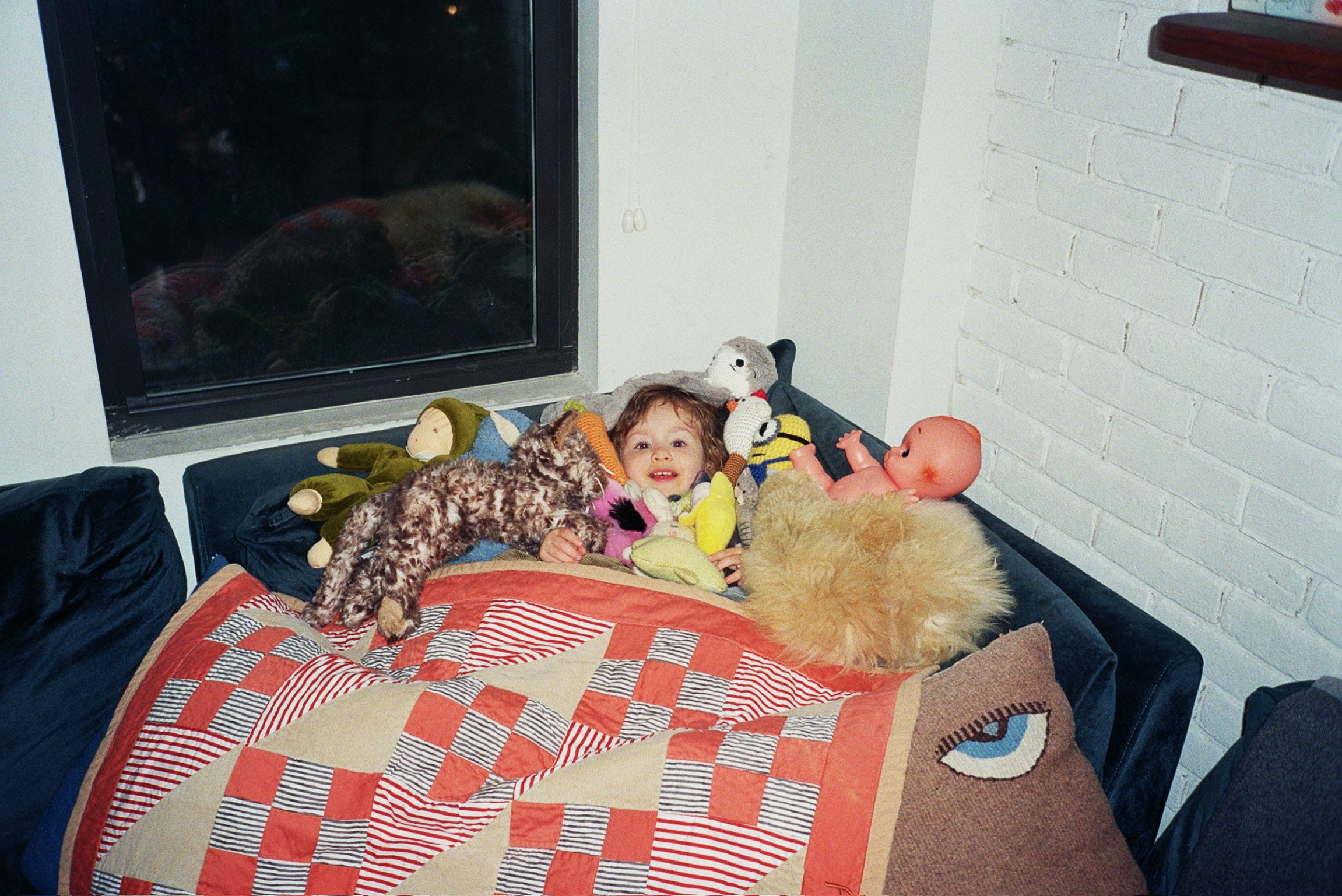
Most nights around 9pm, Avi and I are putting the living room back together: collecting tumbleweeds of pipe cleaners, returning figurines to baskets, throwing errant pillows back on the couch. Sunny is sound asleep by this time, having bid her mess a happy farewell 30 minutes prior. Whenever we make note of this arrangement, we laugh in surprise. Technically speaking, being Sunny’s toy custodians does not align with our parenting values. We want her to contribute to maintaining the house, treat her things with respect, and understand the symbiotic relationship between use and care. We’ve read multiple books and received endless tips on emphasizing these skills. And then we’ve ignored them.
If a few details were different, I might feel guilty about this, reason that we ought to get our shit together on this front, commit to a strategy, etc. I flirted with that position for a while, but eventually the lack of change stopped feeling like an accident. Avi and I are pretty meticulous about our parenting style—agreeing on precise words, precise tones, precise strategies for any given situation. Our boundaries are firm. So eventually I had to conclude our choice to let the mess slide was intentional in its own way, however unconscious. But if that was true, what was our reasoning? Given how exhaustively we discuss and stress other values and value housework ourselves, why weren’t we emphasizing tidiness with Sunny? It’s been fun to be curious about this choice rather than judgemental, like I’m conducting an investigation into our psyches.
In economics, there’s a concept known as “revealed preference,” which is the idea that a consumer’s behavior is a lot more telling than their stated preferences. That is to say, preferences are more reliably revealed than proclaimed. Consumers say they want one thing; buy another. There are plenty of ways this can be applied to everyday life. We say we want to go to the gym then avoid it, we say we want to read more theory then pick up another buzzy novel (completely random examples that don’t apply to me…). I’ve been drawn to this concept ever since I heard it. It seems obvious and utterly human, and yet, most of us continue to operate as if our thoughts and opinions determine who we are. When our behavior diverges, it’s an oversight, a mistake. Hypocrisy!
I’ve been thinking of our tidying “oversight” as a kind of revealed value. We may say we care about Sunny learning to clean up her toys, but when measured against other values we emphasize—curiosity, kindness, patience, respect, attunement—we actually don’t care that much. To be fair, we do encourage her to tidy throughout the day and she “helps” a lot around the house, but we’d rather end her night by reading her books on the couch, surrounded by chaos, than marching her through a reorg. When I think more deeply about this choice, a value emerges. I don’t think every day needs to end in perfect order; I don’t want her to believe connection and relaxation must be earned through compliance—two of my own preoccupations I resent. (Also, she’s a toddler. It’s just not that serious yet.)
What I find compelling about this value is that I became aware of it through observing my own behavior rather than through a conscious decision-making process. I assume most of us think of our values as something we thoughtfully choose or willingly inherit. But as with revealed preferences, I suspect many of our values are lived out beneath our awareness, only to be uncovered through self-observation. And I’m not just talking about values in the principled or political sense (I value hard work; I value sustainability), but something softer: the things we can’t help but care about; how we want to be, feel, live; the ways of operating we’re drawn to almost involuntarily, that resist our attempts at redirection.
When I was discussing this idea with my friend and editor Mallory Rice, she told me that one of her revealed values is her affinity for editing. For years, she identified primarily as a writer (which she is, and a good one), but she’s come to see this as somewhat in conflict with reality. In fact, she spends most of her time and attention on editing, and not just because it pays the bills, but because her energy naturally channels that way, leading her to commit again and again to editing over the odd writing assignment. While she could see this as a betrayal of her writing practice, she instead sees it as a kind of revelation: Her reverence for creative collaboration is equal to or greater than her desire for authorship. Some part of her knew this before her thoughts did.
Obviously we can betray our stated values for other reasons than secret inner truths. We can feel stressed and take shortcuts, be low on choices or resources, plainly fuck up, be avoidant or neurotic or otherwise unwell, and as a result fail to live the way we actually want. Sometimes our stated values genuinely do align better with our characters than our behaviors. But just as often I think the opposite is true, and not just in the gotcha sense. I think there’s a lot to be gleaned from our actions, our pleasures, our impulses. From the trade-offs we make again and again, despite our attempts to trade otherwise. If we say one thing about ourselves but continually do another, maybe the more interesting pivot than course-correcting our behavior or living in shame, is to say something different about ourselves, and accept that we already are.
Endless self-policing is certainly an option, but aside from being an unappealing way to live, I wonder if it can foreclose on more useful insights. When I noticed how little we stress cleaning up with our kid, it wasn’t just a relief to eschew judgement in favor of curiosity, it was the far more productive approach. Yes, we value cleaning up, but what else do we value more? There was something there we weren’t seeing; something true about us that we’d never noticed. Of course, if we had been betraying ourselves, that question would have led us there, too. Insight was the reward either way, curiosity was just a softer route there.
The density of parenting—hundreds of decisions made every day—is what allowed me to approach the observation this way. Regarding the verdict that we were being lazy, I simply had too much evidence to the contrary. Values are revealed through accumulation and repetition; at a certain point, they can’t be denied. This must be one of the upsides of aging: our choices rack up and offer us a different story than the one we’ve been telling for years. As young people, our stated values are our only compass. I care about this therefore I ought to do it. Later, this can invert. I do this a lot therefore I must care about it. I appreciate this inversion of the neurotic insistence that we’re intellectually in charge of who we are and what we do. I like the idea that rather than choosing who I am or what I value, I can encounter it instead.

Last Friday’s 15 things included the winner of my eye mask debate, two YouTube essays I took notes on, my new favorite IG account, and more.
The rec of the week was RAINCOATS.
On Wednesday, Dear Danny is back!
Hope you have a nice Sunday,
Haley
No posts
Comments
Nothing yet. Say the first thing.
Sign in to join the conversation.