
[This is currently work in progress and being implemented - There will be updates]
At Y42, we strive to reduce the number of meetings that we have in order for everyone to be able to use their time effectively.
However, in a world of collaboration certain meetings are not avoidable. The meetings that are necessary should be catalysts for information sharing, accountability and creativity. However, instead of creating many different ad-hoc meetings in places where an asynchronous alignment is not possible, we decided to put a structure in place that solves for:
Deduplication: Discussing topics only once (and documenting decisions)
Specificity: Clarifying which people are needed for any decision
Documentation: All Agenda Items are protocolled and attendance is not mandatory.
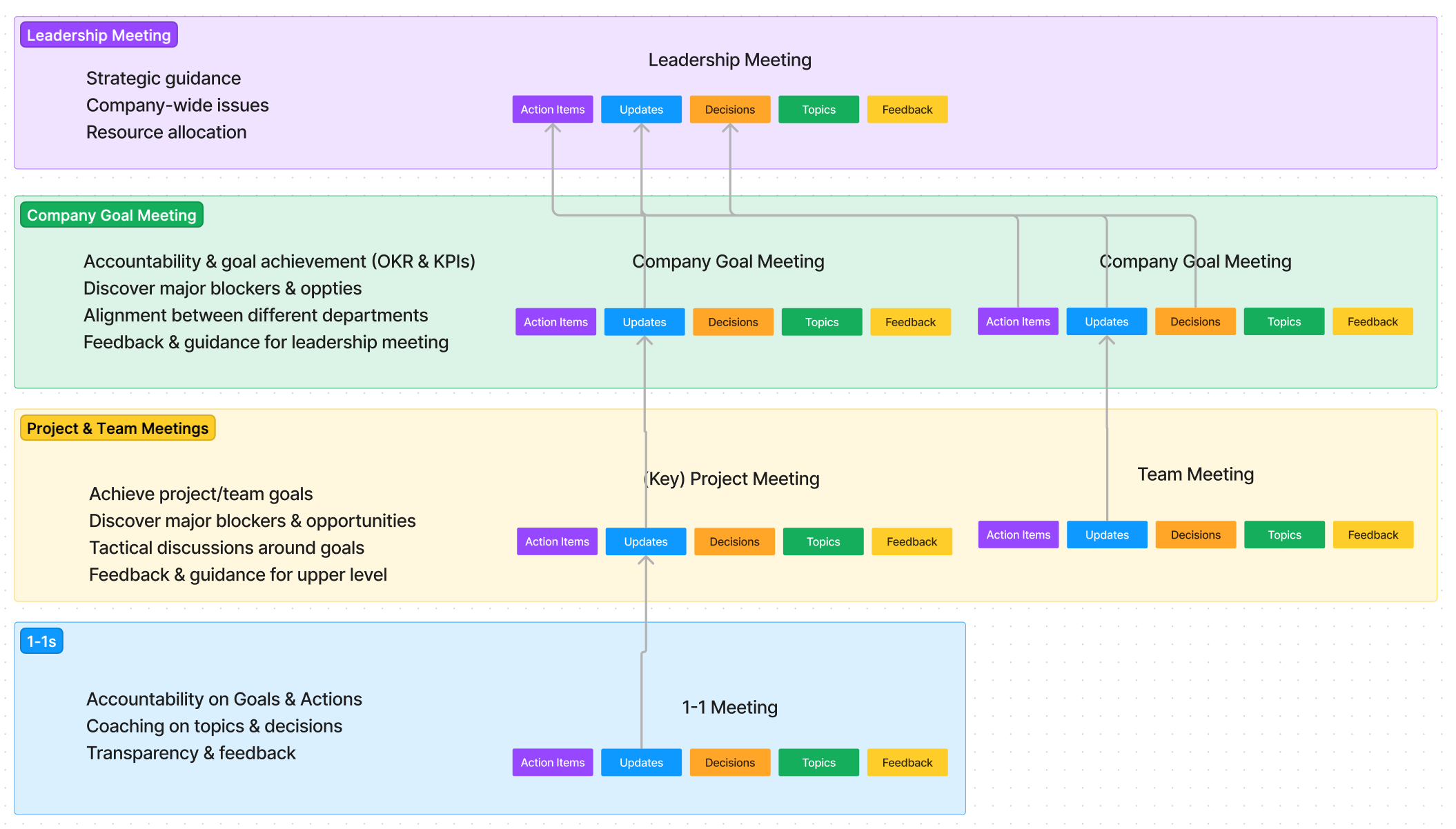
The meeting structure is built like a pyramid, from many “on the ground meetings” to the leadership meeting at the top.
Information flows from “on the ground” to the decision making circles in an aggregated form
Clarifications flow from top to bottom after all important information has been processed
In practice, we use ClickUp tickets to async communicate information between different meetings.
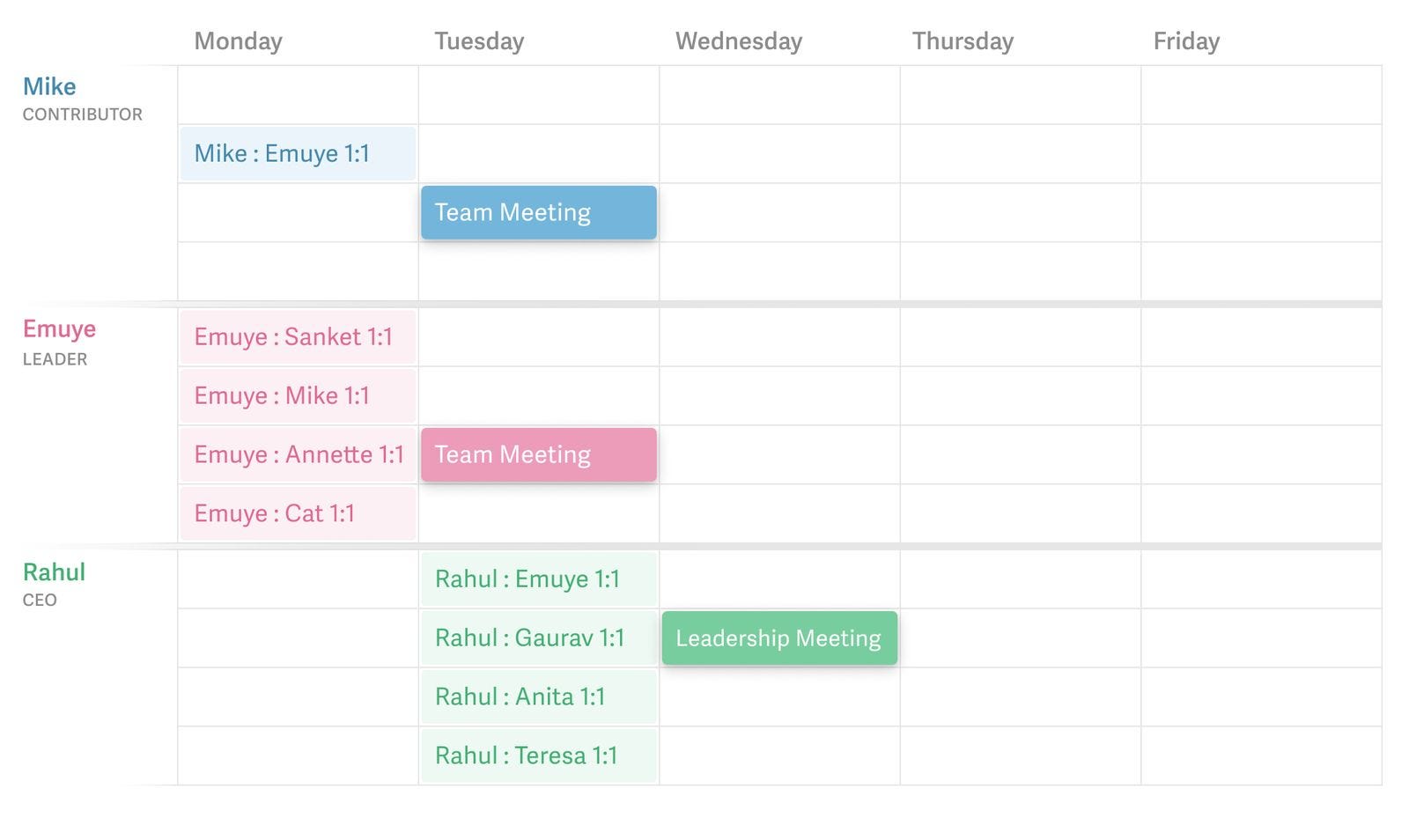
Using a staggered calendar (see illustration) optimizes for the pyramid-like information structure of the meetings so that topics that are raised do not have to wait longer than a week.
Meeting where the leadership team meets to discuss company wide topics and priorities.
Strategic Guidance
Company-Wide Issues
Resource allocation
Meeting where the operators of the company meet to discuss how to achieve key goals and objectives within the company.
Accountability & goal achievement (OKR & KPIs)
Discover major blockers & opportunities
Alignment between different departments
Feedback & guidance for Leadership Meeting
Achieve Project/Team Goals
Discover major blockers & opportunities
Tactical Discussions
Accountability on Goals & Actions
Coaching on topics & decisions
Transparency & feedback
Reasons for using ClickUp:
Better accountability across the organization
Easier global prioritization
Much better accountability on agreed Action Items
Everything is traceable
Finally transparency
You don't have to attend meetings as “FYI” but can easily see action items & decisions
Roll up all action items/decisions across team, department, company
More buy-in from every person due to visibility into everyones effort
Enables highly structured communication
Structured meetings with clear boundaries, agendas
Interchangeable data format (same data structure across different meetings)
Clear flow on how to escalate decisions (from 1-1 to leadership)
Deduplication of information (using ClickUp references)
Downsides to be aware of:
It’s a heavy structure with some onboarding required
People may not “work this way”
It requires a device to be part of the meeting
No posts
Comments
Nothing yet. Say the first thing.
Sign in to join the conversation.