
Prince, admittedly, said “life.” But Prince never had to implement a whole-school teaching and learning priority.
Now, one of the less-advertised facts of life is that women of a certain age can find themselves wide awake at 3am, courtesy of menopause, replaying an argument they had when they were eight: “I should have told Claire that it was MY skipping rope. Why didn’t I say that? God, she was insufferable.”
Apparently, this is what other women do.
I, being an education nerd, lie awake thinking about implementation. Which is objectively worse. At 3.17am, while sensible people are asleep and other menopausal women are finally composing the devastating comeback they should have delivered to Claire in 1983, I am thinking:
“Why do we assume that because we’ve told people something, they understand it?”
“What actually happens to an idea as it travels from SLT, through middle leaders, into classrooms?”
And why, six months after an INSET session on responsive teaching, has the entire thing somehow become “everyone must always only use mini-whiteboards”?
Welcome to my brain.
Recently, my nocturnal education nerdery has kept circling around four things:
quality assurance
mental models
implementation
middle leadership
Because I’m increasingly convinced they’re not four separate things at all. And, inconveniently, this means I think we might need to rethink what school QA is actually for.
I think this starts with a look at some of the biggest implementation mistakes I have seen in my two decades of school work…an exploration I have playfully termed ‘50 shades of implementation.’
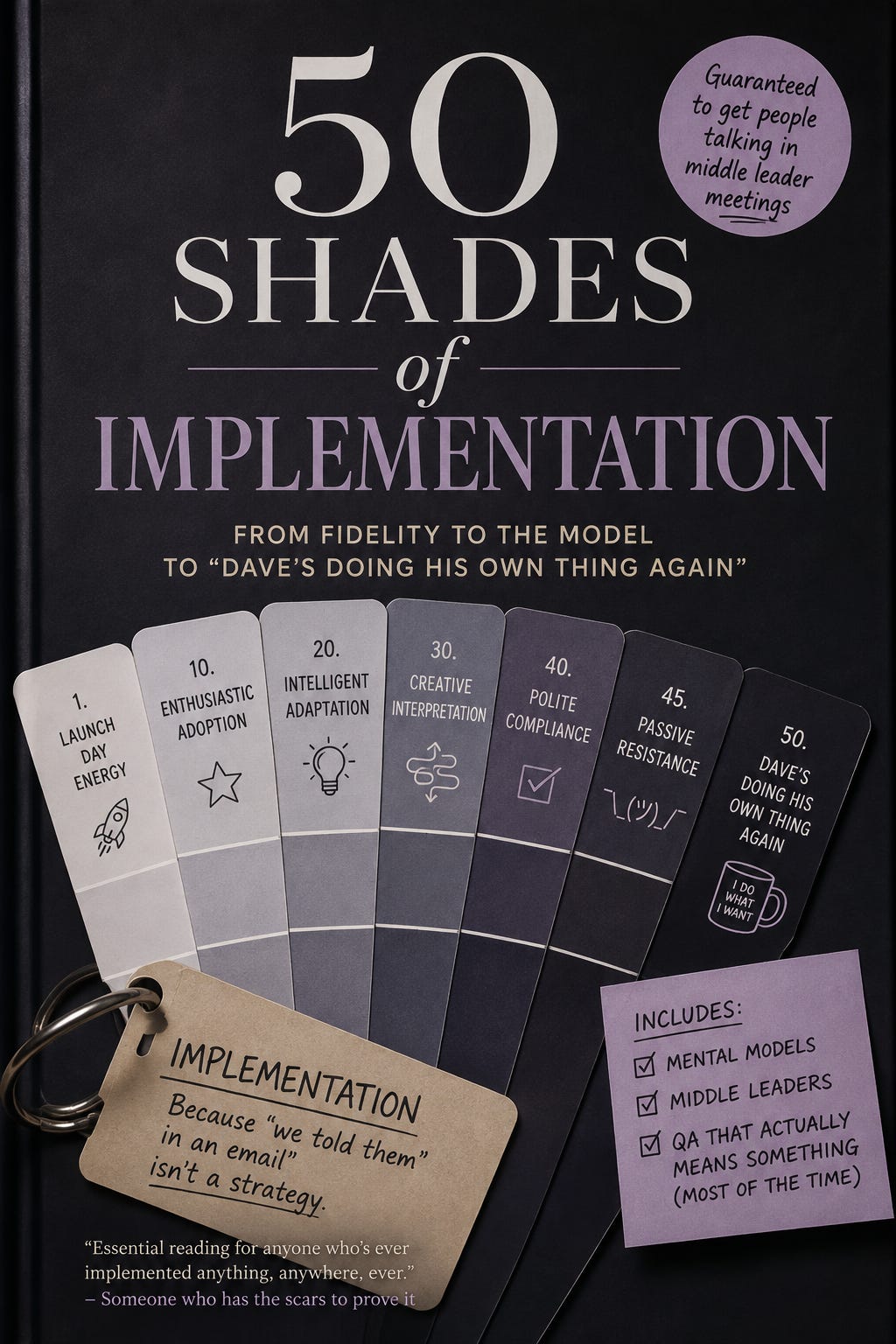
Fifty Shades of Implementation: involving fidelity, adaptation, resistance and, occasionally, a safe word. Usually ‘Ofsted’.
The 12 most common implementation mistakes I have witnessed and been guilty of fall roughly into the following categories:
The photocopier model of implementation: Senior leadership puts a beautifully crisp idea into the machine. By the time it has passed through six meetings, three PowerPoints and a departmental briefing, everyone is holding a slightly grey version with one corner missing.
“We’ve told them” ≠ implementation: “It was on slide 47 of the September INSET PowerPoint” is perhaps not the robust implementation strategy we thought it was.
QA Schrödinger’s classroom: A teaching strategy can simultaneously be embedded and not embedded until somebody announces a learning walk.
The learning-walk miracle: “Remarkably, use of mini-whiteboards increased by 600% during the 40 minutes in which senior leaders were walking around carrying clipboards.”
Implementation archaeology: Sometimes QA feels less like quality assurance and more like digging through layers of abandoned initiatives. “Ah yes, beneath the retrieval-practice sediment we appear to have discovered a rich seam of 2019 growth mindset.”
The mental-model problem: “We thought we had achieved alignment because everyone was using the same vocabulary. Unfortunately, they were using the same words to describe six different things.”
Middle leaders as translators: “The middle leader’s job is sometimes to translate from SLT into English, and then from English into something that will survive contact with Year 9 on a wet Thursday.”
Fidelity versus adaptation: “There is a fine line between intelligent adaptation and ‘Dave has decided not to do it.’”
QA as diagnosis: “If your only diagnostic category is ‘they need reminding’, every implementation problem starts to look suspiciously like an email.”
The implementation email: “Nothing says sustainable behaviour change quite like an email beginning, ‘Just a reminder that, as discussed during INSET…’”
Middle-leader training: “We occasionally train middle leaders for one of the most intellectually demanding jobs in the school by giving them a folder, adding them to another meeting and wishing them all the best.”
The ultimate implementation metric: “The real test of whether something is embedded isn’t whether people do it during a learning walk. It’s whether they still do it in February, period 5, when the Wi-Fi has gone down.”
There is of course also the classic implementation drift:
SLT: “We want teachers to check what pupils have understood before moving on.”
Middle leader: “We’re focusing on checking for understanding.”
Department briefing: “We need to use more checks for understanding.”
Corridor conversation: “Apparently we have to use mini-whiteboards.”
Three weeks later: “SLT are obsessed with whiteboards.”
This is the physical manifestation of a mental model becoming progressively simplified as it travels through the organisation.
So, what is the alternative then? Well, it goes back to the interconnectedness of those four ideas I mentioned earlier: school QA, mental models, implementation science and skilling up middle leaders to be the engine of school improvement.
The important point is that QA is not merely checking whether people are doing the right things. Done well, it reveals how people understand the work, which determines how successfully they implement it.
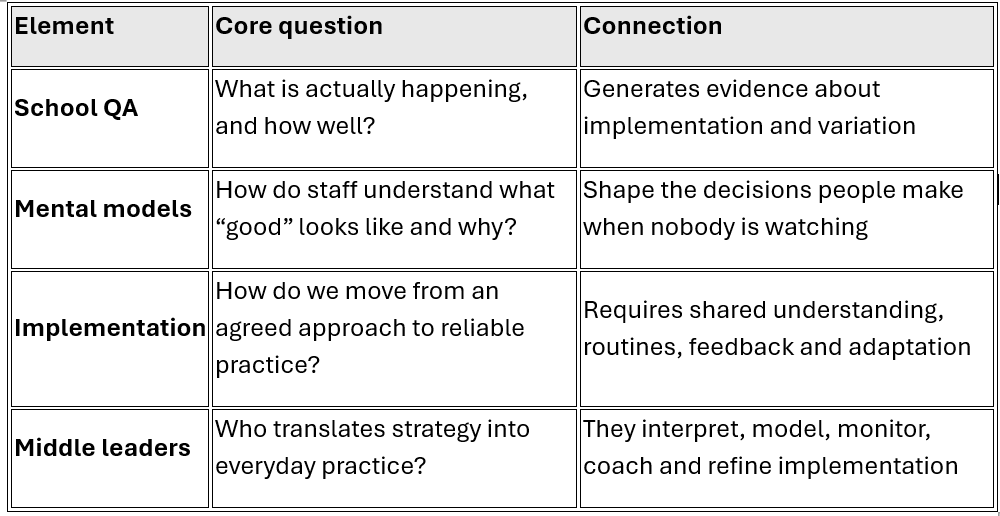
Let’s unpick this table a little bit.
QA can diagnose mental models, not just performance
Suppose a school has agreed that effective checking for understanding is a teaching priority. A conventional QA process might ask: “Are teachers checking for understanding?” But actually, a more powerful process asks: “What do teachers and leaders think checking for understanding is for, and what evidence are they using to decide whether it is working?” This is because two teachers might perform superficially similar routines while operating from very different mental models. One may think, “I need to demonstrate this technique during an observation.” Another may think, “I need information about what pupils understand so I can decide what to do next.” This is important because the second mental model is much more likely to produce intelligent adaptation than the first, which just becomes technique theatre.
So QA should uncover not only practice, but the thinking generating that practice.
Mental models are a hidden implementation variable
Implementation often fails despite apparently good training because leaders assume that communicating a strategy produces a shared understanding of it. Of course it doesn’t and for me you can think of implementation roughly as:
Intended model → interpreted model → enacted practice → pupil experience
The gaps between those stages are critical because senior leaders might have a sophisticated mental model of a new approach, which is then interpreted slightly differently by every middle leader. This results in teachers receiving different explanations from different middle leaders, who then combine those explanations with their existing beliefs and habits. By the time the strategy reaches pupils, considerable implementation drift can have occurred. That means one purpose of QA is to identify the gaps between the intended, interpreted and enacted models.
This makes middle leaders pivotal
Middle leaders sit at the translation point between organisational intention and classroom reality. They aren’t simply conduits carrying messages from senior leaders to teachers, as they are continually make judgments such as:
What does this priority mean in my subject/phase?
What is essential and what can legitimately vary?
What should I look for when visiting classrooms?
Is this teacher struggling with knowledge, skill, motivation or opportunity?
Does variation represent intelligent adaptation or implementation drift?
What feedback or development will improve practice?
Those judgments depend on the middle leader’s mental model of implementation also, which is why only training middle leaders in QA activities such as learning walks, book looks, data conversations, observation protocols etc. is insufficient. You can make someone highly proficient at collecting evidence without making them good at interpreting it.
QA should therefore become part of implementation
Rather than:
Training → implementation → QA at the end
a stronger process is:
Define → train → enact → QA → diagnose → develop/adapt → enact again
For example, if QA finds that a new practice is inconsistent, the immediate conclusion shouldn’t necessarily be “teachers aren’t doing it.” Middle leaders could diagnose several possibilities:
Knowledge: Do people know what to do?
Understanding: Do they understand why and when to do it?
Skill: Can they actually do it?
Beliefs/mental models: Does the new practice conflict with how they currently understand teaching?
Environment: Do routines, curriculum, workload or systems make the behaviour difficult?
Implementation design: Is the approach itself unclear or unrealistic?
Those diagnoses lead to completely different leadership responses.
This creates a strong case for designing middle-leader development around mental-model formation, rather than simply giving leaders a collection of leadership techniques. For instance, give several middle leaders the same classroom evidence and ask:
“What do you think is happening here? What evidence supports that interpretation? What else would you need to know? What would you do next?”
Their answers reveal their mental models, which can then be supplemented and developed through contrasting cases, discussion, worked examples, deliberate practice and feedback to develop increasingly sophisticated shared models of:
what good looks like → why it works → what evidence matters → what legitimate variation looks like → how to diagnose problems → what leadership response follows.
QA then becomes an opportunity for middle leaders to repeatedly test and refine those models against reality.
The deeper connection
Ultimately, all four of these concepts concern the same problem:
How does a school create shared understanding that produces increasingly reliable, context-sensitive professional judgement?
Senior leaders cannot directly control thousands of decisions made every day. As I have blogged about many times, policies and checklists can create surface compliance, but they cannot specify the correct response to every situation. Instead, the more scalable approach is to develop shared, accurate mental models among the people making those decisions. This is not quick work but it is the deep work that underpins real school improvement.
No posts
Comments
Nothing yet. Say the first thing.
Sign in to join the conversation.