
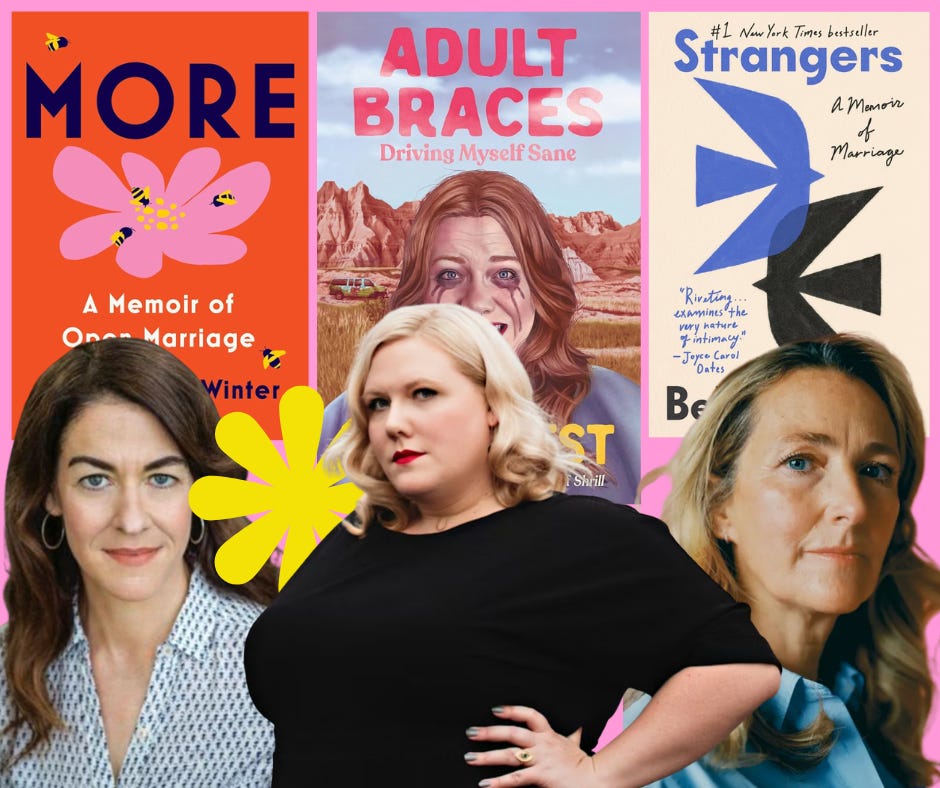
What greater warmth is found than from the flames of a white woman’s burning marriage? The marriage doesn’t even need to end for us to make snow angels in its ashes. We’re not intruders. She’s invited us into the fire by way of a novel, an essay, a memoir. Like moths, we flock to read it.1
In 2024, that marriage was Molly Roden Winter’s, the author of More: A Memoir of Open Marriage. Winter was a virtual unknown, but her story alone catapulted nonmonogamy into the zeitgeist. Even in a media landscape atrophied by layoffs, it was reviewed in The Washington Post, The Atlantic, The New Yorker. She and her husband were even guests on the NPR show I work for. The book became a New York Times bestseller, a rare and charmed outcome for a debut author.
Earlier this year, the marriage story we swarmed to was Belle Burden’s: Babe Paley’s granddaughter and author of Strangers: A Memoir of Marriage (There’s a pattern even to the titling of the books in this genre). The memoir traces the decline of Burden’s twenty-year marriage after her husband suddenly walked out on her. An instant New York Times bestseller.
Lindy West is now the white woman whose marriage has inflamed the internet for weeks. Her memoir Adult Braces: Driving Myself Sane, was released last month to manic debate. It documents West’s cross-country road trip as she reckons with the fallout of fame from her years as a feminist icon and battles depression. But the frenzied reaction around the book is not about those themes: it’s about her open marriage, particularly the way her spouse behaved inside of it.
I’m not here to litigate the content or merit of West’s book or the others. I’m here to talk about the space these stories claim in our cultural terrain, the way they dominate discourse. I’m naming a phenomenon that, year after year, holds true. West is famous (And Burden, wealthy), but still the equation feels infallible: White woman + bad marriage + nonmonogamy (or infidelity or both) = the book everyone’s talking about.
It’s practically the fate of every big book that contains a nonmonogamous thread to invoke the polyamorous equivalent of gay panic in the media: Polyamory Isn’t Progressive, cries The Wall Street Journal. Say It With Me Now: Open Marriages Never Work, shouts The Free Press. Don’t Tell The Internet You’re Polyamorous, chuckles The New Statesman. Love Is Never Having To Say You’re Polyamorous, squawks The Times. I’m all for people living as their ‘authentic selves.’ I just don’t think we need progressives trying to convince us that polyamory is normal, whines this weird subtitle to a USA Today opinion piece.
I don’t know, guys, it feels like some of these calls are coming from inside the house. But I’m here to assure you that nobody wants your husband with his crossed-out face on Feeld.
In the case of Winter’s memoir, many of the headlines sound like jokes, like satire: How a Polyamorous Mom Had ‘a Big Sexual Adventure’ and Found Herself or The English Teacher Who’s Become the Face of Polyamory or Is This The End of Monogamy? (penned by Winter herself for Elle UK).
The question that’s asked every time a book about nonmonogamy is published to any fanfare is the least interesting one: But does it actually work?
Haven’t we run that inquiry ragged? Jean Garnett, who wrote the only white-woman-open-marriage-story I recognize for The Paris Review, said after her divorce:
“…A newspaper editor got in touch with me asking if I would care to join the buzzy conversation around West End Girl [Lily Allen’s album] by spitting out a thousand words on “why open marriage doesn’t work.” I did not care to; I do not see open marriage as an unworkable model—certainly no more so than monogamous marriage.”
A new formula emerges: one ‘failed’ marriage + nonmonogamy = parade of polyamory hit pieces.
Every time we ask the same tired questions, we prevent the discussion from becoming something deeper. What we should be asking instead is why we’ve pinned our entire understanding of this sprawling and splintered identity on a few books by white women? Why do their stories have the power to force an entire romantic paradigm into question when millions of bad monogamous marriages get to simply be that: bad?
The backlash to West’s partner, Aham Oluo, has been loud. Oluo cheated on West with at least two women.2 Her consent to ENM, at least in the beginning, is murky. Oluo claimed West did not grasp concepts of ownership the way they did because they’re Black and West is white (note the lack of articles saying interracial marriages never work—y’all not brave enough to go there)3. The memoir ends with West in a throuple with one of the girlfriends Oluo was seeing behind West’s back. They all share a home. Most nights, West allegedly sleeps in the guest room where she can hear the other two having sex. West says she’s happy. We can’t know if this is true. We only know Oluo’s actions are heinous to many of us, and West’s inability to see them as such is unsettling.
But all that has nothing to do with some inherent evil lurking around the corner of every nonmonogamous relationship. The awkward framing of West’s memoir as polyamous self-discovery journey, as subversive feminist character arc, reminds me of another book I wrote about. Liars by Sarah Manguso (reviewed in the LA Times, The New Yorker, NPR, The Guardian) is about a terrible marriage and a white woman with means who cannot manage to leave it. The husband cheats, cusses at her, cannot keep a job, leaves the room while she’s speaking to him. The novel is positioned as a feminist send-up of heterosexual marriage which Manguso has argued is simply a ‘bad choice’ “We are impelled to make.”
In Liars, the husband ultimately leaves the wife after sixteen years for another woman. She doesn’t exert agency to extricate herself from him. The heroine, Jane, is cast as the everywoman (hence their vanilla names Jane and John—your average couple). She’s a professor, a writer, living in the US in the 2010s. I always think of NYTs book critic Parul Sehgal’s response to Manguso’s claim that this kind of marriage is inevitable for most women, that heterosexual marriage is, in a way, fundamentally an unconsensual act because we are so socialized to perform it: “As the product of generations of arranged marriages, a number of them coerced,” Sehgal, who’s Indian-American, writes, “I find that such claims feel strange, if not obscene.” As a descendent of enslaved women, I have to agree: I don’t really want to hear about a white upper-middle class woman in the 21st century acting like she doesn’t have any choices. Manguso is telling one story. Sehgal is telling another. Imagine a world in which we hear only Manguso’s.
My position is a weird one, riddled with conflicts of interests: I identified as polyamorous for years but am not sure if I want to keep practicing.4 I wrote a Modern Love essay about my decision to break up with my boyfriend and pursue solo polyamory. In it, I mis-defined terms, I sounded wiser than I was, I fucked up as people who stumble into being spokespeople for an entire community do. I was hated on the internet for a while, not nearly on the scale of West, but enough for others in my life to notice. I am a steward of stumbling over yourself in public, trying to make your decisions legible to others while they remain illegible to you. Stories are mirrors of ourselves, portals to other people and places, yes, but they can also have a distorting effect; they are not neutral.
My own book, They All Fall In Love At The End, is coming out in June; it’s a novel about a young Black woman tripping through an open relationship, falling for all the wrong people, trying to write herself a happy ending. Why else would I write this piece if I didn’t have a forthcoming book? This is how you handle an atrophying media landscape, you slip in when there’s an opening. And so I’m calling out the glut of white women marriage and nonmonogamy books at the same time I’m piggybacking off of their success like a flea clinging to the back of a dog. The glut, anyway, is an illusion: there are exponentially more books about monogamy. Those searching for nonmonogamous stories are still trekking across a narrative desert. Where are the ones involving relationships between non-white people? Where the woman instigates opening the relationship? Where polyamory is something one is, not only something one does? Not an antagonist or answer to monogamy, but simply a different logic? Where it’s not that big of a fucking deal when it gets released into the world, just another story?
The canon of nonmonogamous stories is still too spare and therefore the discourse stays stuck, endlessly orbiting the worlds of white married women.
The bad ones stick up like thumbtacks. The rope is too thin, we’re hanging too much on it. No wonder it’s falling down.
My mom pointed out to me that because there’s more white women than Black or other women in the US, to most people, their marriage stories AREN’T white women marriage stories, they’re simply marriage stories. But like, I don’t have a man, I don’t even have a dishwasher, their lives feel so fucking far from mine
Some people debate whether this was cheating or not….I’m not about to get into that lol we do know West was blindsided and upset when she found out
And I’m not saying anyone SHOULD go there! I’m highlighting the ridiculousness of it
Not bc it’s bad!! but bc I do what I feel like loll
No posts
Comments
Nothing yet. Say the first thing.
Sign in to join the conversation.