
This essay is co-authored with EUGENIO BELTRAN, a renowned dental public health specialist, epidemiologist, and former senior leader at the U.S. Centers for Disease Control and Prevention (CDC) and the American Dental Association. He has spent more than three decades advancing oral health surveillance, prevention, and policy across the Americas and globally, including through extensive collaboration with the Pan American Health Organization and the World Health Organization. A former Co-Director of the WHO Collaborating Center at NYU College of Dentistry, he has helped shape many of the public health approaches that underpin contemporary oral health policy and practice.
There is a sentence that ends thousands of scientific papers. I read it. You read it. Most of us have written it.
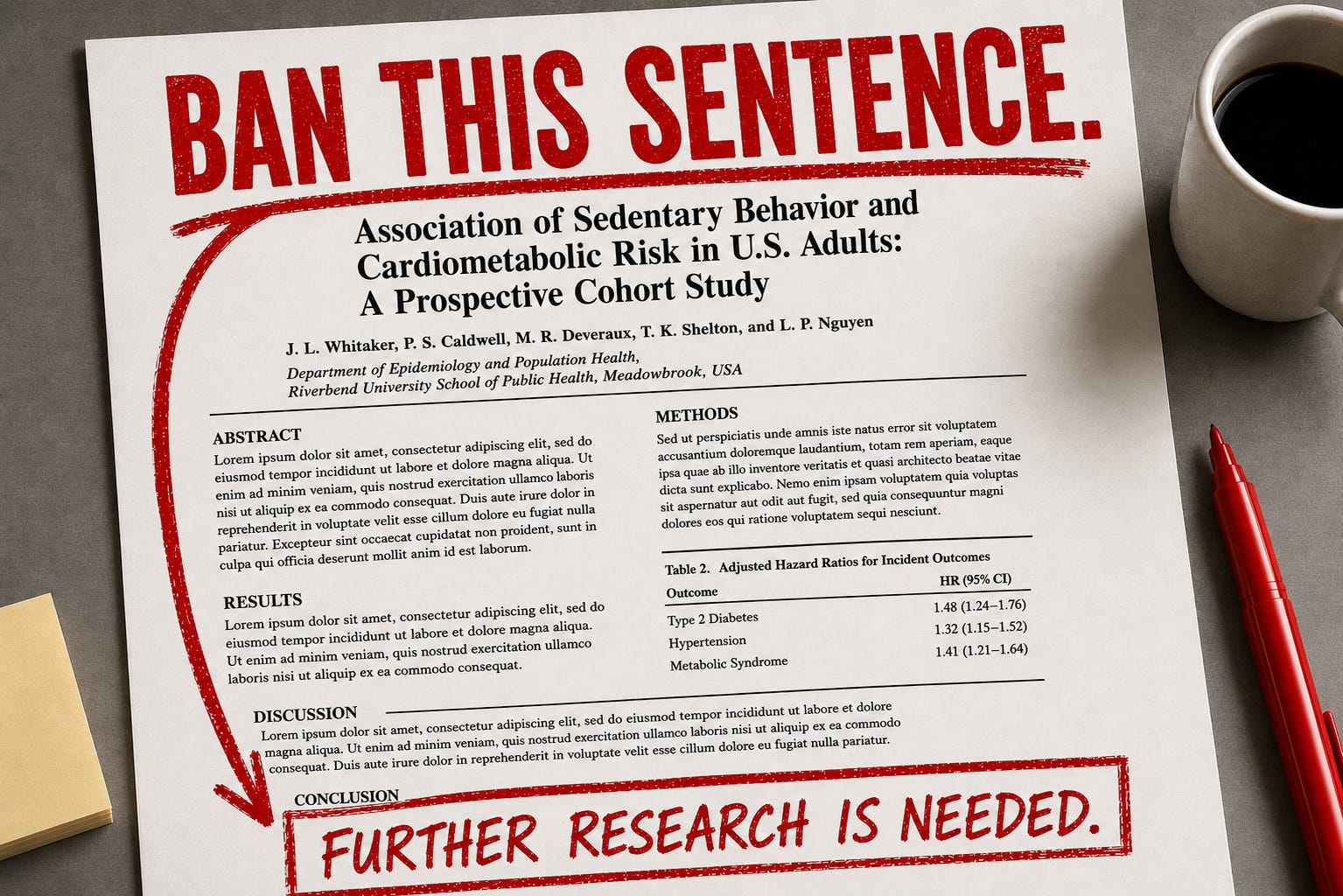
Further research is needed to fully understand…
More evidence is required before firm conclusions can be drawn.
Future studies should explore…
It is the academic equivalent of leaving the room just when the difficult conversation is about to begin. And perhaps journals should stop accepting it.
Not because more research is never needed. Of course it is. More research is almost always needed. That is precisely the problem. As a conclusion, the sentence says almost nothing. It is not a finding, not a recommendation, not even a useful statement of uncertainty. It is a ritual. And rituals matter because they tell us what a profession considers safe, respectable, and legitimate.
In public health, this ritual has taught generations of authors that the safest way to end a paper is not to say what follows from the evidence, but to defer the burden to someone else, somewhere else, sometime later. The study finds an association between commercial determinants and disease: further research is needed. The review shows that an intervention works but is not implemented at scale: further research is needed. The data reveal a pattern of avoidable suffering among poor and excluded communities: further research is needed.
The sentence has become so normal that we barely see what it does. It turns evidence into prelude. It cushions the force of a finding. It converts a possible obligation into a question for the next grant cycle. It sounds careful. Often, it is a retreat.
That word may feel mild. But consider what the sentence frequently performs. An author spends years studying a problem. The evidence is imperfect, but meaningful. The direction is clear. The implications are uncomfortable. Someone should regulate, fund, stop selling, stop neglecting, stop pretending not to know. And then the final paragraph retreats into the safety of incompleteness: more research is needed.
What the sentence often means is this: the evidence is strong enough to publish, but not strong enough for me to say who should act.
That is not humility. Humility would be specific. It would say: this is what we know; this is what we do not know; this is what the current evidence already justifies; this is what remains genuinely uncertain. Humility does not require silence about consequences.
There is a deeper fiction beneath all of this: the idea that science is only an observer. A study does not simply report a problem. It frames it. A burden estimate does not simply describe suffering. It ranks it. A conclusion does not simply close a paper. It tells the reader whether the evidence has consequences.
So when scientists say “further research is needed,” they are not neutrally stepping aside. They are making a choice about responsibility. They are deciding that the safest public position is to describe the world without clarifying what the description demands.
There is a difference between making policy and making evidence consequential. There is a difference between advocacy and responsibility. There is a difference between overclaiming and refusing to say what the evidence already supports.
“More research is needed” allows the author to avoid the discomfort of interpretation while still appearing rigorous. But in public health, the world outside the paper is the whole point.
Some journals now require authors to state what was known before the study, what the study adds, and what the implications are for research, policy, or practice. These sections matter. They acknowledge, implicitly, that evidence does not speak for itself.
But too often they become another genre of compliance. Authors learn the format. Reviewers check that the box exists. Editors move on. Consequence has been proceduralized. We ask authors to declare relevance but not to confront obligation. We ask what the study adds to the literature, but less often what it demands of the world.
There is another reason the sentence survives: it fits the reward structure of academia almost perfectly. Academic careers are not built on saying “we know enough.” They are built on the next paper, the next grant, the next unanswered question. A conclusion that says “this evidence is sufficient to act” may be useful to the world, but it is less useful to the evidence production system that opens another funding cycle.
The result is a precise double movement. Papers must matter enough to publish, with claims sharpened, novelty emphasized, implications extracted. But they must also end with appropriate caution: limitations, caveats, the familiar call for more. Significance in the body, safety in the conclusion. Everyone is protected. Nothing is resolved.
This is why the sentence is so hard to ban. It is not merely bad writing. It is a small gear in a much larger machine, one that keeps the literature moving, the grants flowing, the careers advancing, and uncertainty productively alive.
This does not mean that researchers are cynical. Most are trying to be careful, to survive peer review, to keep their teams employed, to stay inside the boundaries of what the academy rewards. But systems do not need bad intentions to produce bad habits. A weak conclusion does not stay inside the journal. It travels. It is read by policymakers, funders, professional bodies, guideline committees, and ministries looking for permission to move or permission to wait.
This matters especially in global health, where evidence is often produced from the lives of people who have the least power over what happens next. Their suffering becomes data. Their deprivation becomes a table. Their exclusion becomes a p-value. And then the paper concludes that further research is needed.
Scientific publishing is full of rules: word limits, reporting guidelines, conflict-of-interest statements, ethics approvals, data availability, CONSORT, PRISMA, GRADE. So why not one more? A journal could simply say: conclusions may not end with a generic call for more research. Not because every paper must become a manifesto. But because evidence does not become neutral by refusing to interpret itself.
If authors want to call for further studies, they should have to answer four questions. What specific research is needed? Who needs to do it? What decision does the current evidence already support? And what are the consequences of not acting while we wait?
That last question changes everything. It forces science to account not only for the risks of premature action, but also for the risks of endless deferral. It reminds us that inaction is not the absence of a decision. It is a decision made on behalf of the status quo.
The real problem in public health is rarely that we know nothing. It is that we know enough to act, but not enough to make everyone comfortable. The demand for perfect knowledge is never neutral. It benefits those who gain from delay. We are not short of papers. We are short of translation. We are short of courage. We are short of institutions willing to connect knowledge to obligation.
The final sentence of a paper is not a small thing. It is where evidence either enters the world or retreats from it. For too long, we have treated the conclusion as a place to perform caution. We should treat it as a place to clarify responsibility.
So yes, more research is needed. It always is. Sometimes that sentence is humility. Sometimes it is precision. But too often, it is the polite grammar of delay, the soft landing of weak findings, and the fuel of academic machinery.
That is why we should stop letting it pass as neutral.
Comments
Nothing yet. Say the first thing.
Sign in to join the conversation.