
Pathfinder Reservoir sits southwest of Casper, Wyoming, feeding a canal system that irrigates more than 100,000 acres of farmland across eastern Wyoming and the Nebraska Panhandle. As of this week, it’s less than 24 percent full.
The district that depends on it, Pathfinder Irrigation District, told its customers this week it could run out of deliverable water by the first week of August. Not because of mismanagement. Because of a winter that simply didn’t deliver.
As of Thursday, Pathfinder Irrigation District had about 393,000 acre-feet of irrigation water remaining for the season. At the same point last year, the district had 676,900 acre-feet. That’s nearly half the cushion, in one year.
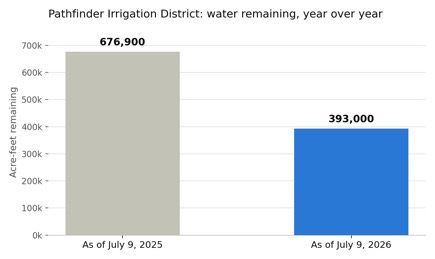
Source: Cowboy State Daily, July 9, 2026, citing Pathfinder Irrigation District and the U.S. Bureau of Reclamation.
The cause traces back to snowpack. George Finnegan, the North Platte water scheduler and a civil engineer with the Bureau of Reclamation, told Cowboy State Daily that peak snowpack in the upper North Platte Basin this past winter, which supplies roughly 75 percent of the river’s water, was the worst on record. Wyoming had its fifth-driest winter since statewide records began in 1895. About 45 percent of the state is currently in extreme drought.
Irrigation districts on this system normally start pulling water in April. This year, deliveries didn’t begin until June. There simply wasn’t enough runoff to justify starting earlier.
Here’s the detail worth sitting with if you work in this industry. The shortage isn’t only about how much water fell as snow. It’s about how much of what did fall is disappearing before it reaches a farm.
Months of dry weather left canal banks and the surrounding soil parched. When water finally moves through the system, a meaningful share of it seeps straight into the ground before reaching the end users. “That hungry ground, it takes up the water,” Finnegan said. Irrigation districts across the basin are pushing more water through their canals than usual just to deliver the same amount downstream.
That’s a physical, structural problem, not a rainfall problem, and it’s compounding on top of the drought rather than being caused by it. Every irrigation professional reading this has seen some version of this at smaller scale: infrastructure built for a wetter era loses efficiency exactly when efficiency matters most.
A June 8 storm caused seven canal breaches in the Pathfinder system, five of them major. Repair crews and equipment that should have been prepping canals ahead of the season got diverted to emergency fixes instead. On June 15, the district went as far as renting a water truck to help with canal repairs.
The Bureau of Reclamation has started sending Pathfinder and other North Platte districts weekly allocation letters, something that only happens in low-water years. Last year also triggered those letters, but districts still had carryover storage from wetter years to lean on. Finnegan’s assessment: “We’ve been kind of living off of that storage.” This year, that cushion is largely gone.
An annual “silt run,” a scheduled high-flow release designed to scour sediment through the system and reduce canal seepage, was set for this past Saturday. District officials were clear it will help, but won’t solve the underlying shortfall. They’ve also said they don’t favor borrowing water for the season, since borrowed water carries a high cost per acre-foot and has to be repaid before next year’s irrigation season even starts. That’s a district choosing not to mortgage next year to patch this one.
For now, the message to irrigators is blunt: conserve every drop, or the water could be gone in a few weeks.
This isn’t an isolated basin problem. Nebraska’s Platte River districts are dealing with their own version of the same year. Lake McConaughy, the state’s largest storage reservoir, entered the season at roughly 51 percent capacity, about 30 points below typical levels. Producers across the Panhandle are already having conversations about switching to lower-water crops like sorghum and millet in place of corn and sugar beets, and reviewing crop insurance and prevented-planting options before the water runs out on them instead of the other way around.
None of this is happening because anyone did anything wrong. It’s what a below-average snowpack year does when it lands on top of infrastructure that was already carrying more seepage loss than anyone wants to admit. That combination, aging delivery systems plus a thinner margin for error, is exactly the argument for the precision monitoring and efficiency investment this industry has been making for the last decade. The districts that can measure seepage, target repairs, and account for every acre-foot in near real time are the ones with the best shot at stretching what’s left of this year’s water. The ones still managing by rule of thumb are the ones most exposed.
Pathfinder’s situation is a preview, not an outlier. Watch this basin through August.
NQH2O: $297.97/acre-foot. The Nasdaq Veles California Water Index — the spot price of water entitlements traded on the CME, updated every Wednesday.

No posts
Comments
Nothing yet. Say the first thing.
Sign in to join the conversation.