
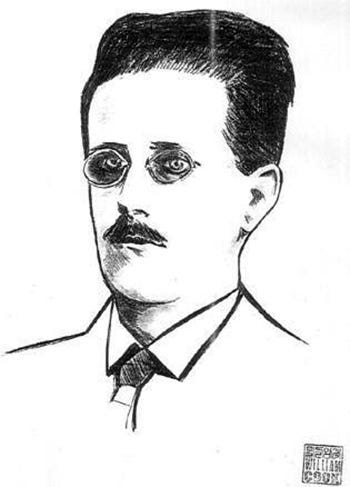
The narrative style of James Joyce’s A Portrait of the Artist as a Young Man involves the reader in the search for meaning. While there may seem to be no definable authorial presence on the surface, the narrator is the author's creation and speaks the language of modernism. Our understanding of Stephen’s character is more explicit and complicated because of the narrative style, which uses vivid stream-of-consciousness dialogue.
The apparent lack of “narrative cues” is what distinguishes Joyce’s novel as different to the standard format and narrative style of conventional fiction. This characteristically difficult mode of fiction is a common medium of modernist literature.
The difficulty of such a novel is that we (the reader & critic) have to read meaning by our own comprehension of the interior (and exterior) world of Stephen, with our own biases, beliefs, preconceptions, and experiences. The problem with this is explicitly emphasized by Wayne Booth in his essay on The Problem of Distance between author, character, and reader in Portrait:
Whatever intelligence Joyce postulates in his reader — let us assume the unlikely case of its being comparable to his own — will not be sufficient for precise inference of a pattern of judgements which is, after all, private to Joyce . . . many of the refinements he intended in his finished Portrait are, for most of us, permanently lost.[i]
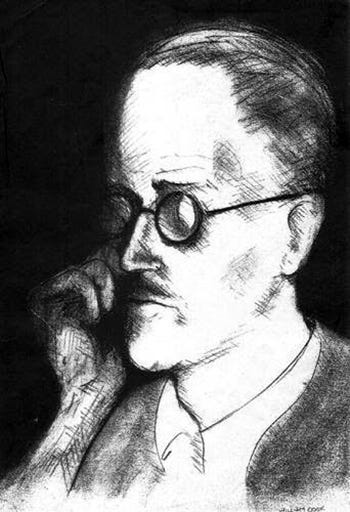
The language and words Joyce uses are not foreign to most literate English readers, yet the style and the complexity of the meaning of the prose are what make it difficult. Moreover, because we are effectively in the mind of the narrator, we also presume that meaning will come from within the language of his speech and thought.
This sense of anticipation preludes the reader’s understanding of what the meaning signifies to and within Stephen’s world. In other words, we expect to find meaning through the narrator, yet until we find our way through the labyrinth of allusion and metaphor that is Stephen’s narration, we can not begin to comprehend the state of his character’s consciousness.
Given how difficult it is to read, Portrait lends itself to many forms of criticism. Its difficulty has extended its critique beyond the realms of modernism into contemporary post-modern analysis and debate. The structural coherence of the narrative depends on the type of reading practised.
For instance, a psychoanalytical (or Freudian) reading would view Portrait as a densely coherent structural novel, given the narrator’s stream-of-consciousness dialogue and the psychological elements that dominate the text. Whereas a feminist critique would assume it was incoherent or misogynistic due to the negative or apparently disempowered portrayals of women in the novel. This reading is difficult because it is hard to prove whether or not Stephen is an autobiographical portrait of Joyce.
The ‘problem of distance’ makes it hard for critics to determine the author’s responsibility or involvement in his character’s beliefs and actions. It is also hard to determine whether his depictions of women are patriarchal and, therefore, negative representations according to feminist critique. The narrative's symbolic and metaphorical nature, and the effective transposition of the narrator’s psyche, make this work hard to distinguish from the author’s own mind.
Parallels between Joyce’s own upbringing and that of Stephen’s are undeniable, yet what separates the two is the genius of the text. As an exemplar of ‘Bildungsroman’ — the literary term used for a narrative that focuses on the psychological and moral growth of the protagonist from childhood to adulthood, by its very nature, Portrait is a work that lends itself to an autobiographical interpretation, despite it being a work of fiction.
By writing a complex and evocative work that seems to defy definition, Joyce effectively works the text so that the reader seeks meaning. This methodology effectively distances itself from criticism that lacks definitive judgments, given the difficulty of the text. While this elusiveness works well for Joyce and promotes criticism and ‘art for art’s sake’, it also generates a negative reaction because of the characteristic difficulty of Portrait. A negative (pessimistic may be a better term) critical interpretation is essentially a reaction to the exclusiveness of modernism and its practitioners, with Joyce sitting at the head of the table.
What most readers (and critics) of this fiction enjoy at face value is a work that can be read as a story with a coherent message, meaning, or ‘portrait’. At a deeper level, what Portrait proposes is a scholarly interpretation requiring more than mere involvement. It almost requires a form of devotion in order to salvage meaning from the depths of Stephen’s stream-of-consciousness narrative.
The central danger of the work is that it becomes too abstract and, as a result, mutually exclusive and somewhat impenetrable. Almost a work of highly subjective and expressionistic art, or a mere curiosity, to the general reader.
While this may seem a presumptuous view of A Portrait (depending on the reader’s response), it must be remembered that because of the demands it places on the reader, we are forced to make these critical assumptions regarding authorial intent in order to understand the text more completely.
In my view, this is the intention behind Joyce’s methodology and narrative style and the reason why his work is so amenable to different critiques and debates. However, this is also the reason why it is considered a difficult and obscure text by the average reader.
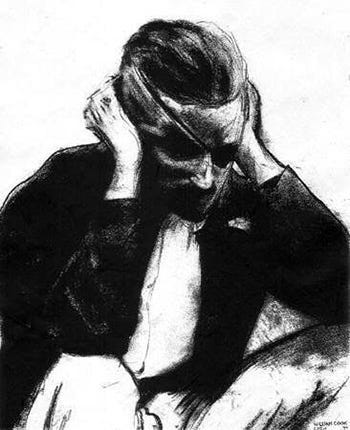
Like anything that challenges the intellect, Portrait provokes a mix of frustration and satisfaction with its many levels of difficulty. The apparent simplicity of the first chapter drags us into Stephen’s labyrinth of memory and experience. The increasingly complex narration and imagery disorientate the reader. Just as Stephen seems to have a deep ambivalence toward all things, so too do we (those of us still reading).
A certain amount of mistrust and caution guides us through the dichotomous corridors of the narrative. As ambiguous as it may seem, because of its perceived difficulties and lack of authorial direction, there is still a story within the structure that seeks the eye (and ear) of the astute reader.
There is a strong relationship between the aesthetic and the character. The novel is, after all, a Portrait of the Artist as a Young Man, and as such, he displays characteristics of the aggressive ideology of youth and artistic temperament. Stephen Dedalus’s life advances from childhood to adulthood in a continual odyssey for meaning and vocation that differs from the conventions, traditions, and expectations of his peers and guardians.
We see the world through Stephen’s perceptions, rebelling against reality and seeking a deeper truth that seems as elusive to him as to the reader. A sense of isolation and subjective relativism envelops his character and his sense of pilgrimage. He searches for camaraderie in other like minds, envisioning other young artists on the same spiritual journey. He hears their voices calling him “making ready to go, shaking the wings of their exultant and terrible youth” (p.253).
He sees himself as “their kinsman”, the embodiment of all artists, yet with an egotistical difference that still sets him apart from all the others. Stephen’s project is the height of allusion — he wants to create what he feels has never been created.
With an abundance of self-generated inspiration and confidence, he states:
“I go to encounter for the millionth time the reality of experience and to forge in the smithy of my soul the uncreated conscience of my race” (p.253).
It is not a selfless personal identity that is to be created from Stephen’s experience, but the “uncreated conscience” of his “race”, a universal paragon that will set him up as the mythological figurehead of his people.
Stephen’s ‘soul’ is exposed and opened to the reader, his soul being essentially the novel itself. He has been creating epiphanies, aesthetic objects, and artistic theories throughout the novel. His ultimate aim is to create a work of art and an experience of a genius never before heard of.
This genius lies in creating an aesthetic object that represents more than itself. That embodies a moral sense of responsibility, a product of an artistic breed that has historically pursued art for its own sake. He believes that he is the artist to accomplish this unconventional task, seeing his ‘art’ as something striving toward genius.
Two main questions need to be asked of this proposal:
Is “the reality of experience” such that it is unique or essentially different from that which has been experienced and recorded before, enough so to create a new “uncreated conscience”?
What “race” is Stephen referring to? Is it the human race, the Irish race, the race of time and space[1], the idealized race of artistic ‘kinsmen’, or the ‘race’ of family that he now hopes to give some moral fortitude and imagination to?
The first question is answered with a single word: no! No individual mortal being, or subjective experience, could hope to create an entirely new moral being (conscience that has not been ‘created’ before) free from the influence of that which has come before, within themselves, let alone in a whole ’race’.
The aesthetic object (or work of art) cannot create and impart a wholly original sense of being, or moral sensibility, that is capable of embodying the collective “conscience” of whatever race it is that Stephen claims as his own. Stephen’s success depends on his understanding and involvement in a thoroughly anthropological (not self-justifying or assuming about the universal nature of humankind) manner, with humanity and reality as the measures by which he judges his own behaviours. And, perhaps more importantly, his own thoughts and beliefs.
Leaving behind a reality dealt with by the imagination rather than the heart does not suggest that Stephen’s project will be successful. Yet, it does imply that his naivete will be confronted by similar archetypes of experience that will force him to confront reality, which defines the human condition, with his heart.
The second question of ‘race’ can only be answered definitively by Joyce himself. I personally feel that Stephen’s race is that of the artist and that he is looking to blow apart artistic convention and tradition by ‘forging’ a new style that will act as a paragon to the rest of the art world. Stephen may not be able to do this alone, with his attempts at poetry and vision, yet Joyce does create this uniquely influential and original work of art and style in A Portrait of the Artist as a Young Man.
There seems to be an element of hope about Stephen’s voyage. An elation that exudes life and dreams. However, the final sentence reeks of impending doom and mythological regression (rather than looking to the future and a new “conscience”):
“Old father, old artificer, stand me now and ever in good stead”. (p. 253)
Stephen is looking for a role model. It is not his biological father that he finds, but the mythological “artificer” — Daedalus. Will he stand Stephen in good stead? Not if Stephen is Icarus (son of Daedalus), rebelling against his father’s requests and flying too close to the burning sun of freedom, consequently melting his wings and drowning. Nor will he if Stephen is the son of Daedalus’s sister, whom Daedalus killed by throwing him off Minerva’s sacred citadel.
So, why use an analogy that ends in tragedy to represent Stephen?
Myth and biology are as much “nets” of the soul as convention, tradition, and expectation. Because his character is doomed to failure from the beginning, he cannot escape the past and be a great creator. His own philosophy on acquiring knowledge neutralizes his aspirations with its contradictions:
“he was destined to learn his own wisdom apart from others or to learn the wisdom of others himself wandering among the snares of the world”. (p. 167)
How can you learn wisdom from others if you are “apart” from others and amongst all the negative things (‘snares’) that you are trying to differentiate from?
There remain no firm answers to our questions. Conjecture and uncertainty are as much a part of our reading as they are of Stephen’s idealistic and seemingly unrealizable aspirations. He yearns for personal fulfilment and completion of the destructive ideals that he takes quite seriously. His name denotes the path he takes. It is all pre-planned, vocation and all, and not by Stephen or Daedalus, but by the “artificer” who is Joyce.
The spelling of Stephen’s last name is significant. The change from Daedalus to Dedalus distances his surname enough from the myth to imply an alternative meaning. As we find out, Stephen’s journey is a bit of a ‘dead-loss’, his aspirations to an immortal (‘dead-less’) state of created conscience proving unfounded and invalid in its reliance on myth and guidance from influential figures.
Like other critics such as Caroline Gordon[ii] and Marguerite Harkness[iii], I feel that Stephen is set up to fail. The novel's difficulty in meeting this end is evident in its extensive invention and intellectually challenging alternatives.
My opinion is that it is Joyce’s intention to do this with Stephen’s character so that once we have reached our conclusion, we can concentrate on the text.
Stephen’s character acts as a foil to the testimony of artifice and creation, of the text as a work of art, a novel of artistic dexterity, genius, and vision, and a masterpiece of words. In this respect, the difficulty of Joyce’s text does what it sets out to do.
Notes:
[1] “The race is not to the swift, nor the battle to the strong, neither yet bread to the wise, nor yet riches to men of understanding, nor yet favour to men of skill; but time and chance happeneth to them all”(Ecclesiastes 9:11). A biblical reminder that human events do not always turn out in the way men expect them to, which is poignant in the light of Stephen’s impending flight from the isle, paralleled with Icarus who burnt his wings and drowned in the seas of his unnatural aspirations (mortals cannot aspire to the height of the God’s).
[i] See James Joyce, A Portrait of the Artist as a Young Man, Text, Criticism, & Notes, ed. by Chester G. Anderson, The Problem of Distance in A Portrait of the Artist, by Wayne Booth (New York: The Viking Press, 1968) pp. 466–467.
[ii] See Joyce’s Portrait, Criticisms & Critiques, ed. by Thomas E. Connolly, Some Readings and Misreadings, by Caroline Gordon (New York: Appleton-Century-Crofts, 1962) p. 144.
[iii] See A Portrait of the Artist as a Young Man, Voices of the Text, by Marguerite Harkness (Boston: Twayne Publishers, 1990), p.110.
For more interesting articles, visit
https://www.gwcookwriter.co.nz.
No posts
Comments
Nothing yet. Say the first thing.
Sign in to join the conversation.