
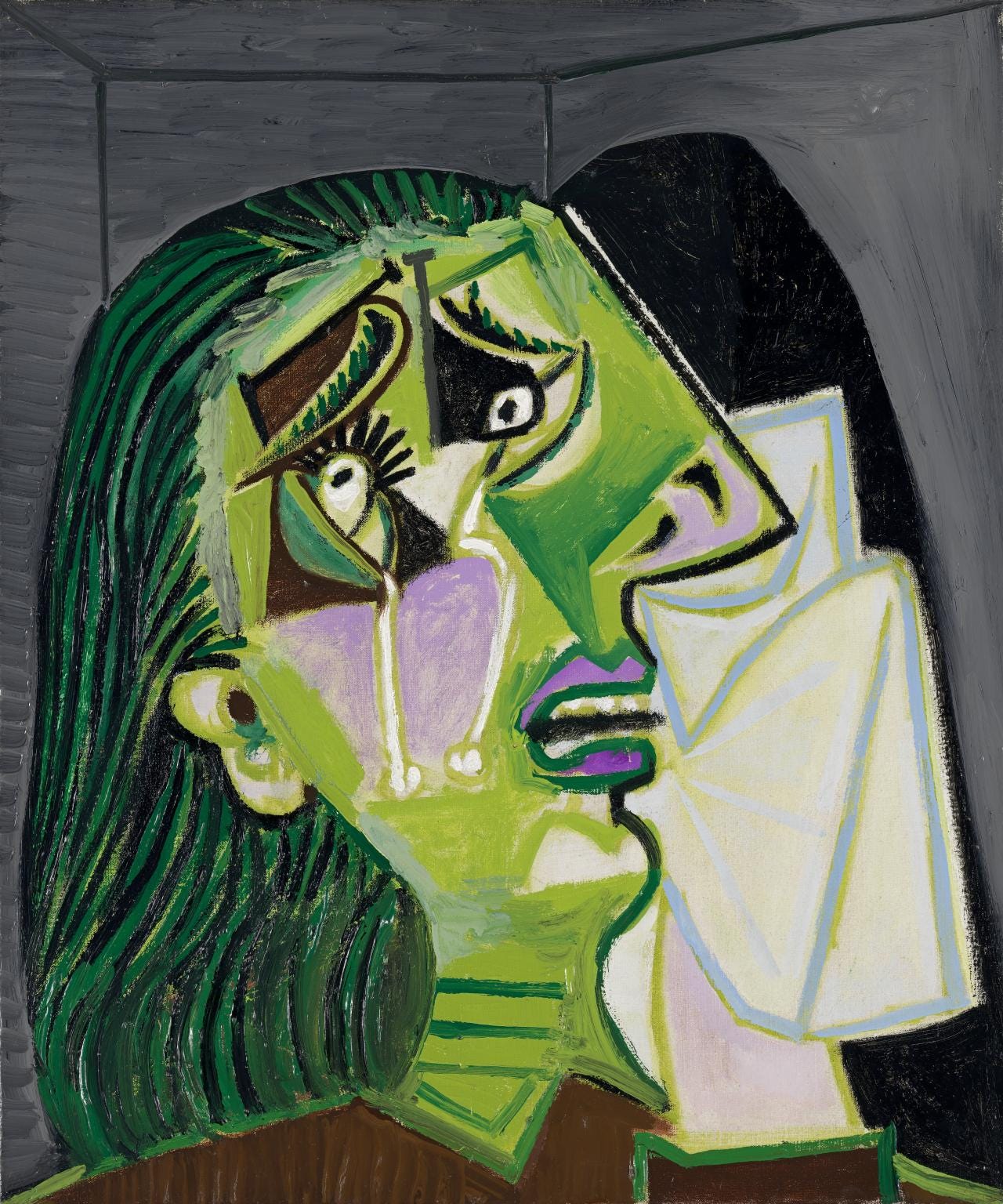
Oh no, I’ve been stolen!
Who stole the Picasso from the NGV in 1986? Spoiler alert, Brechtian epic framing: it was two art/crim kids, directed by David Larwill from Roar studios. OK, here’s why I think that…and some suspects I have ruled out of the inquiry
It was forty years ago about today….that the Picasso went away. Yes, on 2 August, 1986, ‘Weeping Woman’, the National Gallery of Victoria’s recently acquired Picasso was discovered to be missing, stolent!, and the whole city went into ten days of uproar, delicious for many, less fun for others. This anniversary has been somewhat muted. Marc Fennell’s TV series on the theft aired a couple of years ago, giving a last burst of attention. There’s been nothing in the papers this week. Not surprising in a way. The Melbourne it happened in was quite different to now; still a dowdy and boundaried city, in which everything happened within. There was still a lot of industry, unions were big, the inner suburbs were still working class communities with a few drop ins, the laneways were yet to be discovered, tourists were few and the image on the postcard was of the Floral Clock. Fifteen per cent of people went to uni or college, and those who did went to a bewildering array of unis, techs and teachers college. We drank in thousands of pubs preserved by arcane liquor laws, where each week, hundreds of live bands played. In the inner city, modernism was over, the left was dead, Baudrillard was god and postmodernism was king, centred on endless fifties pastiche we couldn’t get enough of.
It was also the high period of the Cain Labor government, which had come to power in 1982, and was to the left of the Hawke government, elected in 1983. The Cain government had immediately banned nuclear ships in port - a merely symbolic gesture, but one that the local branch of what was now a global anti-nuclear movement could rally around. There were huge demonstrations every time a US destroyer, or fleet did dock, and annual Palm Sunday peace marches in 250,000 people, of every social class and group: one in ten people in a city of 2.5 million. Bliss was it etc, to have the federal Labor government as the right pole of politics. An illusory condition of course, and those of us who came of age during have never really recovered our equilibrium.
It was a small inner city, with a massive suburban penumbra which never figured, and which people escaped from, to this. Hunners played the Station Hotel, singing a love song about a girl who worked in the Rowden White library at the Melb Uni Student Union, inner city mag Tension was in the newsagents, SBS’s Rock Around The World was the new Countdown, Brunswick Street Fitzroy was starting up. At its metaphorical centre was The Black Cat cafe, opened in 1982, a cave of 50s retrokitsch, formica tables, milkshakes, weird album covers (‘Arthur Lyman’s marimba maniacs’), and the weird work of Tretchikoff, who painted elegant elongated ladies, usually in blue. Miles Davis and James Brown floated above it all. It was bulk fun and everything was ace.
The Cain government was keen to - with a bit of prodding - give some real grunt to yarts and culture, and in quick succession its dynamic arts minister Race Mathews and others budded off the Melbourne Writers Festival, the Comedy Festival, purchased the old CUB Malthouse in South Melbourne to house Playbox/Hoopla Theatre company - and there launched the hilarious Spoleto Three Worlds Festival run by globetrotting chancer Gian Carlo Menotti, which would evolve into the Melbourne Festival and now Risin’.
But they screwed it up with the visual arts. Race Mathews helped hyperactive NGV director Patrick McCaughey purchase the gallery’s first major Picasso painting, Weeping Woman, one of five studies of then-girlfriend (and artist in her own right) Dora Moar, for a then eyewatering $1.6 million. The idea was simply that every city should have major modern works, and the NGV’s signature holding Tiepolo’s ‘Banquet of Cleopatra’ had been in a few too many ads by then. Weeping Woman was suddenly everywhere.
But for the town’s actual artists a Picasso was not only a snub, but a poke in the eye. Every other artform was getting good folding money for current work, and painting got a dead great master. Artists already felt that hard done by, as most grants came through the Federal-level Australia Council, and exhibitions were controlled by a string of private galleries, established in the 60s. The previous generation of up-and-comers, the conceptual artists of the early 70s, were now in control of the grant and festival purse strings, and they favoured ‘post-object’ art, someone suspending a pane of glass on an unvisited peak in the Strzelecki ranges, and exhibiting eight polaroids of it, living as St Teresa of Avila in a vat of aeroplane jelly and so on. The Australian painters that were liked were all dead. The NGV had started to have a series of blockbuster shows the most recent of which - Golden Summers, collecting together the Heidelberg School - had been a staggering hit, running for months and months.
The youngest artists coming up, were ‘postmodern’,in the sense of coming after the agonies of whether it was fascist to put oil on canvas. But their style was often early modernist. Their freedom was expressed in a local branch of the global ‘neo-expressionist’ movement, centred on Roar studios in Fitzroy, the style which was really a return to the primitivism Picasso helped inaugurate: thick paint on big canvases, with a lot of totem-like, mythical figures. When the Picasso was purchased, there was weeks of debate on talkback about whether it was art at all (conclusion: it wasn’t). But young artists were grousing too, about the NGV’s superstar approach being extended from mum n dad impressionism, to full modernism. They got short shrift from the late Race Mathews, a great man in my opinion, but capable of being a leetle high-handed at times.
So when the Picasso was stolen, it was extraordinary. But it also felt somehow inevitable. The theft’s revelation effectively demonstrated how easy it was. On Monday 4 August, The Age and other media outlets received an identical letter announcing that they had stolen the Picasso because:
We have stolen the Picasso from the National Gallery as a protest against the niggardly funding of the fine arts in this hick State….
The writers clearly presumed that the theft would have already been detected. But it hadn’t been, until The Age called the gallery and the cops. Only then was it realised that it was no longer in its secure frame. All Sunday it had lain empty, save for a standard gallery ‘movement’ card which said ‘Removed to ACT’.
The ACT were in fact the group who had stolen it, signing themselves the ‘Australian Cultural Terrorists’.
Terrorism was much in the news at the time, as an all-purpose boogeyman. In April of that year, the Reagan administration had bombed Libya, ruled by the mercurial third worldist Colonel Qaddafi, who was happy to give money to guerrilla/terror groups, as part of the global struggle. After the 70s, it had become unmoored from politics. Terrorism was some amorphous badness, that must be destroyed - which the A.C.T felt funding denial was doing to them.
The gallery and government had taken some persuading that the picture was actually stolen. Once that was clear, they sprung into action, albeit of a Keystone Cops type. The police college in those days was on the grounds of the Victorian College of the Arts, next to Roy Grounds’s suburban Chinese restaurant NGV, and the VCA also included the Gallery School, located in the rear area of the Gallery itself. The police recruits were pressed into action, to search the nooks and crannies of the gallery for the painting. And, in an air vent, they found it! And then they found another one! And another. The Gallery school students, with easy access to the gallery, were miles ahead of them, turning out quick knock-offs of the piece, and secreting them all over.
With that avenue closed off, the government and police were pretty much nowhere. They didn’t know the art world at all, and the motives were weird:
2. The Minister must announce a new annual prize for painting open to artists under thirty years of age. Five prizes of $5000 are to be awarded. A fund is to be established to ensure that the real value of the prizes is maintained each year. The prize is to be called The Picasso Ransom.
A ransom but not for yourself? They quickly defaulted to the idea that organised crime had been involved, and the painting was already out of the country. But they had no leads there, either. McCaughey decided that security was too lax, and removed the chairs that the small army of security guards sat on. They promptly went on strike (the 80s!), and the gallery closed for three days. Rumours swirled. The conclusion come to was that the thieves had gone into the gallery late Saturday afternoon, hidden themselves before closing, done the deed, and walked out with the painting under an overcoat the next day. This is almost certainly wrong. But it covered the truly embarrassing fact that the lax oldstyle running of the place, in which the Gallery School was on site of the gallery, was a joke: anyone could walk in and out if you knew the person on the school desk, or, just looked arty. From the school, you could get into the gallery.
The Cain government played it tough, announcing that Interpol had been involved, and the thieves would be prosecuted, not a prank etc etc
By the second week, the whole town was following it with bated breath in between bouts of laughter. No web; it was a three newspaper city, and you followed it in The Age, then late editions of the Sun, then the afternoon Herald. The newsboys yelled it, the flier posters kept you updated, and the global press even expressed mild interest (the actual Weeping Woman, for which our version was a reduced colour study, had itself been stolen decades earlier, in New York). This was our thing, a Melbourne thing, the perpetual headline open on the clanking W class trams.
Then ACT upped the ante, sending a second letter, which made things personal and visceral:
Dear, oh dear. Race Mathews, you tiresome old bag of swamp gas...
1. We have not dumped the painting in a blue-nosed funk. What should have caused us to panic? Perhaps you imagine that the news that Interpol has been alerted will cause us to cower in our ill lit garrots awaiting the inevitable knock on the door as the relentless Clouseaux of a hundred nations stalk us…
By now, McCaughey was beside himself. But finally he caught a break, though it was nothing that the police did. On the weekend, with the destruction deadline looming, art dealer Anna Schwartz let him know that she had been at a dinner party where a young artist, Mark Howson, had talked rather too knowledgeably about what it would take to make the theft. Howson was one of the leading artists in the ROAR studios collective, which had become the centre of neo-expressionist, anti-’new establishment’ painting in Melbourne. McCaughey persuaded a very reluctant friend, artist Jan Senbergs, to accompany him to visit Howson. Dropping in on Howson’s dingy shared terrace house in Fitzroy North (the 80s!) on Sunday night, they were, according to McCaughey’s record, directed to Howson’s studio in West Melbourne, where they talked non-commitally with Howson - while noticing that the walls of the studio were covered with newspaper clippings of the theft (which, in those days, you had to collect as they came out). McCaughey said that the NGV wasn’t interested in prosecution, and that if the painting were found in a locker at Spencer Street station (the deliciously grim precursor of Southern Cross, with a trains mural by famous literalist Harold Freeman, which looked like children’s wallpaper) or Tullamarine airport, they would urge that the matter not be pursued. Two days later, on the evening of Tuesday19 August, The cops got a phone call saying they should look in locker 227 at Spencer Street. There, after the door was broken off, the painting was found, professionally wrapped (Fennell’s three part series spent twenty minutes on trying to find this obviously long destroyed locker bank, because they didn’t have three episodes of material; talk about art crime). Tests were done; it was declared to be genuine. The art world having done their work for them, the cops followed up some obvious art leads, and came up empty handed. Security at the hitherto small town gallery was beefed up. The story entered the bloodstream, appearing in at least six novels and a few films, as Melbourne went from Grim City, to Melberlin. It only began to fade in the last decade, as we became a towered Eurasian city and overseas student village, wiping away much of our continuity.
Soooooooooooooooooo….who dun it? Your correspondent got the Picasso bug, a few years ago, and, as everyone does, hit a wall on culprits who suggest themselves. Mark Howson was ha in the frame for very obvious reasons, and this has been to his detriment as an artist. I don’t think he did it. But I think people from Roar did. And one particular figure within it, David Larwill, the group’s most talented painter, and rather, spirited, person by far. Thereby hangs a tale.
But first let’s look at the evidence. I decided not to poke around the decaying Melbourne-arati for vague hints and gnomic utterances. Those who don’t know want to pretend they do, and those who do know are desperate not to have to say - because the people who did may be, heh are, still arts administrators and figures in the final part of their careers. The cops are still pissssed off about being made fools of, and the high value of the object - $10m in today’s money in straight conversion; recently valued by Sotheby’s at $100 million (don’t tell Ben Carroll) - means they can keep the crime on the book.
But prior to going into the evidence, let the writer say this. I think there is absolutely no moral complaint against the thieves. It was hilarious, there are thousands of Picassos around, it was handled scrupulously, it was returned safely (we think). But not everyone feels that way.
So, now, let’s Kaiser Sose it. In what follows, unlike other coverage, I’ll be naming names, though usually of people who I think aren’t guilty, and leaving one important one out. So, back to the first ransom letter, in full:
We have stolen the Picasso from the National Gallery as a protest against the niggardly funding of the fine arts in this hick State and against the clumsy, unimaginitive stupidity of the administration and distribution of that funding.
Two conditions must be publicly agreed upon if the painting is to be returned.
1. The Minister must announce a commitment to increasing the funding of the arts by 10% in real terms over the next three years, and must agree to appoint an independent committee to enquire into the mechanics of the funding of the arts with a view to releasing money from its administration and making it available to artists.
2. The Minister must announce a new annual prize for painting open to artists under thirty years of age. Five prizes of $5000 are to be awarded. A fund is to be established to ensure that the real value of the prizes is maintained each year. The prize is to be called The Picasso Ransom.
Because the Minister of the Arts is also Minister of Plod, we are allowing him a sporting seven days in which to try to have us arrested while he deliberates. There will be no negotiation. At the end of seven days if our demands have not been met the painting will be destroyed and our campaign continue.
Your very humble servants,
Australian Cultural Terrorists
The notes were typed and handwritten - a police graphologist concluded that the writer was ‘artistic, probably homosexual’ (the 80s!) - in a single hand, and what’s noticeable is that whoever wrote this first one, knows arts funding. The language of the first para is a little teasing (and archaic - niggardly wasn’t out of bounds in 1986, since its etymology does not link to the n-word. But it was on the way out). But it’s down to business.
Whoever wrote has firm views on how arts funding works. Their implicit complaint is that state funding is directed to institutions,influenced by favoured people, and not getting to artists (the 80s! The 90s! The 2000s! The…). The second remedy is a more direct prize, and the author knows that inflation needs to be allowed for.
Now these look like the same sort of demand, but they’re very different. For there were two political movements in art circles at the time; one was agnostic about prize-based funding, and for the latter it was anathema. These two groups had been very active in the mid-70s, but then had a major falling out.
They were all together in a magazine called A.M, or Arts Melbourne, and which evolved into the still extant Art Almanac. One group was aesthetically radical, including people such as Kiffy Rubbo, Ann Galbally and others. The other side was aesthetically and politically radical, represented by the Marxists, chiefly Charles Merewether and Ann Stephen, at the Preston Institute of Technology - one of the city’s half dozen art schools attached to tech institutes.
My first suspicion centred on a figure from the first group, a critic named GR Lansell. He was a little older than the rest of the AM Group - he’d been a toyboy lover of Mirka Mora’s back in the 1960s - and he had a style that well, here’s part of the second ransom letter:
We hope you enjoy playing the political he-man, unflinchingly refusing the outrageous demands of these cultural crackpots. You continue flexing your political pectorals before an admiring electorate for as long as you can, Minister. Seven days after the painting came into our hands (Sat 2nd Aug. 10.00PM) if our demands have not been met you will begin the long process of carrying about you the smell of kerosene and burning canvas
Now here’s Lansell in AM on Norman Lindsay:
‘What to make of poor old Norman Lindsay? That moth-eaten Puck summoning up his seemingly endless harems of pneumatic nudes -embarrassing not because they are nude, but because they seem more appropriate to some adolescent masturbation fantasy, Flinders Street railway station fare, masquerading as fine art…’
It continues in this vein for some time. The style, the disposition, is very, very similar. To be fair, it’s also a common style of the time, queenish and arch. That it was deeply unfashionable by the 1980s, suggested Lancell. But Lansell’s other writing in AM and elsewhere doesn’t mark him out as particularly annoyed with state funding; indeed he’s a defender of the state against the private art market. By the 80s, he would have been well out of the swim of those with the moxy to actually steal a painting, I am guessing.
The spotlight then shifts to the Preston crew of Merewether and Stephen, and artists and critics they were connected to: Terry Smith, artist Ian Burn and John Lendon. In 1977, AM had come apart completely as the core editorial collective had rejected some Althusserian Marxist writing from the latter three, which, being Althusserian, had managed to be firebreathing and dull at the same time. This was published instead in a one-off publication The Great Divide whose editorial, of an art publication, began:
The Great Divide is class division in Australia. The class war can appear to based solely on the economic and political front, and ignoring the cultural front. [Malcolm] Fraser’s strategy is to make Australia safe for capital interests…’
It continues in this vein for some time. But I’m not knocking that. Truth was the extension of art education etc in tech and teachers colleges - Preston, Prahran, Rusden, Frankston etc - had made art education available to working class kids without matriculation etc. These colleges had wide discretion on who they admitted, and they took it. There would never be such an equalisation of cultural training access again.
The ‘Great Divide’ group, mostly still with us - Ian Burn drowned trying to save other people’s children from a coastal rip in the 1990s - thus did studies on art funding, and targeted the processes of a state institution like the NGV as a material ideological apparatus. Here’s the para of the first note again:
1. The Minister must announce a commitment to increasing the funding of the arts by 10% in real terms over the next three years, and must agree to appoint an independent committee to enquire into the mechanics of the funding of the arts with a view to releasing money from its administration and making it available to artists
Now here’s theorist-firebrand Terry Smith, from an anti-NGV protest leaflet in 1975:
1…‘This action [removal of an experimental exhibition], following the removal of the Art and Language Show to the Art School of the Victorian College of the Arts is the culmination of a long history of prejudice against experimental art
2. We demand that it should be policy that the work of contemporary artists should receive the same respect that is given to art of the past
4. We demand the right to contribute to policy making at all levels within the gallery, in particular…
It continues in this vein for some time. Yes, it’s generic protest and admin language, but again, the same cadence, the same mode of address. What were Smith and others protesting? The removal of a piece by conceptual artist Dominique de Clario from the NGV foyer. This was significant because, well here’s part of the second Picasso letter:
Seven days after the painting came into our hands (Sat 2nd Aug. 10.00PM) if our demands have not been met you will begin the long process of carrying about you the smell of kerosene and burning canvas. You are gambling the State’s two million dollar investment in the Picasso industry against our twenty cent investment in Bryant & May.
What was De Clario’s cancelled exhibition a decade earlier? Piles of kerosene tins and burnt matches.
Did some combo of Merewether, Smith and others ride out for one last sortie in the 1980s? No, I don’t think so. Actually, I think they were all out of the country by then. But it is unlikely because of the other demand: for art prizes. This was anathema to Marxist critics, simply reproducing individual quantitative and arbitrary worth of the market, in a prize process. I don’t think they would have had anything to do with such demands, so they’re ruled out as active participants. We’ll take the cuffs off, Chuck.
We’re getting closer to concluding it was Roar, but let’s consider a couple of other possibilities, at least as marginally involved. One was one or two writers around the recently launched Virgin Press, a cool little inner city paper (though published in Hampton), an early one of many publications edited by the late Ashley Crawford, and overlapping with many of the same people as Roar. Alas the State Library has not retrieved the run of Virgin Press and its successor Tension, before deadline. So that’ll have to wait. Another braying news and broadcast journalist, whose British-Australian cadences and arch manner seem to echo through the notes, and who has spent rather a lot of time talking about who can have stolen the Picasso, must also remain anonymous. I suspect him because of a dog-that-didnt-bark. One of the notes was sent to the correct address of the Channel Ten newsroom. But the newsroom had just moved, and its old address was on media release sheets (then available as a print item). This person would have known the correct address. But the identity’s NSFW. What perhaps of the Tch Tch Tch(its actually three arrows as a name, but I’m not doing that) art/action group led by Philip Brophy and Maria Kozic? Brophy is another Preston Institutista, teaching there from 1982, and stealing a Picasso would surely count as anti/post/un-art. They too, I feel, would not demand art prizes, and spoil such an eclat as the eevent in question.
But then there’s ‘the couple’. The couple appear in some form in multiple tellings of the story: in Gabrielle WilliamsThe Guy The Girl The Artist and His Ex. , in Chris Wormersley’s Cairo, and in a strange piece in Crikey, in which the author told us he’d worked it out, that everyone who knew it had praised him, but didn’t even hint at who it was. There’s two versions of ‘the couple’; one is a fairly uber pair of critic-theory types, annoyed at the glutinous genius fest the Picasso acquisition had become. Another is the one I’ve heard from three sources, a boy artist, who was formerly a thief, and his girlfriend who worked - as many, casually, did - as a red-blazered NGV security guard. They’re the ones who did the double act it’s said, the girl provided the special screwdriver, the boy came and went not through the gallery, but through the gallery school entrance. They took the painting down to Y and J’s wrapped in an overcoat, snatched a quick drink beneath Chloe, etc etc. That’s either multiple sourcing or a hearsay echo effect. And we’ll come back to them.
McCaughey’s encounter with Mark Howson, made public when McCaughey’s memoir was published in 2003, obviously puts the aforementioned Roar studios on the spot. For good reason. The studio had been formed in 1982, by 15 young artists excluded from the private gallery system, because of the punkish rawness of their work (also some of it was meh), and excluded from grants by the post-object new establishment. They quickly became a counter-institution, living and working in a big bluestone building on Brunswick Street, with their own gallery. They hung out at the Black Cat during the day. Their launch parties became legendary. A wider circle of artists and wannabees attached. They applied for grant after grant, and never got one.
At the centre of Roar was David Larwill. Larwill, who died in 2010, was by far their most talented artist, and most interesting figure. He worked in a thick-textured highly patterned style of figures and objects, incredibly frenetic colourful, and, just, really good. He was passionately political, from ground up, providing art for anti-nuclear and other causes, and spending time up north with mob he had connected to in a peripatetic youth, and championing their art down here. His background was complex: his middle class family had moved to the not-yet-bougied Mornington Peninsula, after financial setbacks, in the 70s. He’d fallen in with the tail end of the sharpie movement, done shoplifting and minor stuff. He did art at Frankston tech, then dropped out to work in a westernport side steel mill (it’s now an artisanal wellness bakery). A rich girlfriend allowed a couple of years of travel, then anomic depression, before a friend supported him for two years to work on art. His talent, genius, was clear to all. Living in St Kilda he got into….Preston Tech in 1980. Yes, the old Merrewether-Stephen foco, whose teachers included artist Peter Booth.
Now, Booth was a hero to the emerging neo-expressionists. In the early 70s he’d been a minimal abstractionist, mainly black squares. Having exhausted that he’d been one of the first to leap into figuration, creating a black-grey world of lizard headed demagogues and shambling zombies in blasted desert settings. It was powerful, and original, and courageous. They sell for millions now, but he couldn’t get a buyer then, supporting himself through teaching, and working as a picture hanger at the NGV (and learning its arcane system, which included a unique wall fastener, and screwdriver to match). Larwill picked up a lot from the teachers there, but after a year, the director, Betty Churcher said he was spending half his life on the road, and may as well just go and be an artist. With Howson and others he formed Roar a year later.
So, I do not believe Mark Howson stole the Picasso, or even knew of the plot to do so. But I believe David Larwill did, or was involved in the organisation of it. And he did it with the young couple who appear in the folk telling of it.
Such a conception relies on two things. The first is that Howson of Roar (or so McCaughey claims) heard that dropping the thing off in a specific bank of lockers would stall an investigation, and two days later there it was. And second, that the existential oomph to actually steal something is not given to everyone. Per Genet, or per Sartre per Genet, to be a thief is a unique way in the world, and a pack of fags or a Picasso is all the same. It’s the act of taking it off the wall, or arranging such. Larwill had that; few do. That seems to motivate the group name ‘ACT’. An admonition to self, amidst a bunch of bohemians who talked endlessly about what they’d do, but never did? Someone ACTed
Furthermore, he had an idea of how the NGV worked. Peter Booth had not only been his mentor. It’s also been said that Booth got Larwill picture hanging work there.
This is where ‘the couple’ come in. One source on this said that both had been part of the very outer circle of Roar. The boy, it is said, was an accomplished department store shoplifter, high end cosmetics and accessories from Myer and David Jones. Now consider a part of the second letter:
[directed to Race Mathews] 3. The people of Australia, and you as one of their elected representatives, should rejoice that a theft involving less risk than shoplifting cotton hankies from David Jones was performed by a group whose first desire is to return the painting
Now, it’s possible that one source could have reverse engineered a shoplifter from the letter. But two sources have suggested this figure to me. That seems to make it less likely that it’s reverse engineered, and more likely that it was written with, or about, the shoplifter in question.
There is more in this second letter. It’s a strange one, veering in style from pompous and arch, to a little infantile. One suspects that deliberate misdirection might be involved. But its first para reveals something:
Dear, oh dear. Race Mathews, you tiresome old bag of swamp gas...
1. We have not dumped the painting in a blue-nosed funk. What should have caused us to panic? Perhaps you imagine that the news that Interpol has been alerted will cause us to cower in our ill lit garrots awaiting the inevitable knock on the door as the relentless Clouseaux of a hundred nations stalk us. What an imaginative fellow you turned out to be. Interpol! Call on Red Adair to read your gas meter, do you?
The latter stuff, Closeau(x) of the Pink Panther series, Red Adair, a 70s hero, who put out oil rig fires. The needle swings back to Lancell with this. But i think it’s a head fake, which accounts for the affected tone.
The ‘bag of swamp gas’ is more direct. The reference did the rounds at the time. But where was it from? The answer is Peter Booth’s work, which repeatedly feature drifting, sinister miasmatic clouds of gas across desert landscapes.
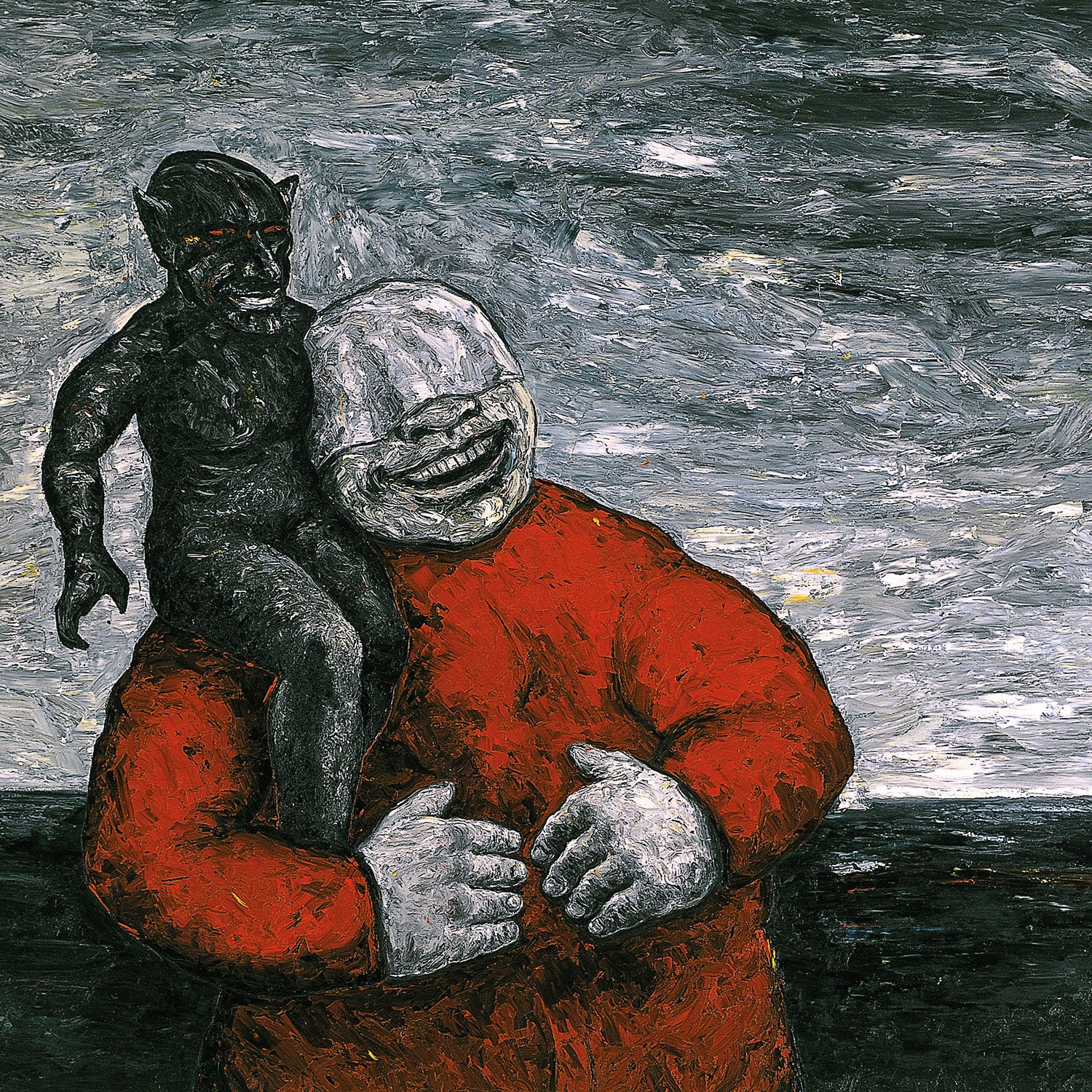
Swamp gas aplenty in the sort of Peter Booth that team Roar loved….(claiming fair use on this one)
What about this:
We have not dumped the painting in a blue-nosed funk
‘Blue-nosed funk’ sounds like it should be some mid-twentieth-century phrase. But it isn’t. One can’t find a single example of it. But blue noses? Funk? Where have we……Ah! The James Brown (‘get on up! Like a sex machine!). The Tretchikoff ladies! It’s the Black Cat cafe! The note was written in The Black Cat by Larwill. The Booth gas image came from within him, the blue nose funk came from without, and they met in the note.
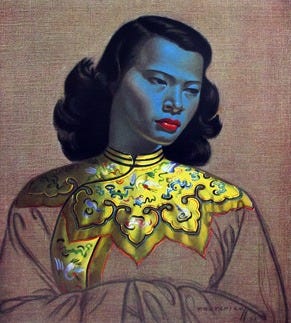
Tretchikoff classic, prominent in the Black Cat. Chinese Lady in blue nose funk, Was Larwill staring directly at this when he wrote the second note?
That all then joins to the Preston Institute foco, whom we rejected as suspects. They didn’t have a part in it, but Larwill was there for a year at its radical height. So it seems possible that, for someone already politically oriented, the struggles and conceptions of the 70s were passed down.
What about the third note? That was included with the painting in the locker, and as far as I know there’s no complete copy of it released. The second part claims that ‘they’ never really believed prizes would be set up; they simply wanted to raise the issues. The first is a very free form and rather nasty fusillade of insults, again at Race:
Race Mathews, does anything at all go on inside that solid block of lard your mother’s obstetrician thought might be a head…It is like being ticked off by a solemn and statesman like boarding house blancmange…
‘Boarding-house blancmange’ was an occasional earlier twentieth century expression, found in various places, meaning obvious (surely). The note writer - assumed to be someone different to the writer of the first two - would most likely have got it from Ngaio Marsh, the NZ crime writer, who uses it a few times, and whose books festooned the second hand bookshops people still frequented. That suggests a woman; men didn’t read Ngaio Marsh. The imagery - lard, obstetrics etc - suggests a surrealist, if an artist. There’s a couple of names… The hatred for Race Mathews seems mimicry in this case.
So David Larwill, the couple - whose names I don’t know - and a fourth person, who supplied much of the sensible detail - the point about using a fund to maintain the real value of the proposed prizes.I’m pretty sure I know who this is, but they’re still working, so we’ll draw a veil.
Further research would narrow this down. Perhaps with AI it might be possible: comparing writing styles more exactly. But that would mean scanning in a lot of undigitised material from the time. And what of the picture made from descriptions of a woman seen with a flat package at Spencer Street station on Tuesday August 12?
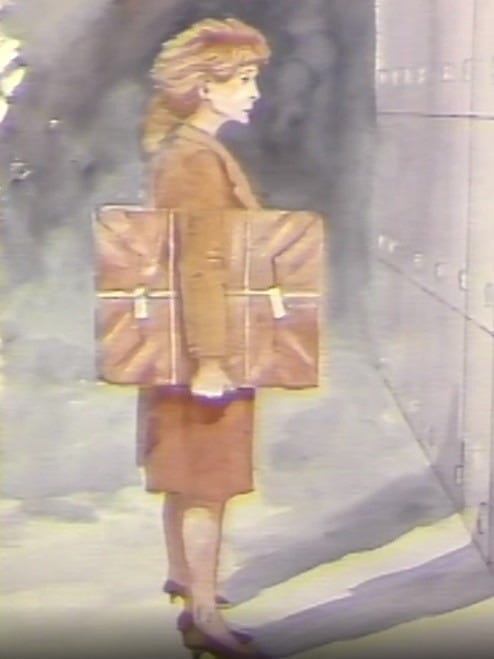
The young girl? Sister Margaret Manion? Or one of the AM crew? It occurred to me that it might be a rather unflattering rendition of the artist, the late Elizabeth Newman, who was seeing a Roar artist at the time. The spirit of the age being to get the girlfriend to transport stuff (dope, guns ,art) that might get you arrested. I asked Lizzie about this, during our two year tempestuous affair, in which she once tried to drown me (it was in the artificial lake in the Tivoli Gardens, Copenhagen, so…..) but she denied it. Or was sphinxlike in her silence.
Well maybe it was someone completely other than Roar. But I doubt it. Larwill told Howson about the exploit, cos you’ve always got to tell someone, and Howson, lubricated on good wine and swanking at a dinner party told them. None of the novels written about it even slightly work, because they take off on flights of fancy from something that really happened, and are thus arbitrary. They draw away from the delicious and unanswered question. Who did it? Who stole the Picasso?
Where are they now? The boy? I bet he’s dead of smack. The girl? Somewhere, there’s a cool woman early sixties gone back to natural gray, walking the grandkids round Preston Market, or having a coffee at the Venus Bay general store, or loading bags of baguettes and rocket into the Range Rover outside Malvern Woolies, somewhere there’s someone who left work and skipped over Princes Bridge to meet her bloke at Young and Jacksons under Chloe, a square wrapped in a jacket. And if you want, you can visit on Flemington Road, the Larwill Art Hotel, where the master’s work is displayed across five floors. If it all went down as I suggest, well, what can you say. Play us out Forbesy……..
Any frayed waiting room copy of Who
could catch this scene: flash Eurotrash
surveys a sulky round faced
überBabe who’s got the lot—what else
could this painting mean, except that
superstars can will their luck …
…
But if they suggest Eros,
what role does Agape play in this–
downstairs & screaming, being shown The
Instruments? You wish, voyeur, you wish.
John Forbes, from ‘On Tiepolo’s Banquet of Cleopatra’
—
Know anything? Want to spill?
Email me at: FontanaCheshireEsk@gmail.com
Or
Or
For total anonymity, send me an unsigned card at
PO Box 410, Flinders Lane Melbourne 8009
Comments disabled alas! Send as per above
Till next week…..
Comments
Nothing yet. Say the first thing.
Sign in to join the conversation.