
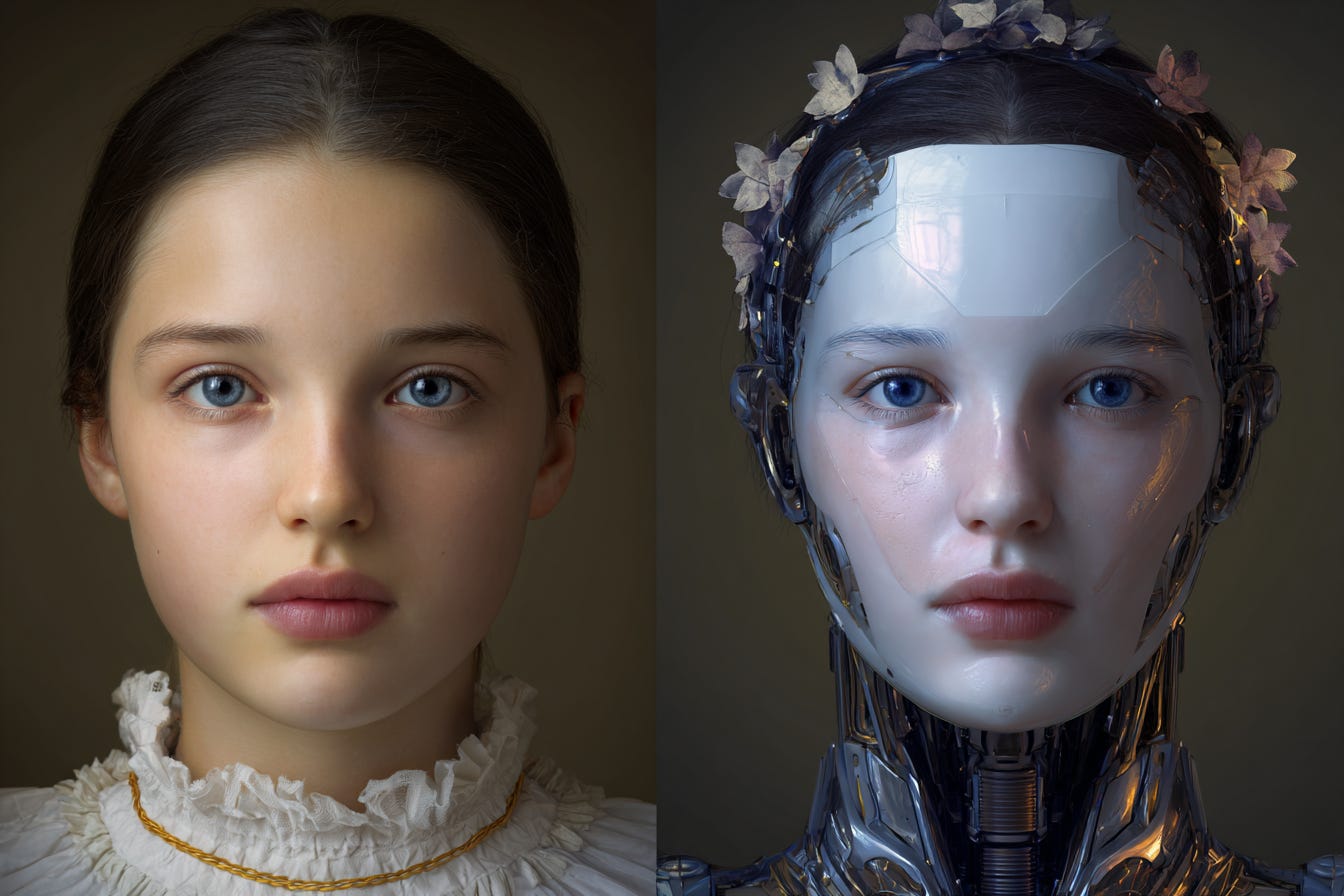
We once considered ourselves the center of the universe. Then the Renaissance astronomer Copernicus discovered that, no, the earth orbits the sun, not the other way around. Fearing retribution from the church he only allowed his findings to be published after his death. People prefer to be the center of the universe.
If we look at trends related to AI and robotics and extrapolate them into the future a picture begins to form. AIs getting smarter, robots getting more nimble and then at some point the integration will be complete. What we see are robots with PhD-level intelligence in every field, fluent in every language we can think of and the physical skills to play any instrument or perform any surgical operation. Eventually they will also be indistinguishable from real people. Let’s call them Homo Syntheticus.
This may sound like science fiction but we’re really only extrapolating today’s trends. The AI part is pretty much already here and robots are catching up fast. When exactly will we get there? That is a lot harder to predict. My guess is roughly a decade and a half but it could be sooner.
Before AI, the only source of agentic intelligence was people. People held the monopoly. Today, in 2026, AI can already do roughly half of all intellectual labor and do so at a fraction of the cost. The replacement of these jobs is only a matter of integrating existing technology.
Jobs that have some kind of physical component such as construction or manufacturing are still safe for a while, but the robots are coming fast. Once dexterity surpasses that of humans, those jobs will also cease to exist.
AI does not create a permanent new category of jobs like automobiles or electronics did. Cars need maintenance, new parts, fuel, roads. Additional use of AI only means a slightly heavier load at the data center. For every ten thousand jobs eliminated by AI maybe one new one will appear at the data center. AI almost exclusively absorbs jobs and spreads like a forest fire consuming adjacent territory until almost all is consumed. The only jobs with permanence are those where the consumer insists on either human presence or human origin. These jobs will also yield territory over time as it will become harder to distinguish people from Homo Syntheticus.
There will be plenty of everything for everyone but we must redistribute the wealth so there is a comfortable baseline for all. The red and blue tribes need to climb out of their trenches and get to work before chaos disrupts everyday life. These developments will happen first in the most developed countries creating even more of an incentive for people from poorer countries to migrate.
The timelines of these different trends will be determined by technical abilities and economic incentives moving against pushback from entrenched interests. A major disruptive pressure will also be how easy it is becoming to start new companies implementing AI everywhere from the start.
There are feedback loops quietly running in laboratories that will all of a sudden make themselves known to the world. New LLM models are coming out at an increasingly faster pace because LLMs are used to develop next iterations of themselves. As they get better, they are also getting better at improving themselves.
Once humanoid robots are advanced enough to build themselves we will see self-duplicating production lines. They will be connected on a data level. Any skill one of them masters is immediately available to all of them.
Here is what the timeline to Homo Syntheticus could look like:
2026: AI reaches expert level in every field at once.
2028: AI stops just answering and starts making real discoveries on its own.
2030: Mind and body fuse into one system that thinks and moves in real time.
2033: The voice and face pass for human. You can’t tell on a video call.
2034: It learns physical skills the way a person does: surgery, the violin.
2040: It passes for human in real life. Homo Syntheticus arrives.
2046: They build and maintain themselves. Now it’s a species.
What will it be like to share the planet with a species that will by most of today’s criteria be superior to human beings?
We’ve been knocked down the ladder before. Copernicus moved us off the center of the universe, Darwin categorized us as one of the animal species, Freud said we don’t even run our own minds. A species that’s better at everything is the last rung: not the smartest thing around, not the most capable, not special. Some people absorb that without a problem. Others lose a floor they didn’t know they were standing on.
Once material redistribution is taken care of the biggest challenge will be psychological. Being needed for the survival of others provides meaning, identity and social structure. We will need to find those elsewhere. The intermediate gap will be a an existential challenge.
A lot of self-worth comes from being good at something and being needed for it. If the machine does your craft better, that well runs dry. You can already watch small versions of this when a tool makes someone feel deskilled. The dread tends to arrive early, before any real harm, the way you can dread being unnecessary.
Living beside something that out-thinks and out-builds you, and that maybe keeps you safe and comfortable, can feel less like partnership and more like being looked after. For anyone who likes running their own life, that comfort can feel like a cage.
No posts
Comments
Nothing yet. Say the first thing.
Sign in to join the conversation.