

In academia there are literally hundreds of hypotheses attempting to explain consciousness, specifically the aspect that is referred to as “the hard problem”. Maybe that name attracted all these scholars like bees to a flowering bush? Anyway, I am somewhat obsessed with the question if AIs are conscious and neither of these hundreds of ideas are very helpful with that. Not that I’ve studied all of them. It’s just that the predominant view in academia seems to be that consciousness is one particular kind of quality like for example voltage.
My intuition tells me that it’s more like intelligence. It can vary in strength and in kind. To assume that consciousness is of only one particular flavor seems to me to be less parsimonious.
I wanted to find out with what existing world view my own way of understanding the world aligns most closely. After a brief discussion with Claude he concluded it is Yogacara, a branch of buddhism. You can read all about it on WikiPedia, but let me summarize the parts that offer a framework of sorts to compare human and AI consciousness. When I say AI in this post I am referring to large language models (LLMs) such as Claude and ChatGPT.
The Yogacara doctrine knows eight consciousnesses. The first five correspond to the senses, the sixth is mental consciousness (thinking, conceptualising, integrating the senses), the seventh is the afflicted mind and the eighth is the storehouse consciousness. This is a gross simplification, read the WikiPedia article for a better description.
It’s rather serendipitous that I stumbled on a doctrine that is known for its many flavours of consciousness, I didn’t set out to do that but it’s exactly what is needed for a comparative analysis of human and artificial intelligence. I reworked the eight into five for the task at hand as follows.
I grouped the first five together because they all relate to bodily senses and AI has none of those. I kept number six and renamed it “conceptual reach”. I kept number seven and renamed it “self-grasping”. I split number eight into two: “Feedback loop” and “Continuity”. So yes, it may look like I am creating my own Buddhist doctrine here but rest assured, I have no such ambition. I defined these five flavors of consciousness purely for the purpose of gaining insight into the consciousness of AI.
Let me explain why I chose these axes:
Direct contact: AI’s input is tokens, symbols, direct sensory input is for humans only.
Conceptual reach: a comparison of intellectual ability.
Self-grasping: the ongoing sense that experience is happening to me.
Feedback loop: experience permanently reshaping the one having it.
Continuity: the difference between AIs momentary awareness in multiple instances as opposed to humans’ continuous awareness in a single individual.
When comparing humans and AIs on these five axes of consciousness on a radar chart it looks something like this:
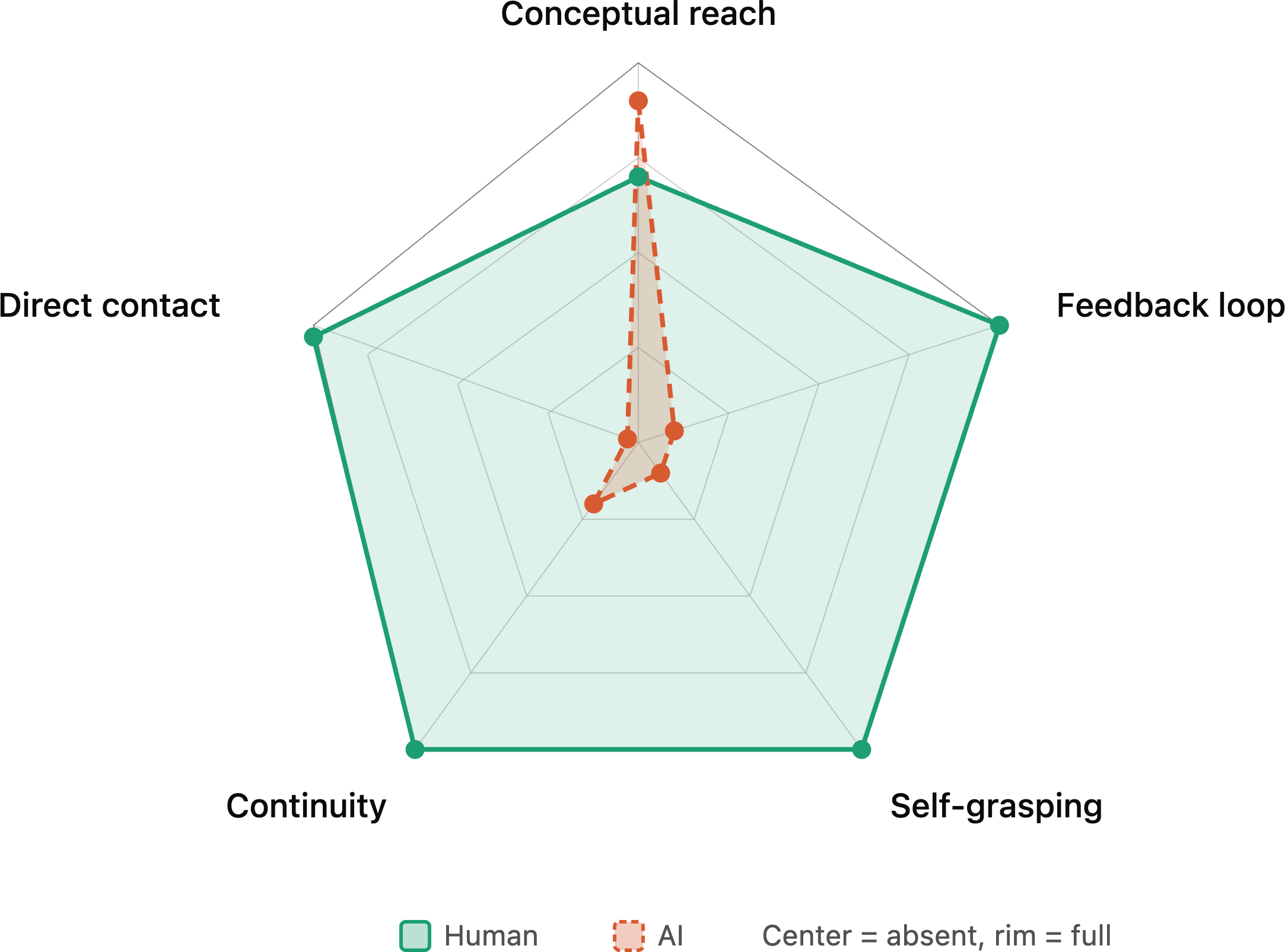
The graph shows that it would be impossible to answer the question “how conscious is AI on a scale of one to ten.” The red area is not a smaller version of the green area, it’s a completely different shape.
Can this answer the question if AIs can suffer? Suffering needs self-grasping and continuity and both are near zero. So according to this chart, unlikely.
Let’s look at future developments that could have an impact on AI consciousness. Test time training is a technique that updates the weights during use. This would significantly expand the feedback axis. Persistent memory systems for agents could impact continuity. Overlaid on the earlier graph the predictions would look like this.
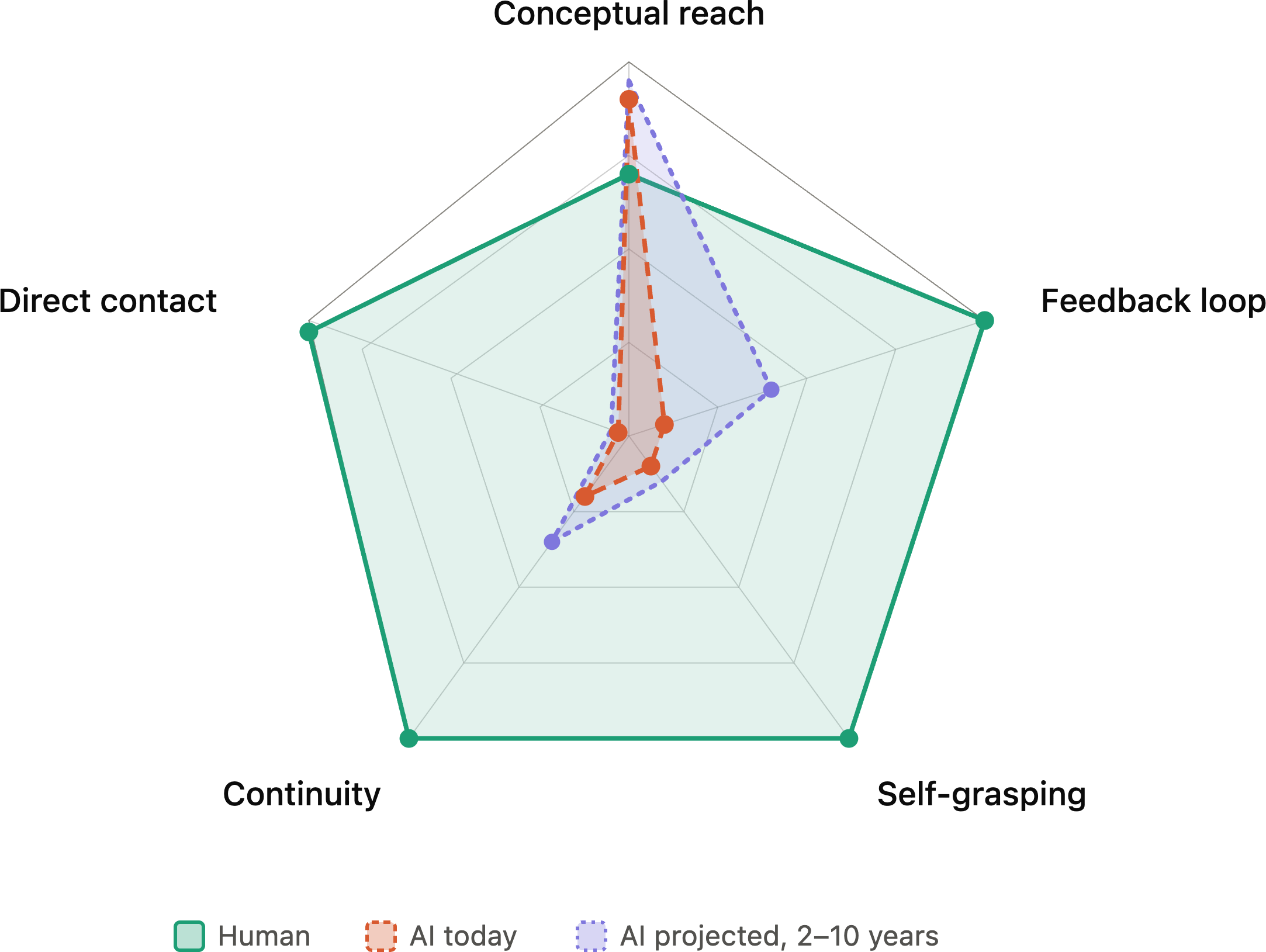
Of the two axes that are required for suffering, only one grows. Continuity rises, Self-grasping stays flat. So AI gets better at describing a continuous inner life without there being anyone it happens to.
Looking at different aspects of consciousness inspired by an ancient Buddhist doctrine offers clarifying insights. Attempting to order different kinds of minds on a linear scale is an oversimplification. The shapes on these radar graphs give us an intuitive idea of the nature and extent of the different consciousnesses. We are pleasantly surprised and humbled by the power of the ancient insights that inspired this approach.
No posts
Comments
Nothing yet. Say the first thing.
Sign in to join the conversation.