
For years, a social media account called @catatonicyouths has been curating and posting clips of cringe-worthy music moments from across the social internet, from live performances gone gross to DIY big-budget music videos, from blatant clout-chasing to acutely earnest bedroom song confessionals. High brow, low brow, and everything in between, they frequently feature the worst of both amateur and professional realms. As the name of the account and its milieu attest, the kids are not all right.
Fortunately for those of us who have left the Metamines for the bright daylight of reality, this person also makes many of their clips available on YouTube in the form of compilation videos, the most recent of which arrived this week. As one commenter puts it, “There’s a whole world out there and tbh it sucks to know about its existence.” With that introduction out of the way, I recommend you stop reading now and watch TikTok music is good (part 4).
A lot of what you can see on the modern internet is an object lesson in Guy Debord’s “The Society of the Spectacle,” which turns sixty next year. Debord’s brief but powerful tract comprises 221 theses that synthesize history, economics, and philosophy into a snowball of post-Marxist social and cultural critique that appears to prove itself end over end, year after year.
As Europe bounced back from WWII and entered an unprecedented period of stability and economic prosperity, Debord saw by-products of accelerating capital that Marx could not have predicted 100 years prior. Where Marx observed that the movement of commodities and capital in the marketplace obscured their fundamentally social nature from the people that bought and sold them, alienating those people from their labor and each other, Debord saw, in parallel, “an immense accumulation of spectacles. All that once was directly lived has become mere representation (Thesis 1).” To Debord, writing during the media explosion of the mid-20th Century, the enormous crush of images produced and re-produced by capitalist society—in news, propaganda, films, or advertisements—had achieved the same alienating power that Marx observed in the physical marketplace or the factory. Like a total facsimile of the real world, like capital’s ghostly doppelgänger, this spectacle had grown to encapsulate, accommodate, and re-write all livable experience in terms of production and consumption, and this was no longer a by-product of capitalism but the entire point. In Debord’s definition, the spectacle is not just the collection of images produced by a capitalist society, but a synthetic stand-in for the actual social fabric of our world that is mediated, influenced, and dominated by these images (Thesis 4).
To understand why this is a problem, you need to at least put yourself in the shoes of an anti-capitalist. We don’t want a fake world at subscription prices that keep rising! Remember that to Marx, capital is a totally undead, non-human force. You can be a capitalist and throw your capital around, but there is no “leader” of capitalism; the system itself sets the terms and conditions, and humans bend around it to either swim or die. The same goes for the spectacle. Debord’s argument is that the spectacle produces a kind of false consciousness and false sense of societal unification, a comforting, commodified fairy tale that “this is just the way things are,” even while its primary effect is to keep people separated, isolated, and alienated (and laboring). The bevy of consumption laid before us keeps us complacent and distracted while the spectacle serves its true purpose as a zombie-like agent/enforcer of the status quo: the capitalist mode of production. The spectacle is tautological and contradictory—it emerges from capitalist activity as a natural outcome but soon eclipses it to become the goal of that activity (Thesis 6); it is the total justification and permanent argument for capitalism as the dominant economic system; it is “the self-portrait of power (Thesis 24).”
And while readers in the ‘60s who were enjoying good jobs and well-made products (that they could afford) might have had to squint to imagine what kind of doom Debord was seeing in all the automobiles and advertisements whizzing by, I think we are well-tuned by our modern media hellscape to understand exactly what he means by “all that once was directly lived has become mere representation.” Think about what content you’ve consumed online in the last week: did you watch someone else play a video game? Did you see any dashcam footage of a car accident? Police body cams? Any videos of someone cooking or eating something? A politician speaking? Did you watch a POV video of someone wiring an electrical panel even though you’ve never flipped a breaker in your life? What about someone performing a sport you’ve never done or visiting a place you’ve never been? Interacting with an animal from another continent? Or even just a video of someone else’s cat doing a cat thing while three of your own actual, real cats do cat things in the very room you occupy? Maybe you just watched another person in a poorly-disguised apartment living room speak directly into the camera for three hours about a 90-minute movie. A spectacular use of your leisure time, no doubt.
Did your favorite sports star post about a social issue, and were people fighting in the comments about it? Did you read and follow along? I saw that McDonald’s posted a thing about it too. The zeitgeist—it’s everywhere, right? Keep up! I’ve never been to Africa, but I watched a white dude sail across the Atlantic Ocean and nearly die, alone and on camera. Were you even able to see any of your friends on this so-called “social” media, or did you just spend the time dodging memes, advertisements, sponsorships, or other calls to consume? And how often did you not see those things, even while they were present?
Did you watch any videos of people performing music?
Debord was a hard-liner. One of the difficult pills to swallow about “The Society of the Spectacle” is that, unfortunately for you and me, everything is already spectacular in nature, including the things we like and think are cool. There are a handful of theses that attempt to locate the movement of art across spectacular time, but they’re not optimistic (186-192). Celebrities are definitely not to be trusted (Thesis 60). And that’s what’s so insidious about the whole affair: any product of a spectacular society is necessarily a part of the spectacle itself and therefore implicated in upholding the dominant economic order and all of its injustices and inequalities. The spectacle is obviously Matthew McConaughy and Woody Harrelson acting like yokels in a commercial for Salesforce. It’s obviously young people who aspire to grow up to be “influencers.” It’s obviously the very concept of “bottled water.” But it’s not-so-obviously also your favorite anarcho-punk band, Keanu Reeves, and AOC. Sorry Bad Bunny fans, but the spectacle is definitely Bad Bunny at the Super Bowl.
The thing to understand is that the spectacle doesn’t just distract us from reality like a mobile circling over a baby’s head; it is reality replaced by capital; it is the mobile, the baby, and everything that has conspired to put mobile and baby in this time and space.
For Debord, it seems that any engagement with the system produces results favorable to the system; the only truly revolutionary position to take is one that insists on razing the whole thing. The spectacle exists across borders and governments (even the communist ones, for as long as they swim with a capitalist global order), and it’s quite possible that no matter how good we may feel about our personal ethics and sense of morality, our constant consumption belies the truth of our anti-revolutionary complacency. That may sting to those of us who think ourselves progressive, but as we roll into what looks to be another record-breaking year for heat (and inequality, and war, etc.), the question, as ever, is: will we change before it’s too late?
I think it gets interesting when music is involved. Music is a pre-spectacular activity, by which I mean humans have been doing it long before we arranged ourselves to serve capitalist modes of production. Like all art, it has been co-opted and debased in order to sell things other than itself, but maybe it still allows us to access fundamental human experiences and feelings that are yet unadulterated. Because it is frequently as entertaining as it is emotional, it is imminently spectacular.
Say what you will about the performers featured in “TikTok music is good (part 4),” I think we can all agree that they are united in their apparent lack of self-consciousness. This blind confidence allows for the leakage of all kinds of amateur signifiers to go unnoticed by the performer, though they are painfully obvious to us. The leakage is just as often found in the medium itself as it is in the content; it’s not just the crude lyrics, funny outfits, and bad taste, but also the bad camera angles, lack of attention or care for detail, or indeed too much attention to detail, perfectionism, etc. The perfectly timed but misspelled captions. The intense but stock visual effects and filters. The thoroughly TikTok-ian practice of enthusiastically introducing your song directly to the camera before launching into the chorus in the middle of a supermarket freezer aisle. These are the things that make us cringe and laugh when we watch these clips.
But in addition to being poor representatives of music in general (and blissfully unaware of it), these people also unconsciously reproduce and perform elements of the spectacle which, in this context, appear just as amateurish and even disturbing. Our discomfort comes from the fact that they stand out to us in ways that they are never ever meant to. Perhaps such a fissure in the plastic, oily smooth veneer of the spectacle—what Debord calls the “general gloss on the rationality of the system (Thesis 15)”—perhaps such a crack is just what we need to get in.
The third video in the series, at 0:12, features a startling and hilarious false equivalency between the apocryphal (and pre-spectacular) event of Christ’s execution and last year’s very real assassination of right-wing professional bad-faith arguer and racist Charlie Kirk. The irony of this mythological mixup is that Kirk hardly needs to borrow any of the potency of Christ’s myth—in spectacular terms, Kirk is more alive than ever and is arguably, as the Beatles once claimed about themselves, “bigger than Jesus.”
Some of the clips feature sharp, modern production values, and the accouterments of the modern spectacle—the colored LEDs, semi-pro lighting, and high definition video—lend this absurd lyric an air of salability. The artist, Joel Jackson, has a spectacularly salable brand as a “90s Worship” artist with 55.5k subscribers. But listening to just that short clip, it’s hard to imagine that this music is meant to be taken seriously or even listened to at all. Do we think even Charlie’s fans want to listen to something that reminds them of his brutal public demise? No—for someone, somewhere out there, this thing is intended to move money. Sure enough, a quick search for Joel Jackson pulls up not only his unique blend of political and religious fusion music, but also an apparel label and a vague “ministry.” In something so coldly corporate and indeed anti-Christian (vis-à-vis Charlie Kirk’s actual worldview), it’s easy to see the mechanism of the spectacle appearing in its deeply insincere and fascist true form: the forgettable music is there only as a channel by which a pre-spectacular, ancient source of unimpeachable morality (the Christ myth) can be usurped and adopted—not by Charlie Kirk, who is dead, and not even by Joel Jackson’s own spectacular enterprise (though he benefits from the association), but ultimately by the capital itself that churns underneath all of this activity in an unending insistence on a demonstrable source for its authority.
Another clip just seconds later serves up Kirk’s name in the context of a limp pushback against those who had labeled him a Nazi during his lifetime. Stop me if you’ve heard this one before: Jesus Christ, Charlie Kirk, and Hitler walk into a bar. Where else does this motley crew get together except within the spectacle?
Other clips are markedly low effort but no less spectacular. Observe the woman at 2:52 who simply recites “psychosis, I’m psychotic” while a beat plays off-camera. The spectacle has long accommodated the performance of mental health problems—from theater to film, from angry post-millennium nu-metal to the song “Monster” by latent social monsters Kanye West and Nicki Minaj. There are even a couple of clips in this compilation that attempt to play that hand, like the guy posing in a straight jacket around the 4:30 mark. So it’s not unprecedented for people to mimic people mimicking being unwell, especially in the service of selling entertainment. But in this clip, there’s a disconnect. The woman is alone in what looks like a park on a nice day. The beat plays in the background from some other source while she sings and records with her phone—it’s not a fully produced track. Her face is inscrutable. It is almost so banal that it breaks free of spectacular gravity, and the effect is disturbing. Is this person experiencing psychosis? Posting this kind of video feels like a psychotic thing to do. Does she need help? Why would she put this online? Isn’t there a number she can call? The spectacle, which is an artifice of artifices, has no answer to give this woman, and yet she makes her appeal using its vocabulary: “I wanna drop my song,” the caption says. What song?
Think back to Debord: the spectacle is not just a collection of images, but the very social fabric that is mediated by these images. Is this what a tear in that social fabric looks like? And who does the mending?
Many of these amateur videos feature people who are, at best, trying to make sense of the chaotic and unjust world around them. There’s the woman at 1:27 who lets out a primal roar before rapping, “there’s a certain kind of fucked up file that’s fucking pedo in nature;” there’s the skinhead at 4:23 with a bone to pick about the MeToo movement (presumably because someone accused him of sexual assault); there’s the woman at 2:08 singing about ICE while symbolically dropping cubes of ice into a disconnected toilet in the middle of her garage.
These people are fluent in the language of the spectacle; after all, we are born into it and it is the mainstream that we all inhabit. And yet its grammar is invisible and inaccessible to them. While they splash around in the pool of spectacular images next to the typical advertisements, content, and other distractions in your media feed, they are effectively speaking gibberish. These people, who lack not only the means of any meaningful commodity production but also the capital to do anything about it, these people were never intended to contribute to spectacular society. They are born consumers, and it’s only the modern cheapening and democratization of spectacular technology that gives them a door to step through. And I think this speaks to trends in all types of online behavior, not just music. Like the “psychotic” woman, who among us has not witnessed someone we know post something that they definitely should have kept to themselves, a strange and inappropriate outburst, something that makes us wince precisely because it feels all too human? It probably feels that way because we are watching them try to express something deeply human via a nefariously non-human channel: the spectacle. And who can blame them for thinking that they should? The warp and weft of their social fabric is production and consumption, and as always, the spectacle dutifully obscures that the product is not the medium itself, but the human beings who are coaxed into occupying and populating it.
For some, the slick and cynical production values belie a craven desire just to make money. Maybe they “get it.” They may be savvy with their understanding of platforms, algorithms and posting styles. They know engagement. They realize that they can use something like AI to maximize their sheer output, which may increase revenue. They are essentially dutiful capitalists without any capital. I think that in doing the work of creating content for the machine, they hope to find some systemic reciprocation that will allow them to spend their leisure time watching POV videos of someone else doing blue collar work instead of having to do it themselves. Not only is this misguided and antisocial (Debord would say “anti-revolutionary” perhaps), a baby would have better luck sucking mother’s milk from a rock. While they hope for the spectacle to free them from the chains of wage labor, in the meantime they tighten them.
The rest of these people—the many—are left with a sense that images, words, objects, and emotions can combine to make powerful points about the world, but when they are compelled to produce their own versions of these things using the vocabulary that they know—the vocabulary of the spectacle—the effect is flat and unbelievable. As an audience we sense immediately that this isn’t “the real thing,” and you have to imagine that on some level, they feel it too.
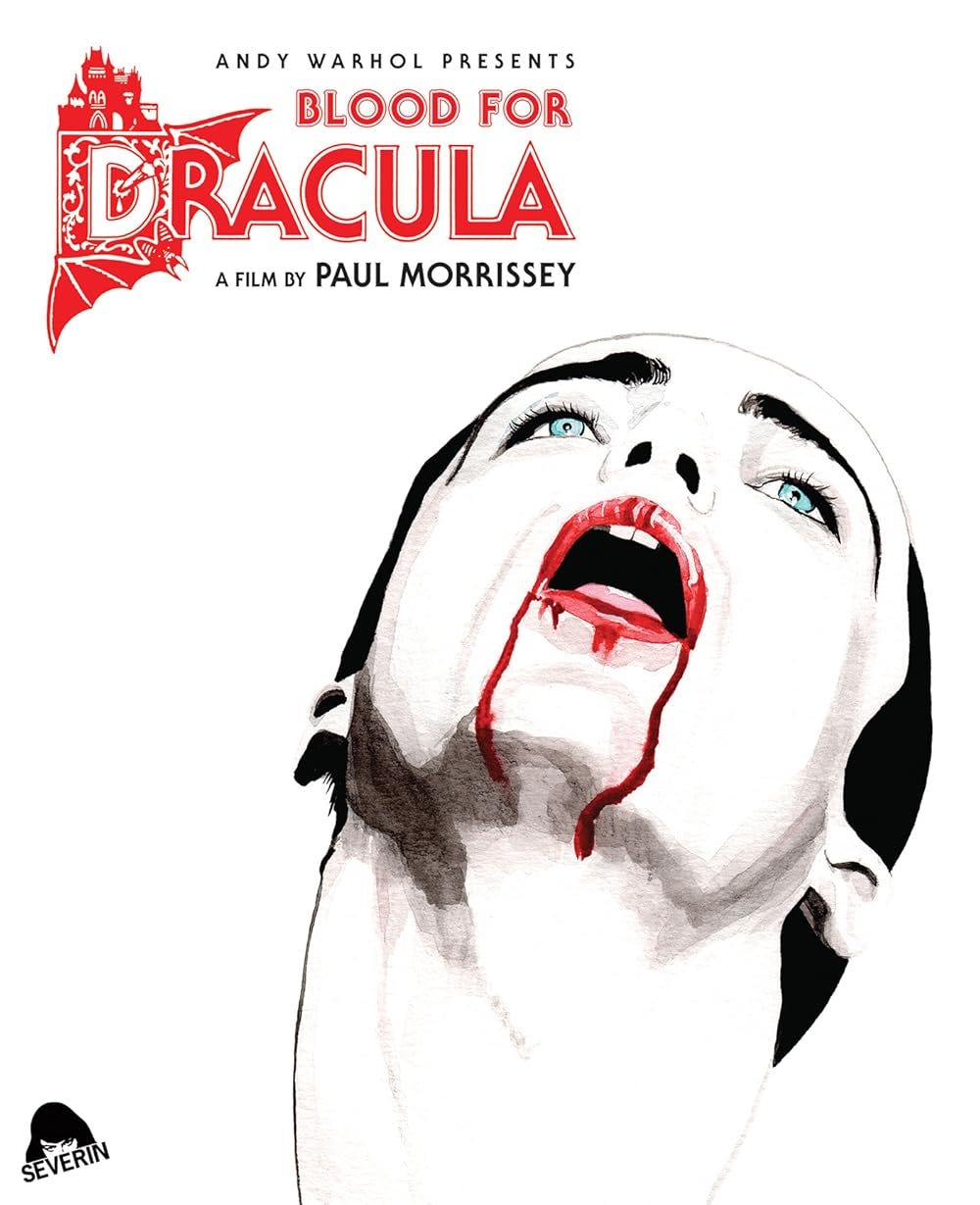
No critique of capitalism would be sufficiently full-throated without some reference to vampirism, and this film fits the bill not least of all because it features a dyed-in-the-wool socialist laborer (played by Joe Dallesandro) who spends the film either naked in bed, spouting revolutionary rhetoric, or most often, both at the same time.
Blood for Dracula (1974) was the second of two X-rated monster films produced back-to-back in Italy by director Paul Morrissey. The other is Flesh for Frankenstein, and though both are “presented” by Andy Warhol, like most things he ever put his name on they bear no actual Warholian influence. Both films star largely the same cast, and although I found Frankenstein to be atrociously bad and not worth recommending, I thought this Dracula was only very bad, and in that so very good way that makes it worth watching.
For one, the photography, setting, and costumes are great. It’s as though the previous three weeks shooting Frankenstein warmed up the whole production unit and they were firing on all cylinders from the moment they began Dracula. Morrissey’s Dracula—played by the mesmerizing Udo Kier—is weak, feeble, and close to expiration. He can only consume virgin blood, and he’s completely tapped out of his supply in Romania. He’s weeks away from dying when his valet recommends they travel to Italy, a “very Catholic country” with presumably many virgins. They shack up in a mansion with a bourgeois family on the verge of financial ruin (the patriarch is played here by legendary director Vittorio de Sica!) who would very much like to sell one of their four daughters to the rich and exotic Count. The only problem is, the adult daughters have been cavorting with the gardener and are not the virgins their parents think they are.
“Ze blood of zese whores is killing me!” Dracula exclaims after he’s attempted to seduce the second daughter and her non-virginal blood has caused him to spasm and vomit uncontrollably. There is something very appealing to me about a weak Dracula. He has no powers of transformation in this film and spends most of it in a wheelchair. The decidedly un-supernatural portrayal makes him, in some way, more believable. The vampire here is more like a crypto-zoological oddity than an all-powerful monster. When he bites their necks, Kier brings the necessary sexuality to Dracula’s signature move, but he also imbues it with an animal kind of desperation for nourishment.
Of course by the end he’s vanquished with a stake, but not before Dallesandro’s gardener has raped the 14-year-old daughter to “protect” her from Dracula. Often knowingly hilarious, sometimes disgusting, it’s all enough to leave just the right kind of bad taste in your mouth: coppery and red.
No posts
Comments
Nothing yet. Say the first thing.
Sign in to join the conversation.