
Scales have a reputation for being boring.
But scales aren’t the problem.
Mindless repetition is.
If you’re simply running a pattern from the lowest note to the highest note and back again, you’re missing almost everything scales have to offer.
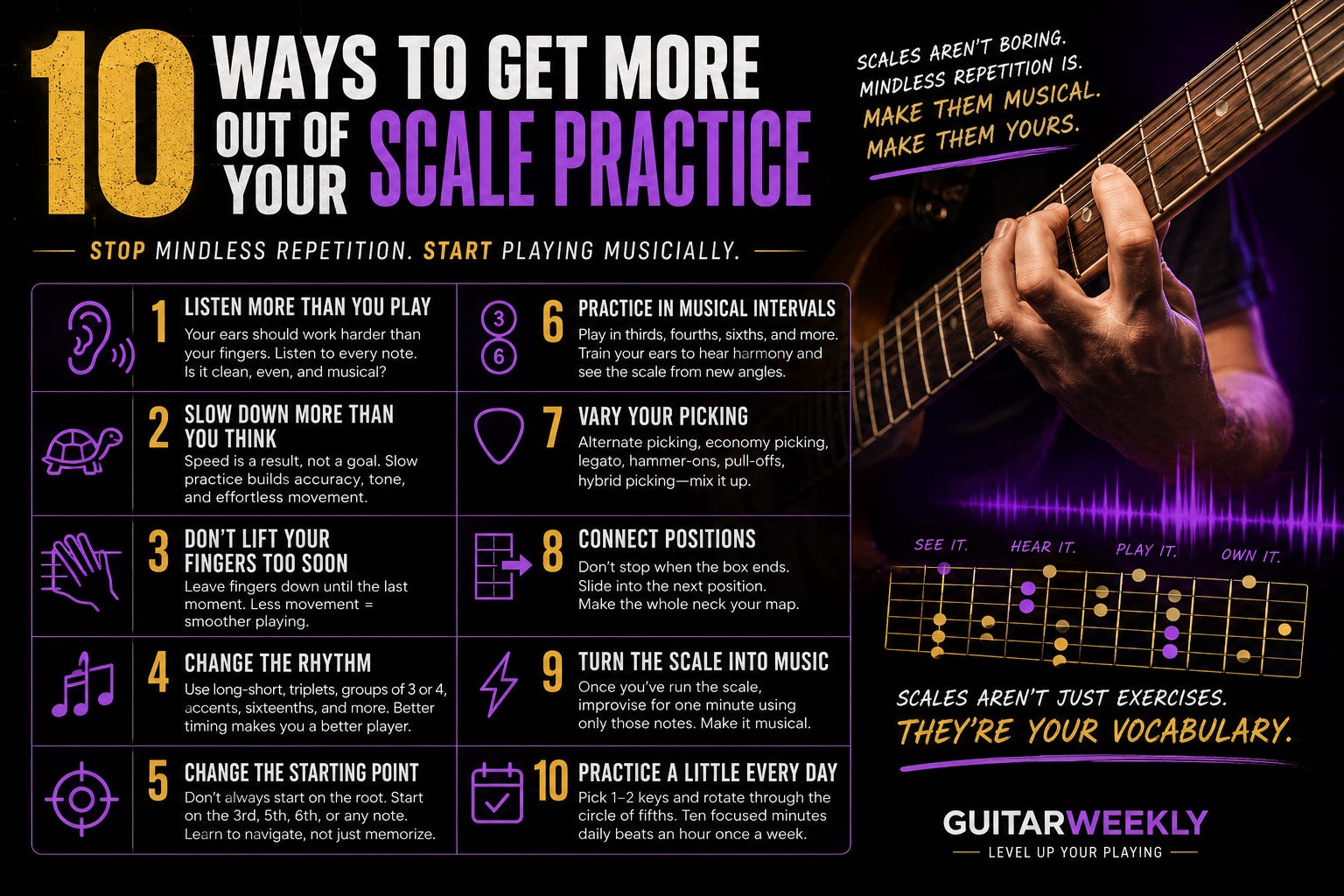
Here are ten ways to make your scale practice more musical—and more useful.
Don’t let your fingers go on autopilot.
Listen to every note. Is it clean? Is it ringing clearly? Are unwanted strings making noise? Is every note the same volume?
Your ears should be working harder than your fingers.
Speed is a result—not a goal.
Slow practice gives your hands time to learn efficient movement while your ears focus on timing, tone, and consistency.
If you can’t play it beautifully slowly, you won’t play it beautifully fast.
Many guitarists release every finger immediately after playing a note.
Instead, experiment with leaving a finger on the string until it needs to move again.
You’ll quickly notice how much unnecessary motion you’ve been making.
Less movement almost always leads to smoother playing.
Don’t always play:
1 & 2 & 3 & 4 &
Try:
• Long-short
• Short-long
• Triplets
• Groups of three
• Groups of four
• Sixteenth notes
• Accenting different beats
The scale stays the same, but your timing improves dramatically.
Don’t always begin on the root.
Start on the 3rd.
Start on the 5th.
Start on the 6th.
Suddenly you’re learning to navigate the neck instead of memorizing a single pattern.
Instead of straight up and down…
Play in thirds.
Play in fourths.
Play in sixths.
This trains your ears to hear harmony while building fretboard knowledge at the same time.
Try:
• Alternate picking
• Economy picking
• Legato
• Hammer-ons
• Pull-offs
• Hybrid picking
One scale can become six different technique exercises.
Don’t stop when the box ends.
Slide into the next position.
Then the next.
Eventually the neck becomes one connected map instead of five isolated patterns.
After running the scale…
Stop.
Improvise for one minute using only those notes.
This is where scales stop being exercises and start becoming vocabulary.
You don’t need every scale in every key every day.
Pick one or two keys.
Rotate through the circle of fifths over time.
Ten focused minutes every day will beat an hour once a week.
Scales aren’t there to impress anyone.
They’re there to help you hear better, move more efficiently, and understand the music you’re playing.
The next time you practice a scale, don’t ask yourself…
“How fast can I play it?”
Ask…
“What can this scale teach me today?”
Check out: GuitarWeekly.com for more!

No posts
Comments
Nothing yet. Say the first thing.
Sign in to join the conversation.