
Iceland is no stranger to extreme, rapid weather shifts. As the local saying goes, you can easily experience all four seasons in a single day just by driving a few dozen kilometers. Yet, even by Icelandic standards (which are famously flexible just thinking about past Christmas) the maximum temperatures recorded on July 12th were truly extraordinary.
Below is a map of the maximum temperatures compiled from the Icelandic Meteorological Office (IMO), which includes data from both official weather stations and the non-official sensors used to monitor road conditions.
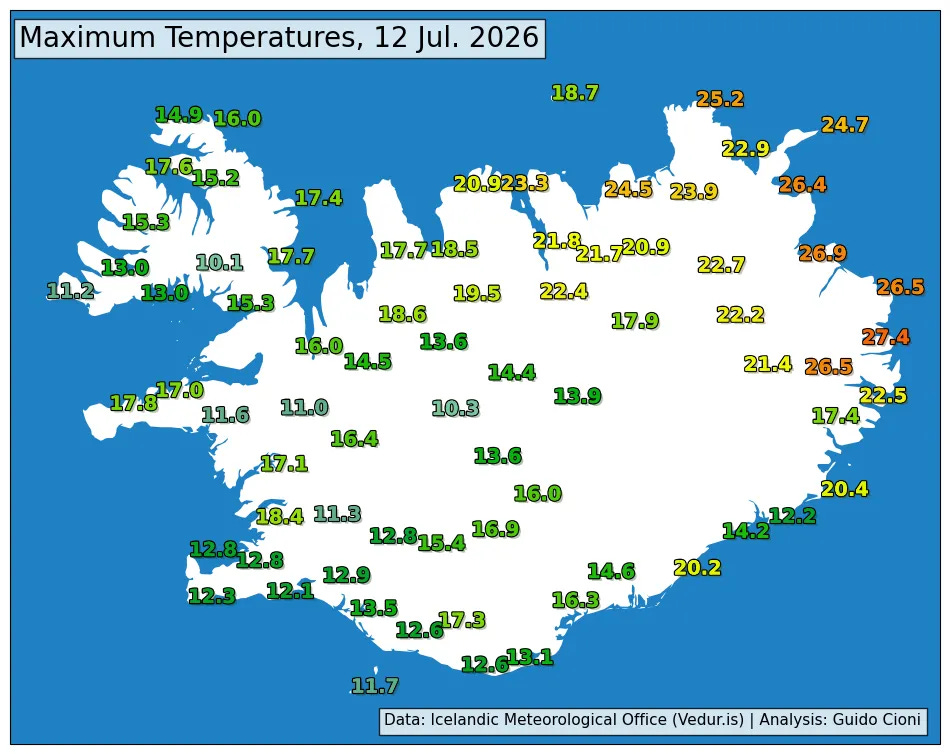
While the western half of the country remained relatively mild or outright chilly, the East Fjords were remarkably warm. The four hottest stations all clustered in this eastern region:
Seyðisfjörður, 27.4°C
Skjaldþingsstaðir, 26.9°C
Seyðisfjörður - Vestdalur, 26.8°C
Neskaupstaður 26.7, °C
Just how unusual are these temperatures? Unfortunately, most of the stations in this top tier lack long-term historical records. Only the Seyðisfjörður - Vestdalur station has a slightly longer dataset, stretching back to 1995.
Using this data, I mapped the distribution of July maximum temperatures for this specific station to see where this event stands.
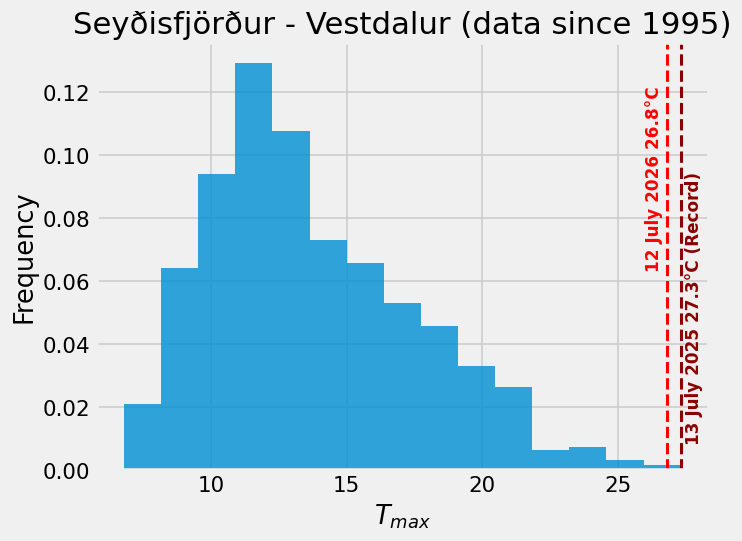
Historically, this location sees an average daily maximum of around 12°C in July, making the 27°C reading an incredible outlier. In fact, this temperature sits well above the 99.9th percentile, making it an exceptionally rare event for this area.
Looking at Iceland as a whole, the absolute heat records for July are higher still. The all-time national record for the month belongs to Teigarhorn in the East Fjords, which hit 30.5°C on July 22, 1939. Other notable highs include 29.7°C at Þingvellir (July 30, 2008) and 29.5°C at Hjarðarland (July 14, 2025).
While road-monitoring stations sometimes register even higher numbers, they generally aren’t counted in official climatological archives due to local interference. For instance, a road station at Fagradalsfjall registered a scorching 39.6°C on July 28, 2021—though that particular “heatwave” was courtesy of a nearby volcanic eruption!
No posts
Comments
Nothing yet. Say the first thing.
Sign in to join the conversation.