
Before we jump in, kudos to you - You’ve done the work.
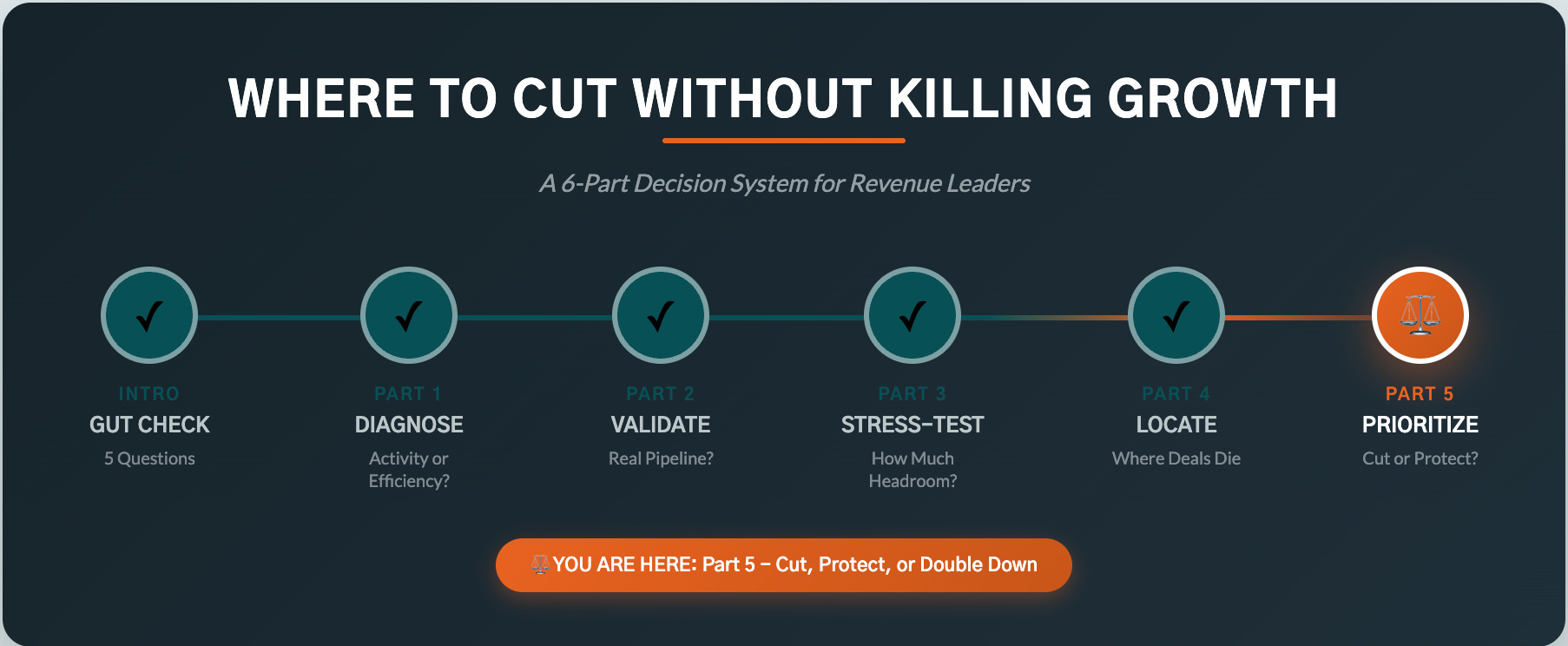
To recap, you know your constraint - Part 1.
You know your real pipeline coverage - Part 2.
You know your headroom - Part 3.
You know where deals die and whether your revenue is worth having - Part 4.
Now we turn diagnostics into decisions.
This is where most revenue leaders get stuck. They have the data but lack a framework for translating it into specific actions. They know something needs to change but cannot prioritize what.
Today, we fix that.
Every GTM investment can be scored across four dimensions. This framework forces tradeoff clarity.
ROI: Does this investment have a clear, measurable return? Can you connect it to pipeline or conversion?
Leverage: Does this investment compound over time? Does it enable other investments to work better?
Risk: How likely is this to fail? Is it proven or experimental? Is success within your control?
Reversibility: If you cut this, how hard is it to restart? What is the ramp time? Do you lose institutional knowledge?
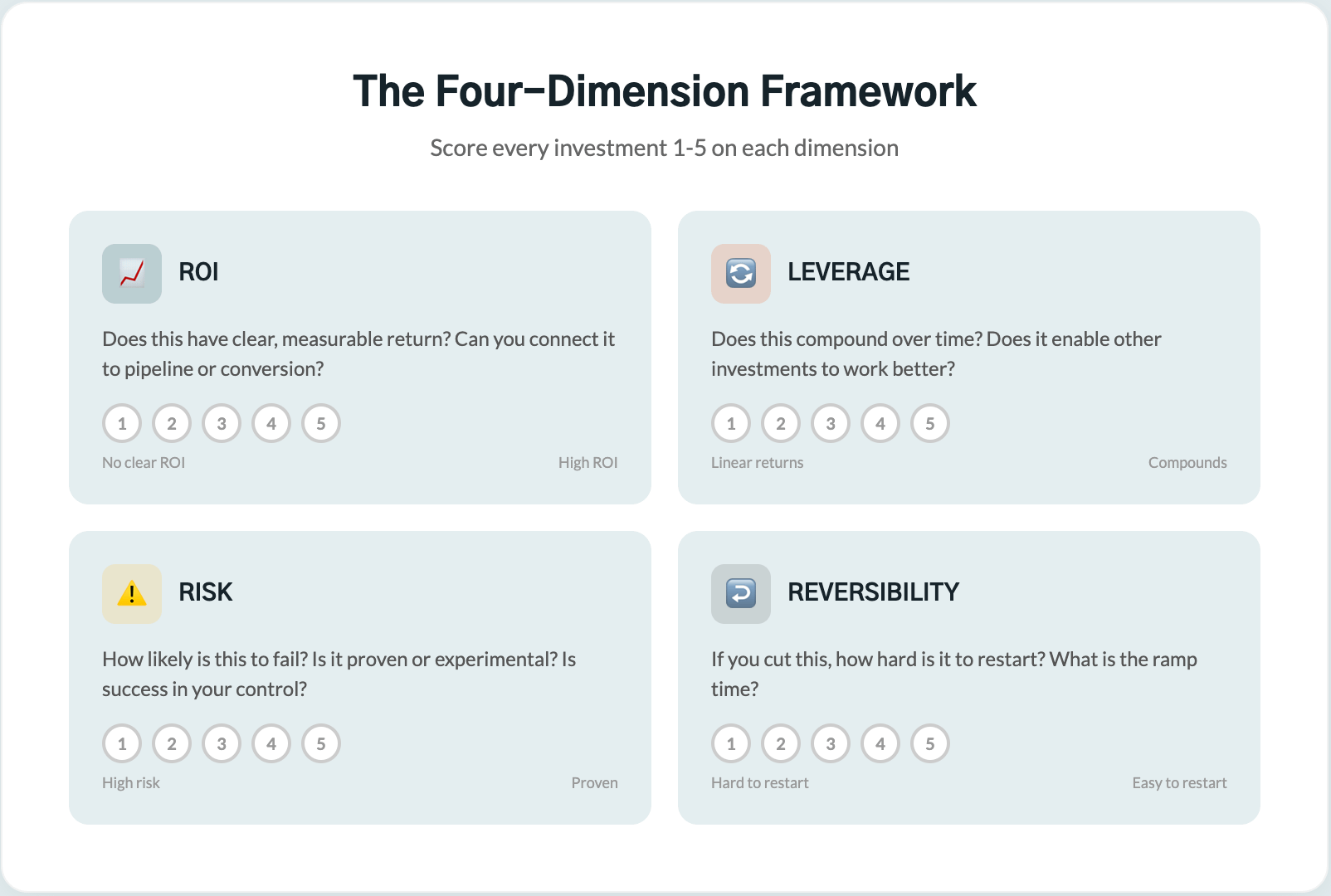
Score each significant investment 1-5 on each dimension. Low scores are cut candidates. High scores get protected.
Once you have scores, plot your investments.
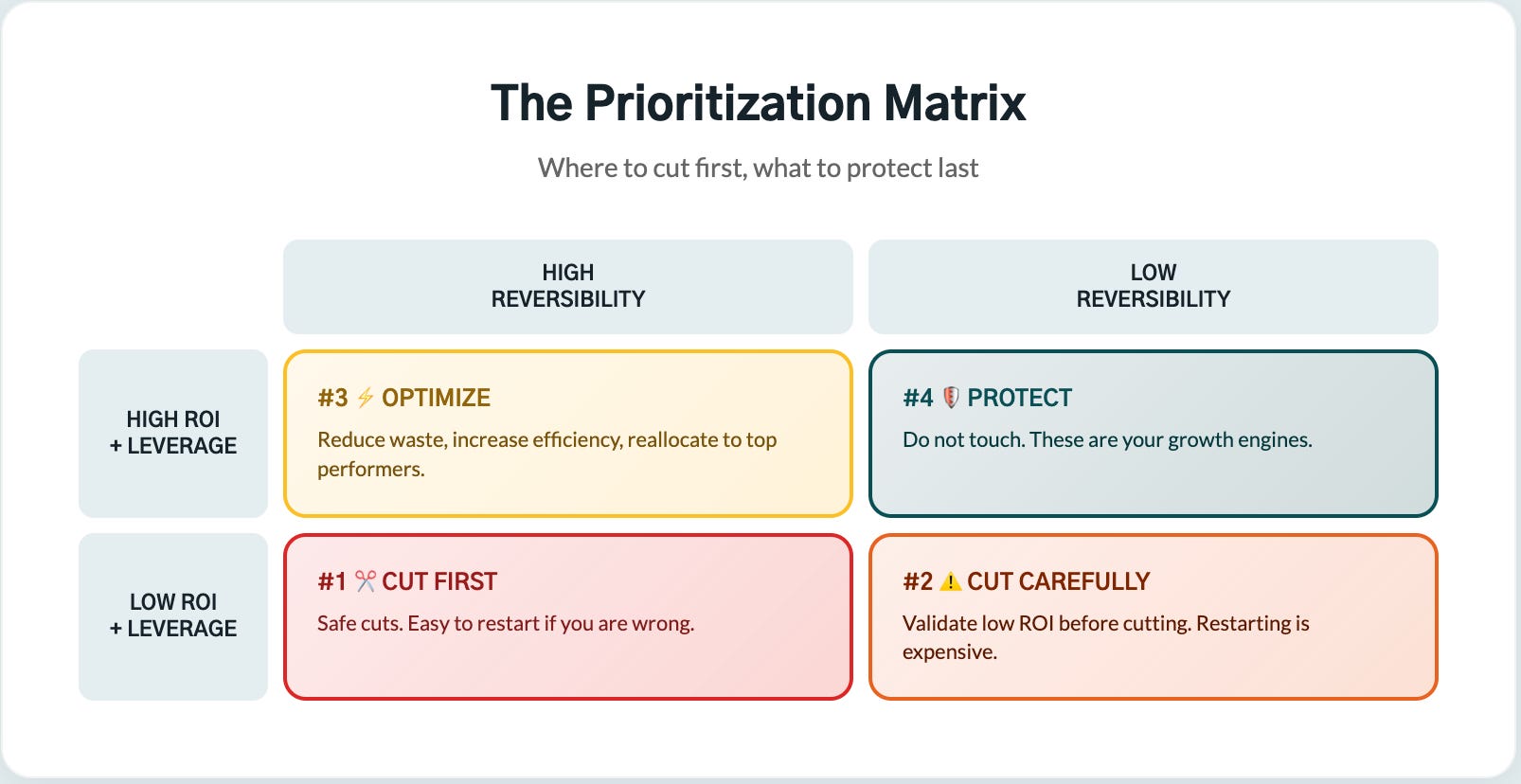
The matrix reveals your priority order:
Cut first: Low ROI, high reversibility. These are safe cuts with minimal downside.
Cut carefully: Low ROI, low reversibility. Validate before cutting because restarting is expensive.
Optimize: High ROI, high reversibility. Reduce waste, increase efficiency, reallocate to top performers.
Protect: High ROI, low reversibility. Do not touch these regardless of pressure.
Based on your diagnostic work, certain cuts almost always make sense:
Tools with overlapping functionality. Most GTM stacks have 2-3 tools doing the same job.
Programs that generate activity but not qualified pipeline. If a channel creates volume but those opportunities have high stale rates or low win rates, cut it.
Roles that coordinate rather than produce. In lean times, doers beat coordinators.
Channels that attract low-quality deals. If a source generates deals with 30%+ gaps between reported and effective value, scrutinize it.
Equally important: what not to cut.
Activities that improve conversion at your fragile stage. If Discovery → Proposal is weak, anything strengthening that stage is protected.
Roles that are hard to rehire. Specialized skills, deep relationships, institutional knowledge. These take quarters to replace.
Programs that generate highest effective deal size. Quality over quantity. Protect your best sources even if lower volume.
Pipeline generation when adjusted coverage is thin. Below 3x adjusted coverage, cutting pipeline generation is self-harm.
Here is how your earlier work connects to prioritization:
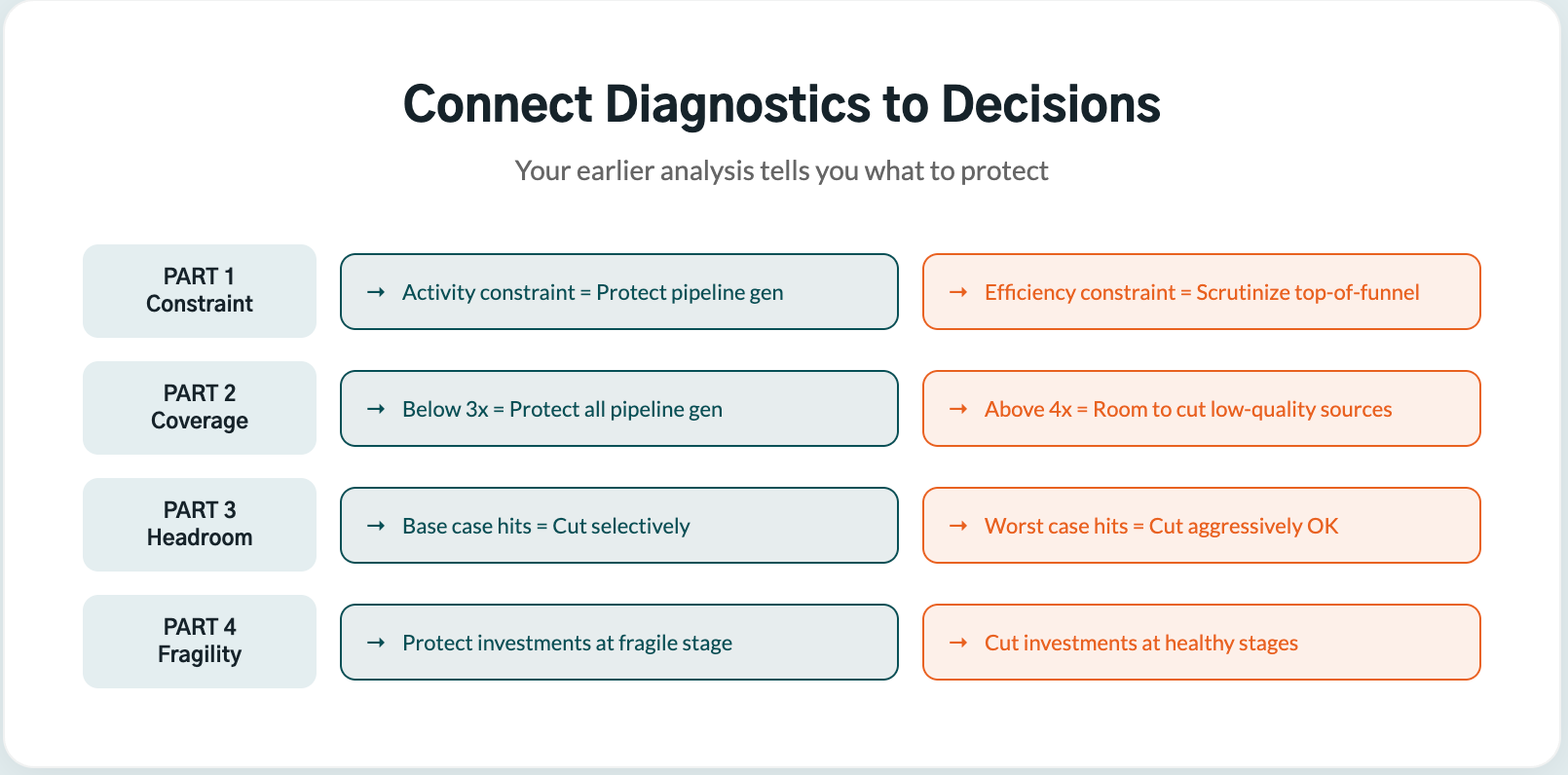
From Part 1 (Activity vs Efficiency):
If activity is your constraint → Protect pipeline generation, cut efficiency investments that are not working
If efficiency is your constraint → Protect conversion investments, scrutinize top-of-funnel spend
From Part 2 (Coverage):
If adjusted coverage is below 3x → Protect all pipeline generation
If adjusted coverage is above 4x → You have room to cut low-quality sources
From Part 3 (Headroom):
If worst case makes target → You can cut aggressively
If only base case makes target → Cut selectively, protect forecast drivers
From Part 4 (Fragility):
Protect investments that address your fragile stage
Cut investments in stages that are already healthy
A CRO needed to cut $400K from a $2M GTM budget. Twenty percent reduction.
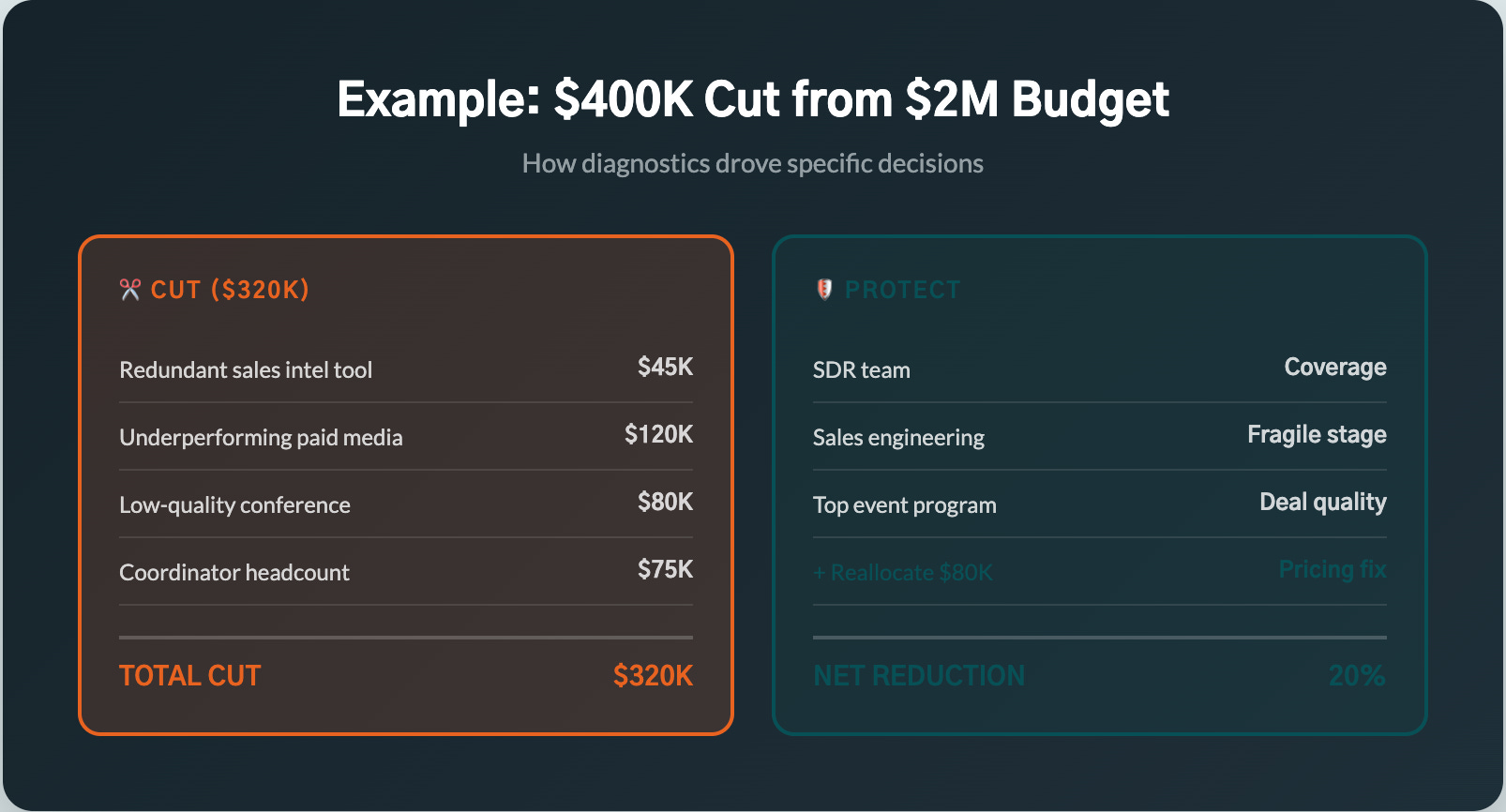
Here is how she used the framework:
Her diagnostics showed:
Efficiency constraint (not activity)
3.8x adjusted coverage (adequate)
Base case makes target (moderate headroom)
Fragile stage: Proposal → Close (pricing issue)
Her prioritization:
Cut ($320K):
Redundant sales intelligence tool ($45K)
Underperforming paid media channel ($120K, high stale rate)
Conference sponsorship with low effective deal size ($80K)
Open headcount for role that coordinates rather than produces ($75K)
Protect:
SDR team (maintains coverage)
Sales engineering (supports fragile late stage)
Top-performing event program (highest effective deal size)
Reallocate ($80K of savings):
Pricing consultant to address late-stage fragility
Competitive intelligence for proposal stage
She hit the 20% target while actually strengthening her weakest conversion stage. The cuts were defensible because each mapped to diagnostic data.
Before you finalize decisions:
Can you score every significant investment on all four dimensions? If you cannot, you are still guessing about what to cut.
Do your cuts align with your diagnostics? If you have an efficiency problem but are cutting pipeline generation, something is wrong.
Have you protected what is hard to reverse? Rehiring specialized talent and rebuilding institutional knowledge takes quarters. Factor that into your math.
Getting this right prevents the final mistake: cutting high-performing programs because they are easy to cut.
Under pressure, leaders often cut what is visible and reversible. Events get canceled. Headcount gets frozen. Tools get eliminated. But visibility and reversibility are not the same as low value.
The framework forces you to evaluate actual impact, not just ease of cutting.
Score your top 10 GTM investments across all four dimensions. Identify your top 3 cut candidates and your top 3 protected investments. Check them against your diagnostics.
Next week, we turn your decisions into a story.
You have the decisions. Now you need to communicate them in a way that builds confidence rather than anxiety.
Next week, we turn your data into a narrative your CFO and board will trust. Because the difference between a cut that creates panic and one that creates confidence is how you frame it.
The question we will answer: How do I defend this to leadership
Comments
Nothing yet. Say the first thing.
Sign in to join the conversation.