
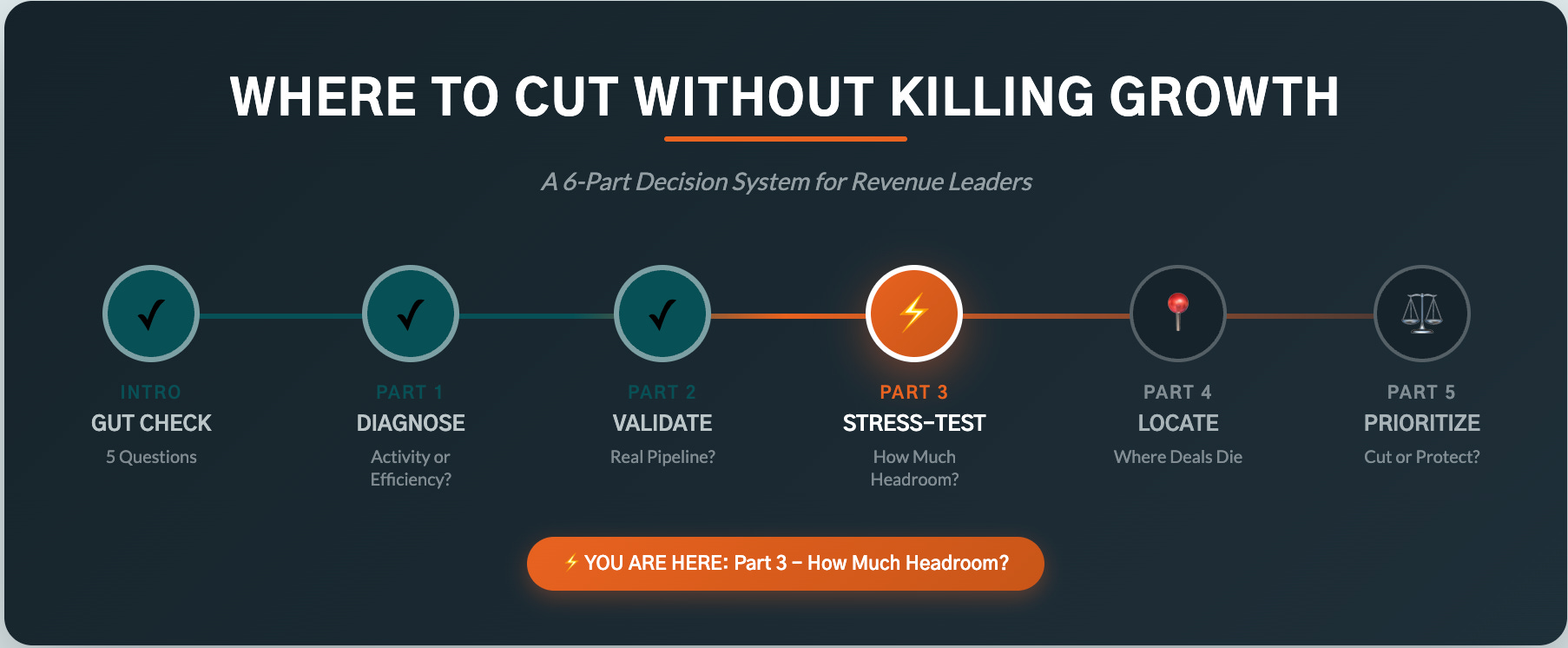
Before we dive in, let’s recap. You know your constraint - Part I…
You know your real pipeline coverage - Part 2…
Now the question that determines how aggressively you can cut:
How much slowdown can your business actually absorb?
Cost cutting creates a tradeoff. Reduced spend typically means slower growth, at least short-term. Before you cut, you need to understand what breaks if things go sideways.
This requires two lenses: forecast risk and capital efficiency.
Most forecasts are single numbers. “We will do $2.4M this quarter.” That false precision is dangerous because it hides the assumptions that could break.
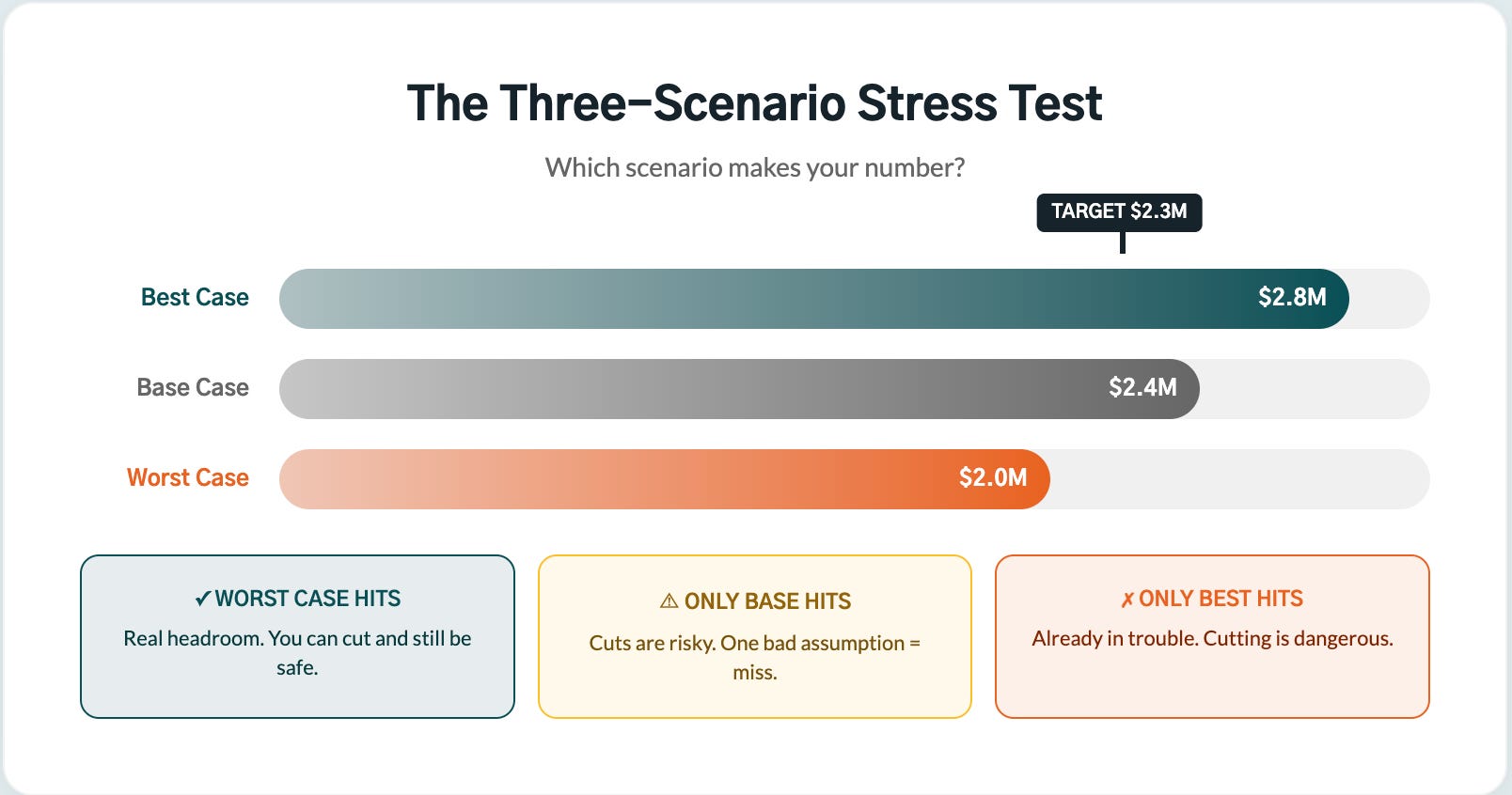
Instead, build three scenarios.
Best Case: Everything breaks your way. Big deals close on time. Win rates hold. No surprises.
Base Case: Historical patterns continue. Some deals slip. Normal variance.
Worst Case: Your three largest deals push to next quarter. Win rate drops 5 points. Pipeline generation slows.
The exercise takes ten minutes. Write down your three numbers:
Best case: $_______
Base case: $_______
Worst case: $_______
Target: $_______
Now ask: Which scenario makes my number?
If your worst case still hits target, you have real headroom. You can afford some cuts even if things go wrong.
If your base case barely hits target, cuts are risky. One bad assumption and you miss.
If only your best case hits target, you are already in trouble. Cutting anything that affects pipeline or conversion is dangerous.
Your forecast is only as strong as its weakest assumption. Identify the three assumptions that, if wrong, would hurt most.
Common fragile assumptions:
“Our two largest deals will close this quarter”
“Win rate will hold at 22%”
“Pipeline generation will continue at current pace”
For each assumption, ask: What spend protects this assumption?
If your forecast depends on pipeline continuing, cutting demand gen directly attacks your forecast. If it depends on win rate holding, cutting enablement might be the wrong move.
This reframes the decision. You are not asking “what can we afford to lose?” You are asking “what protects the assumptions our forecast depends on?”
Forecast risk tells you what might break. Capital efficiency tells you what you can afford.
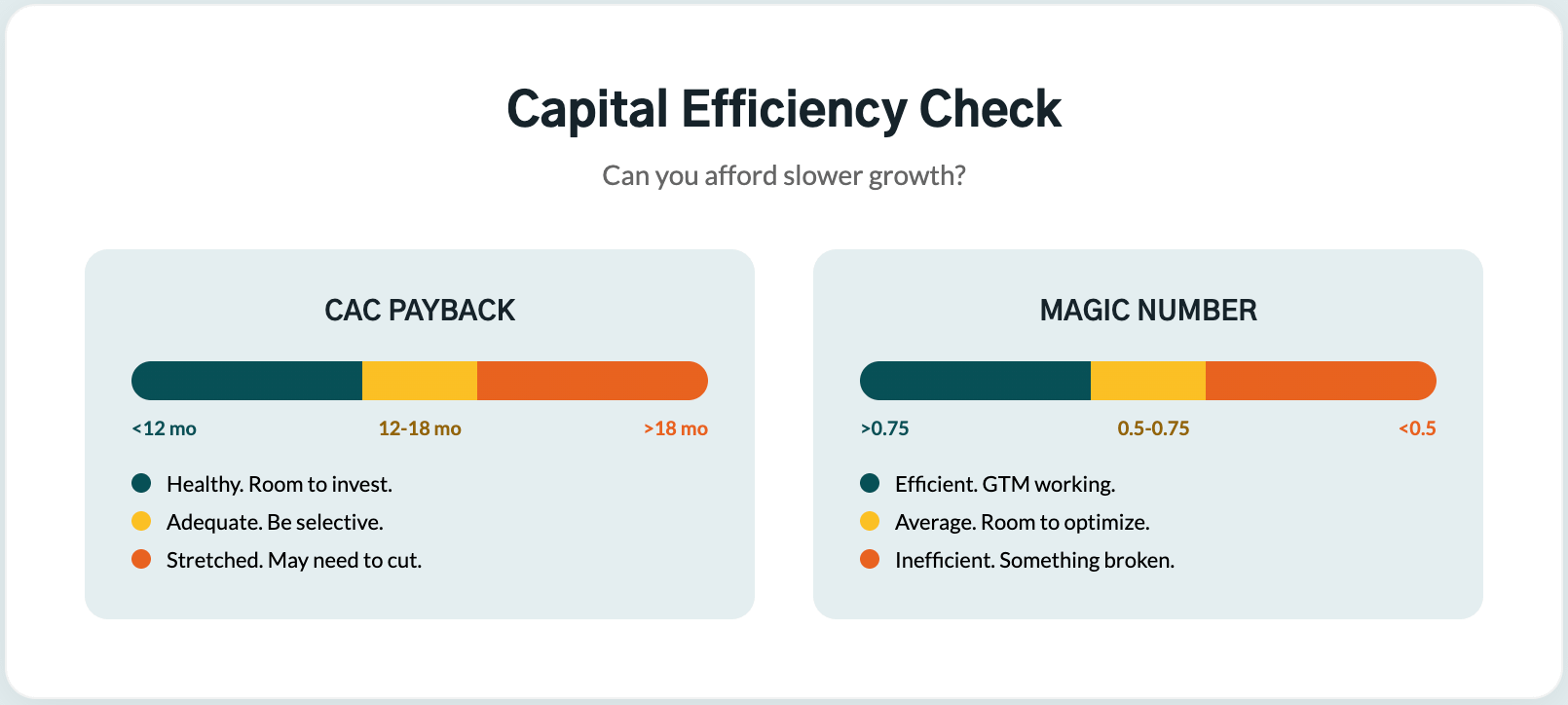
Two numbers matter here: CAC payback and the magic number.
CAC Payback: How many months until a new customer pays back their acquisition cost?
Formula: (Sales + Marketing spend) ÷ (New ARR × Gross Margin) × 12
Under 12 months: Healthy. You have room for strategic investment.
12 to 18 months: Adequate. Be selective with new spend.
Over 18 months: Stretched. You may need to cut regardless of growth impact.
Magic Number: How much new ARR do you generate per dollar of sales and marketing spend?
Formula: (Net New ARR this quarter) ÷ (S&M spend last quarter)
Above 0.75: Efficient. Your GTM engine is working.
0.5 to 0.75: Average. Room for optimization.
Below 0.5: Inefficient. Something is broken.
Write down your numbers:
CAC Payback: _______ months
Magic Number: _______
If payback is over 18 months, the math may force cuts regardless of what your forecast says. You are spending cash faster than customers pay it back.
If payback is under 12 months and your magic number is above 0.75, you might have room to invest, not cut.
Now combine both lenses.
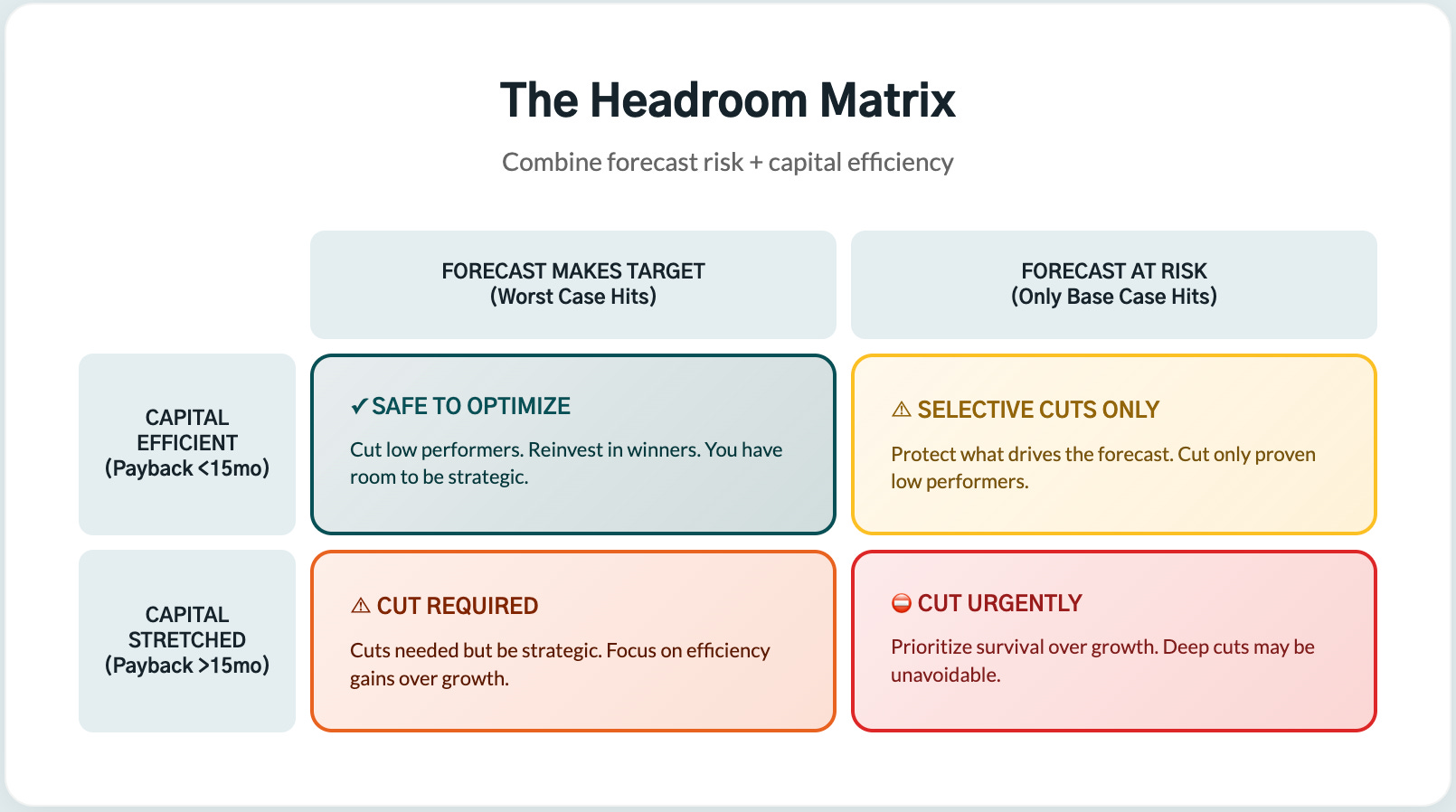
Where do you land?
A VP of Revenue faced pressure to cut 20% from GTM. We ran the numbers:
Forecast: Best $2.8M, base $2.4M, worst $2.0M. Target: $2.3M.
Fragile assumptions: Two enterprise deals (40% of base case)
CAC Payback: 14 months
Magic Number: 0.68
Diagnosis: moderate headroom. Base case made target, capital efficiency was adequate. They could cut, but not aggressively.
The fragility test revealed the constraint. Those enterprise deals depended on sales engineering support. Cutting the SE team would directly threaten the forecast.
They cut 15% instead of 20%, protected everything touching those deals. Hit the quarter.
Before you move on:
Do your three scenarios make the number? If only best case hits target, pause before cutting anything.
What are your three most fragile assumptions? Write them down. Then ask what spend protects each one.
What is your CAC payback? If it is over 18 months, cuts may be unavoidable. If under 12 months, you have options.
Getting this right prevents two mistakes:
Cutting too deep when you actually have headroom, sacrificing growth you could have kept.
Cutting too shallow when capital efficiency demands action, delaying pain that compounds.
The stress test takes fifteen minutes. It turns “how much can we cut?” into “how much should we cut?” Those are very different questions.
Build your three forecast scenarios. Calculate your CAC payback. Plot yourself on the headroom matrix.
You now have three data points: constraint, coverage, and headroom. One more diagnostic (Part 4) before you are ready to decide what to cut.
You know your constraint. You know your real coverage. You know your headroom. Now we find exactly where efficiency breaks.
Next week, we map your conversion fragility stage by stage. Because if you are going to fix something, you need to know precisely what is broken.
The question we will answer: Is it a sales problem or a structural one?
Comments
Nothing yet. Say the first thing.
Sign in to join the conversation.