
Although part of the Founding Cities Narrative, this small essay on the difference between emergent-order and top-down state-formation also works well as a standalone piece. Links to Ch. 1 may be found here, and the first installment of Ch. 2 here.
Now that our villagers, priests, and astronomers are all at work, building the first sedentary societies, it’s time to move on to politics and government. But as it turns out, we still haven’t reached kings and the first great civilizations yet.
A good reason to look at Gobekli Tepe and Catalhoyuk before moving on to the traditional Sumerian city-states that tend to dominate discussion of the first civilizations, is because of what Gobekli Tepe and Catalhoyuk appear to not have. As far as we can tell, Gobekli Tepe, Catalhoyuk, and many other very early settlements and villages were examples of complex human societies with many people, sophisticated buildings and artwork, as well as rudimentary trade and industry…but without an overbearing political class of kings or warriors.
This is interesting and appears to go against our traditional myths and legends about early history, which are full of stories of kings founding cities, kingdoms, and peoples. Most famously, take the story of Romulus and the founding of Rome. In legendary Roman history, Romulus picked a spot, built his walls (killed his brother), and then opened the gates of the city, because he needed people to actually rule over. Greek myths are full of legendary heroes who found cities and become the fathers of great nations.
This is a little odd if you pause to think about it for a moment; why would someone declare a kingdom with nobody in it, and why would people voluntarily choose to come and put themselves into submission under a king? This narrative also presupposes that peoples needed kings and rulers in the first place, as if nobody could live together without a king to give them order and laws. What if this is perhaps a bit of kingly propaganda?
Bottom-up…
There certainly are settlements and cities in history laid out by rulers from scratch (sometimes, as in Alexandria or Constantinople, named after a founder) who directed where buildings, streets, and city walls would go, often in precise grid patterns and following geometric or mathematical rules. Many modern cities also fit this pattern. Take a look at an aerial picture of Chicago or Los Angeles sometime, and you’ll see streets which run along for miles in a straight line. It takes power to tell people to line up.
But there are also many (probably more actually) settlements which existed first, and only then were taken over by a ruler or king. You can often tell if a settlement grew up organically by whether or not buildings and streets were laid out rationally, according to a predetermined plan, or haphazardly, by people who just built wherever was convenient at the time. This is partly why so many old European cities today have charming narrow streets that twist and wind down medieval neighborhoods. If you live in a rural area, you may drive along farm roads originally picked out by horses or cattle trying to find the easiest route to market. Such roads tend to follow the natural curves and elevations of the landscape, as opposed to industrial highways and railways, which often cut through nature in straight lines.
Many things in life are self-organizing, emerging from the bottom up as humans and animals figure out on their own what works best in a given environment. Markets are one of the most extraordinary versions of this, managing to coordinate incredible amounts of information across huge networks, all by something as simple as price signals.
Every day, humans make billions of small (and large) decisions which are unplanned, and often not very rational (which restaurant for dinner? Which product on Amazon? What show on Netflix?). No person, committee, or even supercomputer could begin to categorize all this information and predict where something will need to be in a warehouse six months from now, in order to satisfy your passing whim when you make an impulse-purchase. Yet attaching prices to goods and services filters out how much people desire or need things in an astoundingly complex operatic ballet which is all around us, and mostly taken for granted. This is the genius of Adam Smith’s famous invisible hand, and the “knowledge problem” that Friedrich Hayek diagnosed as the core weakness of totalitarian states and central planning. To say that Communism failed because it couldn’t predict which laundry detergent you’d prefer is both making trite of the thing, and also profoundly true.
Many more things in life are organized this way than we often realize (we have rules of the road, but nobody tries to direct thousands of cars on the highway all at once). American life in particular is famous for this sort of bottom-up social living, where small groups of people identify common problems and find solutions all on their own. The Puritan colonists had no British army to help them against the Indians, so they formed militias and elected their own officers. In addition to its tradition of entrepreneurship and innovation, American history is full of self-organized associations that took on charitable works and social causes, such as fighting poverty, slavery, drunkenness, and forms of discrimination.
This sort of emergent order within societies probably played a bigger role in early history than we realize precisely because it’s not very visible to us. One feature of small organic communities is precisely that they are difficult for outsiders to understand, with lots of unwritten rules, conventions, and traditions which are closely held, or even secret. When it comes to archaeology, most of what survives from early history tends to be grand structures and monuments built by kings and Pharaohs who wanted to be remembered. If a small village ran its own affairs through an informal network of farmers working together and meeting in someone’s house, much less would remain for archaeologists to find. It’s quite likely that entire societies with complex forms of organization and problem-solving in early history, are almost invisible to us in the archaeological record.
So, one rule of thumb when thinking about very early history is that there was probably far more bottom-up informal organization of society than we can easily observe.
…Vs. Top-Down
Once we understand the role of bottom-up emergent order within society, we can better appreciate and understand how and why top-down rule from above plays an important role in history as well.
There are challenges that can be more easily solved from the top, with a clearly-defined leader who can identify a problem, come up with a plan, organize resources, and direct people towards a solution. Crises and emergencies are situations where top-down leaders shine; if there’s a fire in a crowded theater, you don’t want to call a vote or form a committee to discuss the problem. Humans naturally respond to and rally round decisive and confident leadership in a chaotic or dangerous situation. Businesses have CEOs, armies have generals, modern nations have presidents, and ancient kingdoms had kings, who all fulfill this role to varying degrees.
Top-down leaders can often solve problems at scale, directing large numbers of people towards one central solution that isn’t clearly obvious from the ground-level of society. Sometimes when systems or institutions get stuck or break down, firm leadership from the top is necessary to break through the logjam and get things moving again. Many of the greatest buildings, monuments, and works of art, from paintings to movies, are the product of a single person with an overarching vision. Although there are some notable exceptions, committees often ruin more works of art by making too many suggestions or changes that hamper or dilute a single artistic vision.
There are downsides to top-down leadership, however. Because bottom-up emergent-order associations are diffused and decentralized, the damage that any individual “node” in a system can do is often limited. Top-down leadership is like fire; its very power can make it wildly dangerous. Incompetent or tyrannical leaders are the greatest man-made dangers in history.
In early human history, top-down leaders who became the first kings were very much a double-edged sword. They helped create the first cities and civilizations, unlocking many other developments which we consider essential achievements of the human story. Our very word “civilization,” implying the highest, best, and most refined of human activities, is fundamentally tied to the invention of cities. We have marveled at the Egyptian Pyramids, built as tombs for the Pharaohs, for over forty-five hundred years. The world is in many ways richer for the achievements of kings and emperors, the greatest of whom were compared to gods and hailed with plaudits and titles. And their achievements make us strangely quick to excuse or ignore their downsides. Alexander was responsible for the deaths of millions, yet we almost universally call him, “the Great.”
Kings helped jump-start civilization, but they often did so by coercion and violence; issuing orders and collecting taxes by force, and limiting freedom of action. And kings could wage war on a larger scale, leading hundreds and soon thousands of men into battles against other peoples. Just as the Industrial Revolution and nationalism helped make World War I massively more lethal than previous wars, developments in state-building and top-down rule often strengthened a government’s monopoly on violence. The Babylonian Epic of Gilgamesh is the oldest known surviving epic poem, and recounts the heroic deeds of Gilgamesh, Sumerian king of Uruk. Gilgamesh is a great hero, who slays monsters and defies the gods themselves. Yet the poem also opens with a dark passage describing how Gilgamesh oppresses the people of Uruk, taking their daughters for himself, and sending their sons off to war. The prologue of the poem specifically emphasizes how Gilgamesh built the mighty walls and temples of Uruk, which remained visible monuments long after his rule.
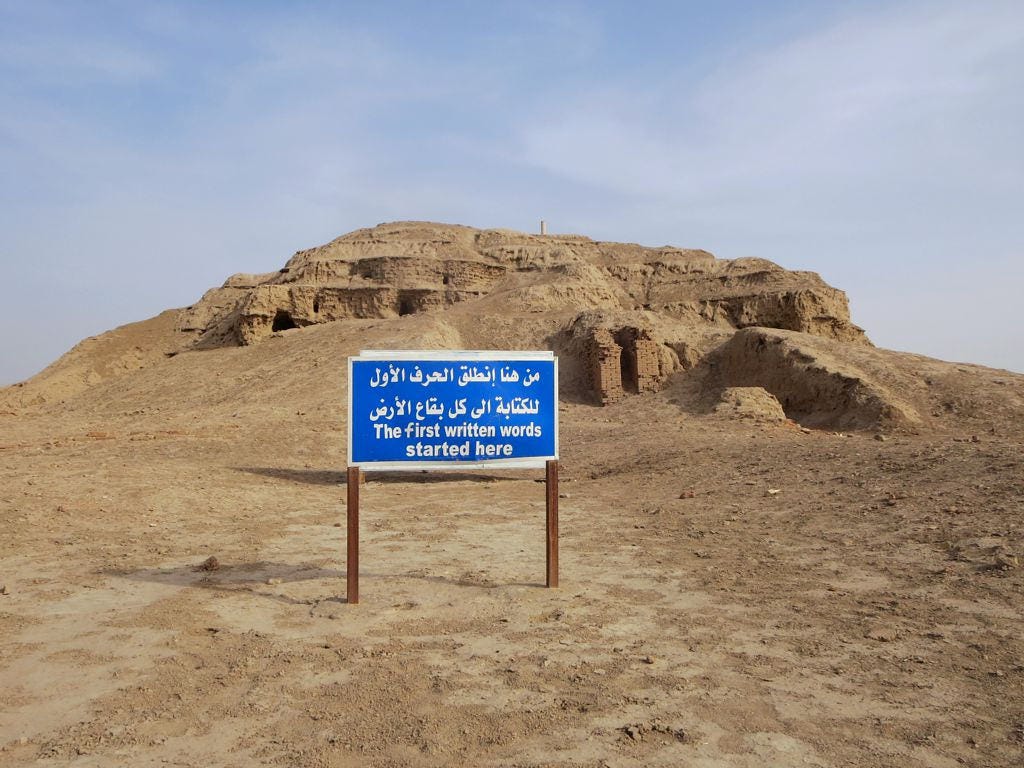
Even as the first kings played an important role in the creation of civilization, their rule was not always popular. In fact, many individuals in the first cities and kingdoms may have been worse off than their hunter-gatherer ancestors. Even permanent sedentary farming itself wasn’t an obvious improvement. The old textbook narrative of “primitive hunter-gatherers giving way to cities and kingdoms” can give us a false sense of progress and seeming improvement. There’s a natural assumption that each stage of historical development must be “better” than the one which came before it. But very often, the earliest stages of major historical changes have real downsides and trade-offs.
Which we shall talk about next time.
Coming in two weeks: two steps forward, one step back.
No posts
Comments
Nothing yet. Say the first thing.
Sign in to join the conversation.