
At Patch plants we call her Ariel but you might know Pachira aquatica as the Money tree or French Peanut. It’s one of our favourites for adding a soft foliar feel as well as a canopy effect in grouped planting schemes but is as striking as a standalone, feature plant. Despite their unusual, tropical appearance, Pachira are easy to look after and in the right conditions with the right care, will flourish. Let’s plunge into the watery origins of this peculiar plant.
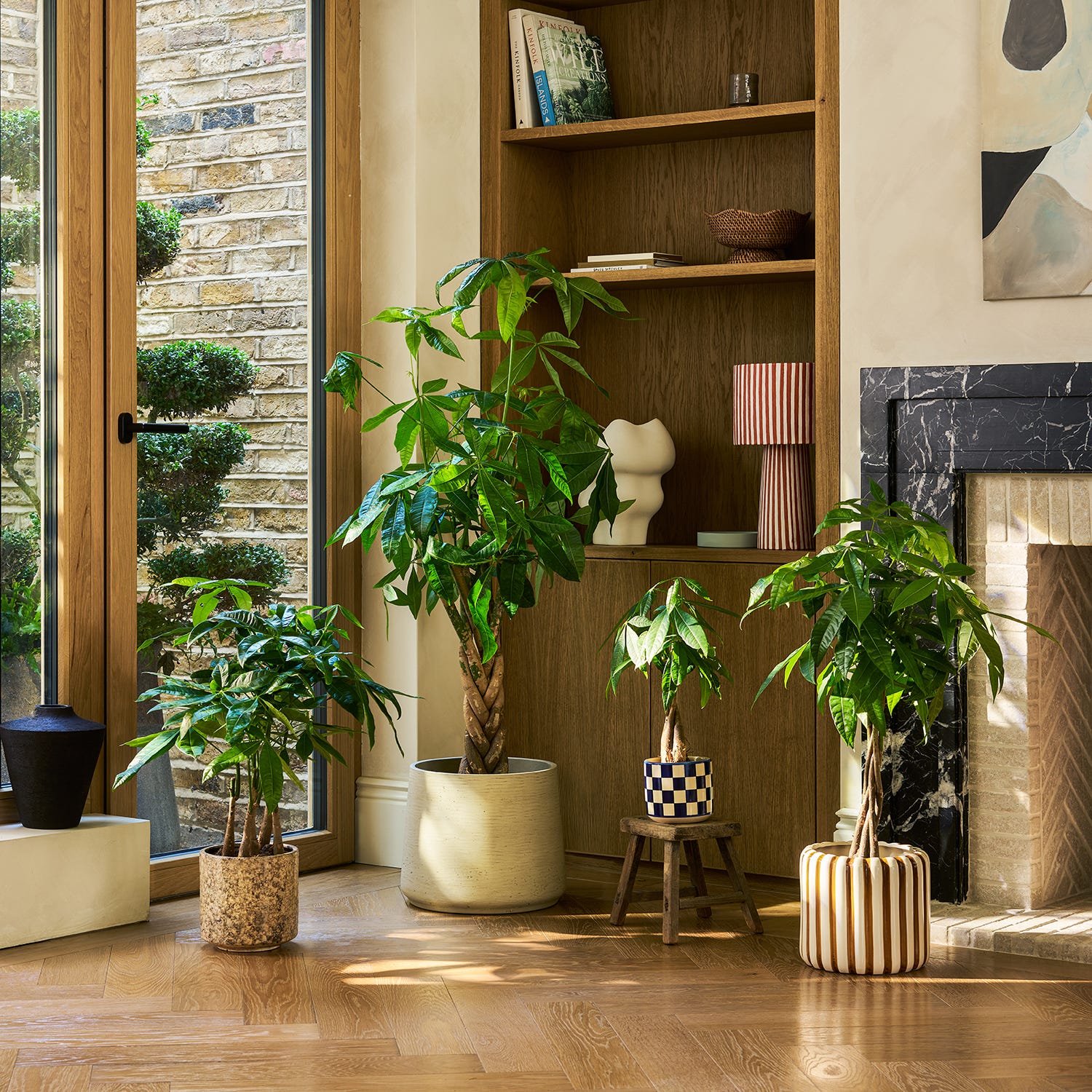
It’s quite possible that what you know as Pachira aquatica is in fact Pachira glabra, the two look extremely similar (with their differences only becoming visible at maturity) and are often confused by Growers and within the houseplant community.
Pachira aquatica originates in Central and South American wetlands (clues in the name ‘aquatica’) and has bright green palmate leaves that are held up on sturdy stems, forming tiered layers. In the boggy ground of a tropical swamp this tree would reach great heights (20 meters or more), but in a pot that inhibits how far and deep its roots can spread, it remains a manageable size for most homes.
Mature trees have the most unusual firework-like flowers, up to 30cm in size and distinguished by a mass of filamental golden and red-tipped stamens, ripe for pollination. As a houseplant grown in the temperate climate of the UK, your plant is unlikely to flower, but knowing what it would look like if it did makes it all the more marvellous.
Once pollinated by either bats, moths or honey bees, the flowers form a fruit that looks like a large woody pod containing up to twenty-five seeds or nuts encased in a downy protective fluff. It’s here that this tree gets some of its most common nicknames, Provision tree, Malabar Chestnut, French Peanut and Guiana Nut, because both raw and roasted, they’re a popular protein packed snack as well as a staple flour when ground. The young leaves and flowers are also picked and eaten as a vegetable by locals across Tropical America and parts of Africa.
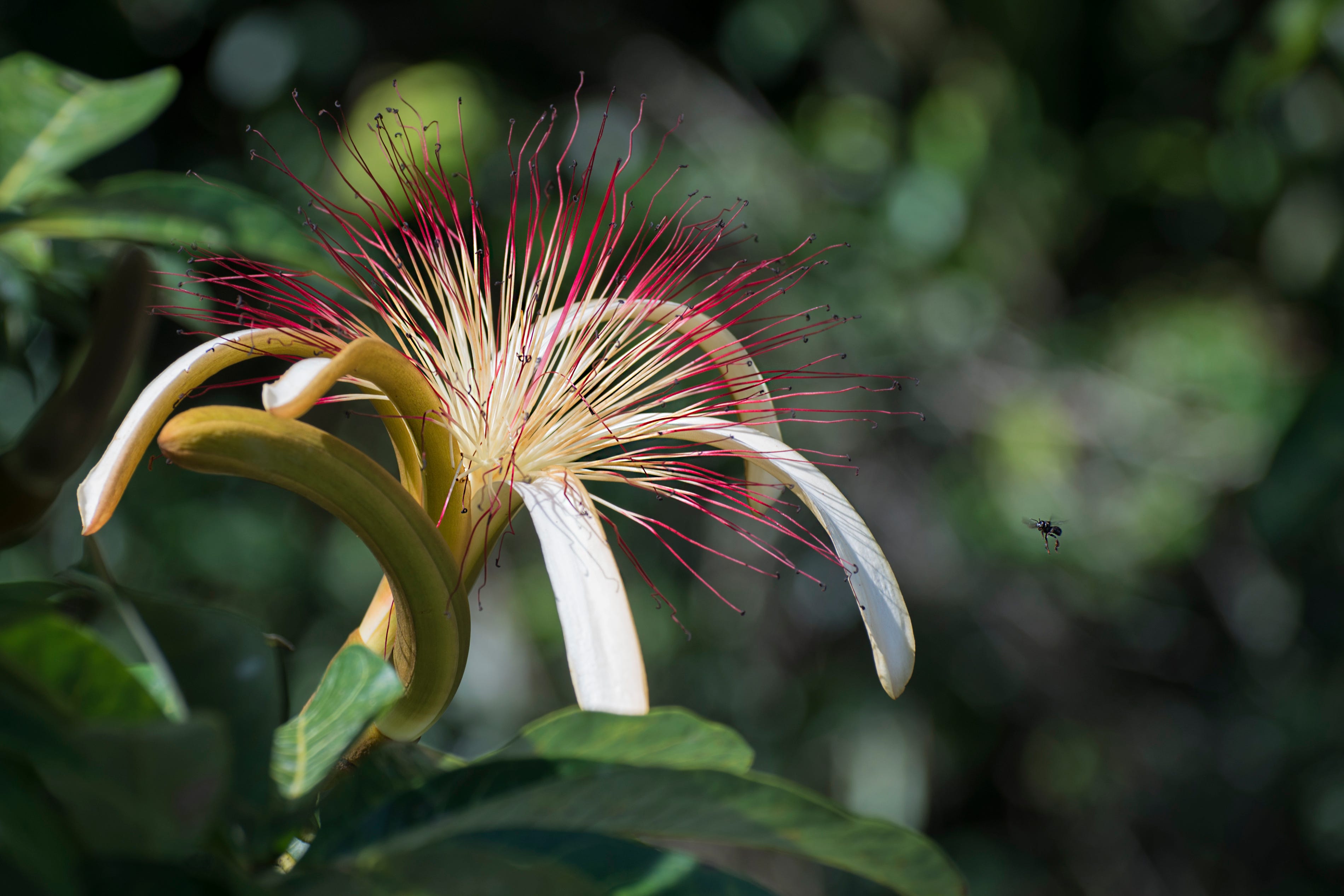
Image thanks to OMeidl on iStock
There are many houseplants referred to as ‘Money plants’ — which says a lot about the capitalist economies we live in from an Ethnobotanical perspective — but Pachira aquatica only coined this common name in the last couple of decades. From humble beginnings too. Legend has it that in 1896 a Taiwanese truck driver planted five small seedlings in one pot and took it upon himself to weave them together as they grew. The result was so aesthetically pleasing that it took off as a houseplant trend, soon becoming popular in Taiwan, Japan and eastern Asia.
This braided tree has become associated with financial luck, profit and prosperity, not only because of one man’s rags-to-riches story, but because of the numerological significance of the number 5. The five saplings braided together and the Pachiras palmate leaves that are divided into five leaflets together symbolise the five elements: Earth, Wind, Fire, Water and Metal. As such, Pachira aquatica has become a popular office plant throughout Asia, thought to help a business thrive. Whether one perceives this belief as grounded in science or superstition, one can’t dispute the power of positive thinking.
The fact is, grown as an indoor plant, Pachira will thrive in a domestic or business environment. While 50% of the charm of this houseplant is its plaited trunk and umbrella-like growth, the other 50% is how easy it is to care for.
Position your Pachira somewhere with plenty of bright indirect light. Too much harsh direct sunlight might scorch its leaves, causing translucent patches. Too little light and your plant will grow slowly and have thinner, weaker stems with long internodes, creating a ‘leggy’ effect.
Water your Money plant when the top two inches of soil feel dry. In a nice bright spot this is likely to mean watering every week in mid-summer and every two to three weeks across spring, autumn and winter. From my experience, they’re often planted up into a dense, fibrous, water-retaining potting medium which makes it tricky to stick your finger in to do the dip-test for watering. This means you’ll have to rely to some degree on your powers of observation and knowledge of the plant’s adaptations.
Did you know?
Pachira aquatica has evolved to store water in its trunk. Despite (or perhaps because of) being a bog plant in the wild, overwatering your Money tree as a pot plant can result in the plant pushing excess water out through the edges and tips of its leaves through a clever strategy called guttation. This is a helpful sign to look out for if you think you might be overwatering your plant. See the video below.
Feed your plant with a liquid plant food as and when you water, every two weeks throughout the growing season, from April through to October. This will encourage healthy foliar growth by keeping the levels of nitrogen, potassium, phosphorus and micro-nutrients in ready supply.
Keep the temperature up and the air on the humid side. Remember, Pachiras are tropical plants that need temperatures above at least ten degrees and they really enjoy higher humidity. The effects of dry air are likely to be brown, crispy leaf tips and edges. Find out how to increase the humidity around your houseplants here.
Repot your plant every two-to-three years, removing some of the existing soil around the roots and replacing this with fresh houseplant potting compost that has been formulated specifically to retain some moisture but not hold on to too much. This is generally suitable for all lush, leafy, tropical indoor plants. Be sure to use a nursery pot with drainage holes to avoid waterlogging and be weary of going up too many pot sizes at once. Only one or two sizes bigger will do just fine.
Prune if necessary. From spring onwards you’ll notice rapid new growth, with the canopy stacking up in tiers. If you have room for your Money tree to grow with reckless abandon, then there’s no need to prune it. But if you do need to manage its size, it’s easy to prune by snipping back the new growth to just above a node. The advantage of pruning is the creation of a fuller, bushier canopy of leaves as the plant’s energy is redirected back down the stems. This is also a prime opportunity to harvest some cutting material to propagate new plants from.
Propagate! If you do take stem tip cuttings - either deliberately or as the side effect of pruning - make a cut just below a node, remove any lower leaves and pop the stem into a glass of water on a sunny windowsill. Keep the water topped up and refreshed regularly. And be prepared for some curious results!
As you’ll see in the video below of some cuttings I took a couple of months ago, the tissue on the stems has formed a combination of a gelatinous substance together with a thickened white crumbly callus around the cut. While rather gross to look at, and often confused with rot, this strange behaviour prevents decay, helps the wound (cut) heal and creates the right conditions for root development.
Once roots have grown, this hydroponically created cutting can be potted up into a small pot of compost. Keep the soil consistently, lightly moist but not saturated for the first few weeks, until you see signs of increased root and shoot growth. While the result is a natural single stemmed young plant, there’s no reason why you couldn’t have a go at potting five cuttings in the same pot and weaving together the pliable young stems as they grow. Be sure to keep an eye on your investments in case they grow too 😀
We’ll leave you now, after this little glimpse of the weird and wonderful that is Pachira aquatica or the Malabar Chestnut. If you’ve had the privilege of tasting nuts from a full grown tree then please drop us a message to let us know how they tasted. For the rest of us, we’ll add it to our travel aspirations.
Happy growing.
Comments
Nothing yet. Say the first thing.
Sign in to join the conversation.