

Think about the last time you searched online for a local service or a product you wanted to buy.
You probably opened several websites, clicked through a few social media profiles, and compared your options. At first, each business seemed different. But after a few minutes, they all started sounding remarkably similar. They all promised excellent customer service, high-quality products, years of experience, and a commitment to putting customers first.
By the time you finished comparing them, you might have struggled to remember which business said what.
That’s because most businesses don’t intentionally become forgettable. They simply end up saying the same things everyone else is saying.
It’s understandable why this happens. When we’re writing a website or creating marketing materials, we naturally look at what others in our industry are doing. We borrow familiar language because it feels safe. If everyone else talks about quality, professionalism, and exceptional service, it feels risky to do something different.
The problem is that if everyone sounds the same, no one stands out.
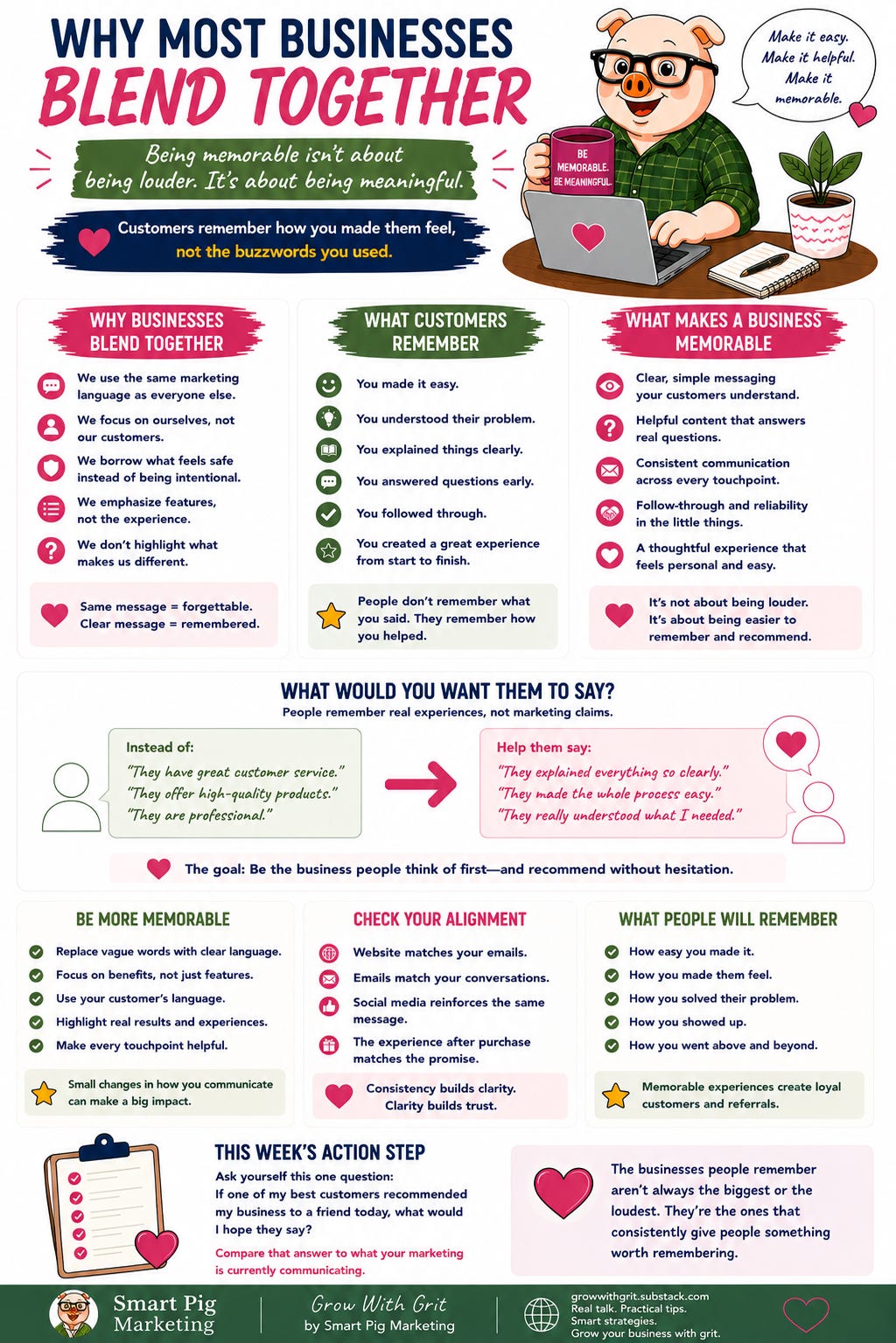
Customers don’t remember businesses because they used the same adjectives as everyone else. They remember businesses that made something easier to understand, solved a problem they were struggling with, or made them feel confident that they’d found the right place. Those experiences leave a much stronger impression than another claim about excellent customer service.
One of the biggest misconceptions about marketing is that being memorable requires being louder or more entertaining.
In reality, memorable businesses are often surprisingly simple.
They explain what they do in language their customers understand. They answer questions before they’re asked. They communicate consistently, follow through on their promises, and create an experience that feels thoughtful from beginning to end. Customers remember them not because they shouted the loudest, but because every interaction made them think, “That was easy.” Or, “They really understood what I needed.”
Those are the kinds of experiences people tell their friends about.
I’ve found it helpful to ask a simple question whenever I’m working on marketing:
“If someone recommended my business tomorrow, what would I want them to say?”
Not what I’d like them to remember about my logo or my tagline.
Not what I’d hope they noticed about my website.
What would they actually say?
Would it be, “They’re really knowledgeable.” Or, “They explained everything so clearly.” Maybe, “They made the whole process so easy.” Those are memorable descriptions because they’re based on real experiences rather than marketing language.
If you’re not sure how people would answer that question, ask a few customers or trusted friends. Their responses can be incredibly revealing. Sometimes they’ll highlight strengths you didn’t realize you had. Other times, you’ll discover that the thing you’re trying hardest to communicate isn’t the thing people remember at all.
That’s valuable information because it gives you an opportunity to become more intentional.
The businesses that stay top of mind aren’t necessarily creating more content than everyone else. They’re creating a consistent experience. Their website sounds like their emails. Their emails sound like the conversations customers have with them. Their social media reinforces the same message people experience after they buy. Over time, all of those small interactions create a clear impression that’s easy to remember and even easier to recommend.
The encouraging part is that becoming more memorable doesn’t require reinventing your business.
It often starts by replacing vague language with clear language. It means focusing less on describing yourself and more on helping customers understand the value you bring. It means looking for opportunities to make every interaction just a little more helpful, a little more thoughtful, and a little easier than people expected.
Those small improvements add up.
Eventually, people stop describing your business with generic phrases like “they were good.” Instead, they begin saying things like, “They’re the ones who always explain things clearly,” or “They made the whole process so simple.”
That’s when your marketing starts working long after the conversation has ended.
Take a few minutes this week to ask yourself one question:
If one of my best customers recommended my business to a friend today, what would I hope they say?
Then compare that answer to what your marketing currently communicates.
If those two things don’t match, you’ve found one of the biggest opportunities to become more memorable.
Because the businesses people remember aren’t always the biggest or the loudest.
They’re the ones that consistently give people something worth remembering.
Comments
Nothing yet. Say the first thing.
Sign in to join the conversation.