

If you’ve been running a business for any length of time, you’ve probably discovered that making decisions doesn’t necessarily get easier with experience.
In some ways, it gets harder.
There are more opportunities than there were when you started. More ideas. More software. More marketing strategies. More people asking for your time. You have enough experience to recognize a good opportunity when you see one, but you also know from experience that not every good opportunity is the right one.
I think that’s where many business owners get stuck.
We’re no longer deciding between good and bad ideas. We’re deciding between several good ideas, knowing we only have the time and energy to pursue one or two of them well.
That’s why I’ve stopped looking for the “perfect” decision.
Instead, I try to ask better questions.
Tracy and I have found that the decisions we regret aren’t usually the ones where we carefully thought things through and made the best choice we could with the information we had. The ones we regret are almost always the decisions we made too quickly because something sounded exciting, felt urgent, or seemed too good to pass up.
Over the years we’ve learned that having a few questions we come back to again and again has helped us make better decisions—not because the questions magically provide the answer, but because they slow us down long enough to think.
The first question I ask myself now is one that probably would have saved Tracy and me a lot of time if we’d started asking it years ago.
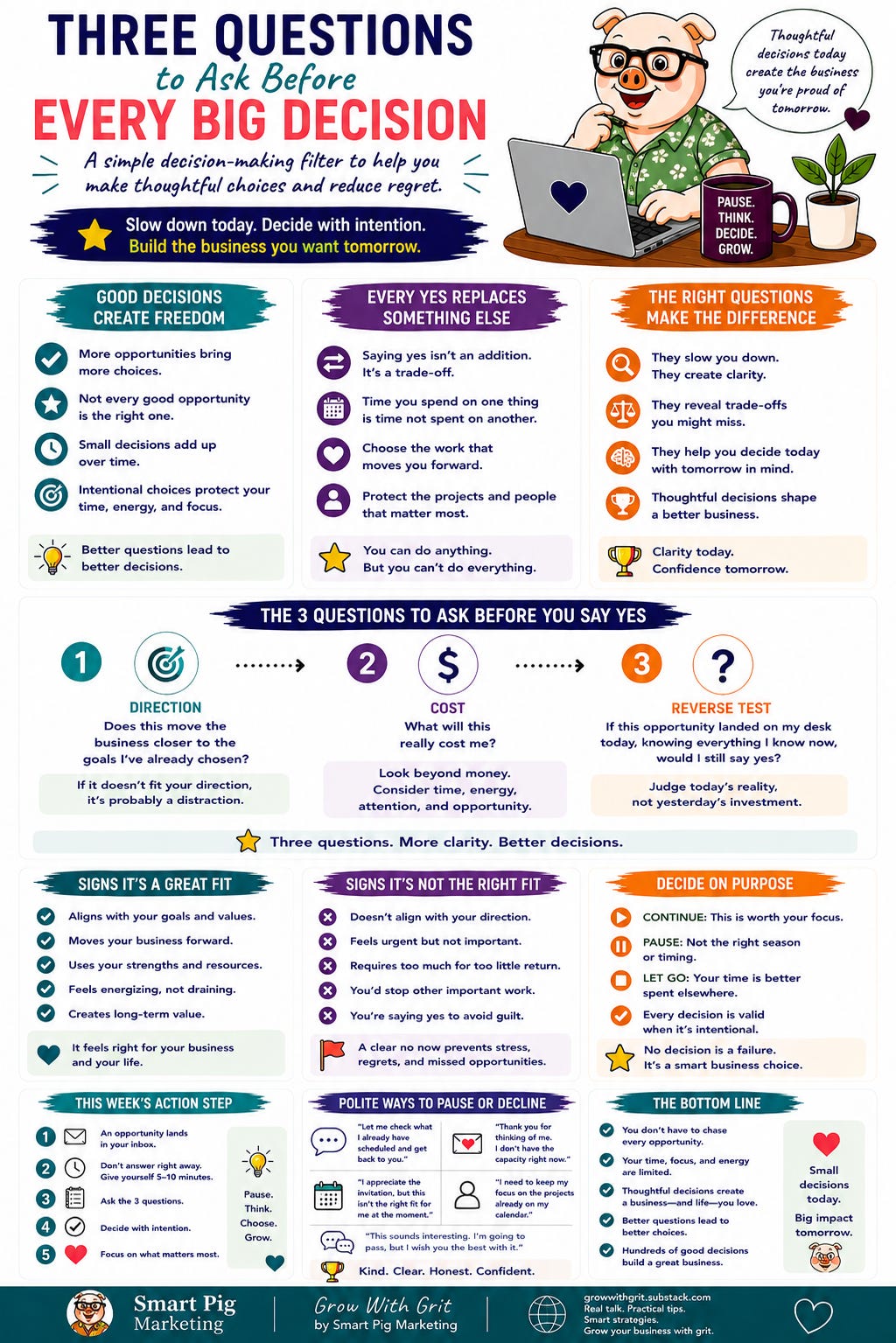
Does this move the business closer to the goals we’ve already chosen?
I like this question because it changes the conversation almost immediately.
Let’s say someone emails you tomorrow with an idea for a collaboration. It sounds interesting. You can already see a few ways it might help your business. Before long, you’re looking at your calendar, wondering where you could squeeze it in.
That’s exactly what I used to do.
Without realizing it, I’d skip right past the most important part of the decision. I wasn’t asking whether the opportunity belonged in our business. I was trying to figure out how to make it fit.
Those are two very different conversations.
Once you’ve started rearranging your schedule in your head, you’ve almost made the decision already. You’re investing your energy in solving a logistics problem instead of stepping back and asking whether it’s the right opportunity in the first place.
That doesn’t mean the opportunity is bad.
It may be an excellent opportunity for someone else.
It may even be something you’d have said yes to two years ago.
The question is whether it fits the business you’re trying to build now.
I think that’s an important distinction because businesses evolve. Tracy and I certainly don’t run our business the same way we did ten years ago. Some opportunities that would have made perfect sense back then simply don’t fit our priorities today.
I’ve learned not to feel guilty about that.
A business that’s growing should become more selective over time. Otherwise, you’re simply collecting more commitments instead of making more progress.
For years, I thought I was pretty good at evaluating costs.
If a piece of software cost fifty dollars a month, I knew exactly what it would cost. If a project required a certain budget, I could work that into the numbers.
The funny thing is that money has turned out to be one of the easier parts of most business decisions.
It’s everything else that’s difficult to measure.
A new software subscription doesn’t just cost the monthly fee. It takes time to learn. You’ll spend an afternoon moving everything over. You’ll probably watch a few tutorials, adjust your workflow, and solve a handful of little problems you never anticipated when you clicked the “Buy Now” button.
Six months later, you’ll still be maintaining one more system.
The same thing happens with projects.
The work isn’t finished when you launch it. Now you have customers to support, updates to make, questions to answer, and another product that needs a place in your marketing calendar.
None of that means you shouldn’t move forward.
It simply means those things deserve to be part of the decision.
That’s why I find myself asking a different question these days.
What will this really cost me?
Not financially.
What will it cost in time? In attention? In energy? What other work will slow down while I’m focused on this?
I’ve found that those answers often tell me far more than the price tag ever could.
There’s one question that has appeared in several articles this week because, quite honestly, I use it all the time.
If this opportunity landed on my desk today, knowing everything I know now, would I still say yes?
It’s such a simple question, but it has a way of cutting through emotion surprisingly quickly.
Sometimes I’ll look at a project and realize I’m only continuing because I’ve already invested so much time in it.
Other times I’ll recognize that I’ve outgrown something, but I’ve kept doing it simply because it’s become part of my routine.
I don’t think either of those is a particularly good reason to continue.
Experience has taught me that there’s a difference between being persistent and being unwilling to let go.
Persistence says, “This is still worth building.”
Stubbornness says, “I’ve already put too much into it to stop now.”
Those can look very similar from the outside, but they’re very different mindsets.
That one question helps me tell the difference.
It gives me permission to evaluate today’s reality instead of yesterday’s investment.
Sometimes the answer is still yes.
Sometimes it’s no.
And occasionally it’s, “Not right now.”
All three are perfectly good answers.
If you’ve noticed a theme running through this week’s posts, it isn’t really about decision-making.
It’s about being intentional.
On Monday we talked about choosing what deserves your attention.
On Tuesday we talked about knowing when it’s time to let a project go.
On Wednesday we talked about protecting your time by saying no.
Yesterday we looked at building a framework for evaluating opportunities before you commit.
Those are all really the same conversation.
They’re about making sure your business grows because you’ve chosen a direction—not because you’ve slowly drifted there one commitment at a time.
I don’t think Tracy and I have become better business owners because we’ve stopped making mistakes.
We still underestimate how long projects will take. We still get excited about new ideas. We still occasionally find ourselves saying, “Well... that seemed like a better idea three months ago.”
The difference is that those moments happen less often because we’ve built the habit of slowing down.
That’s really all these questions are.
A reason to pause.
A chance to think.
An opportunity to make today’s decision with tomorrow in mind.
The next time an opportunity comes your way, don’t answer straight away.
Give yourself five or ten minutes.
Make a cup of coffee. Take a short walk. Grab a notebook if that’s how you like to think.
Then ask yourself these three questions.
Does this move my business closer to the goals I’ve already chosen?
What will this really cost me?
If this opportunity landed on my desk today, knowing everything I know now, would I still say yes?
You may arrive at exactly the same answer you would have given five minutes earlier.
But every now and then, one of those questions will make you stop and see the opportunity differently.
In my experience, those are the moments that shape a business—not because they feel dramatic at the time, but because they’re the quiet decisions that determine where your time, energy, and attention go next.
And over the years, I’ve come to believe that’s how most good businesses are built. Not through one perfect decision, but through hundreds of thoughtful ones.
Comments
Nothing yet. Say the first thing.
Sign in to join the conversation.