

Imagine you’re planning to try a new restaurant.
You’ve never been there before, so before making a reservation you take a quick look online. You read a few reviews, browse the menu, and maybe scroll through a handful of photos. If you’re still unsure, you might visit their Facebook page or website to get a better sense of what they’re like.
What’s interesting is that none of those things tells you exactly how your meal will taste.
Instead, they help answer a different question.
“Does this seem like a place I can trust?”
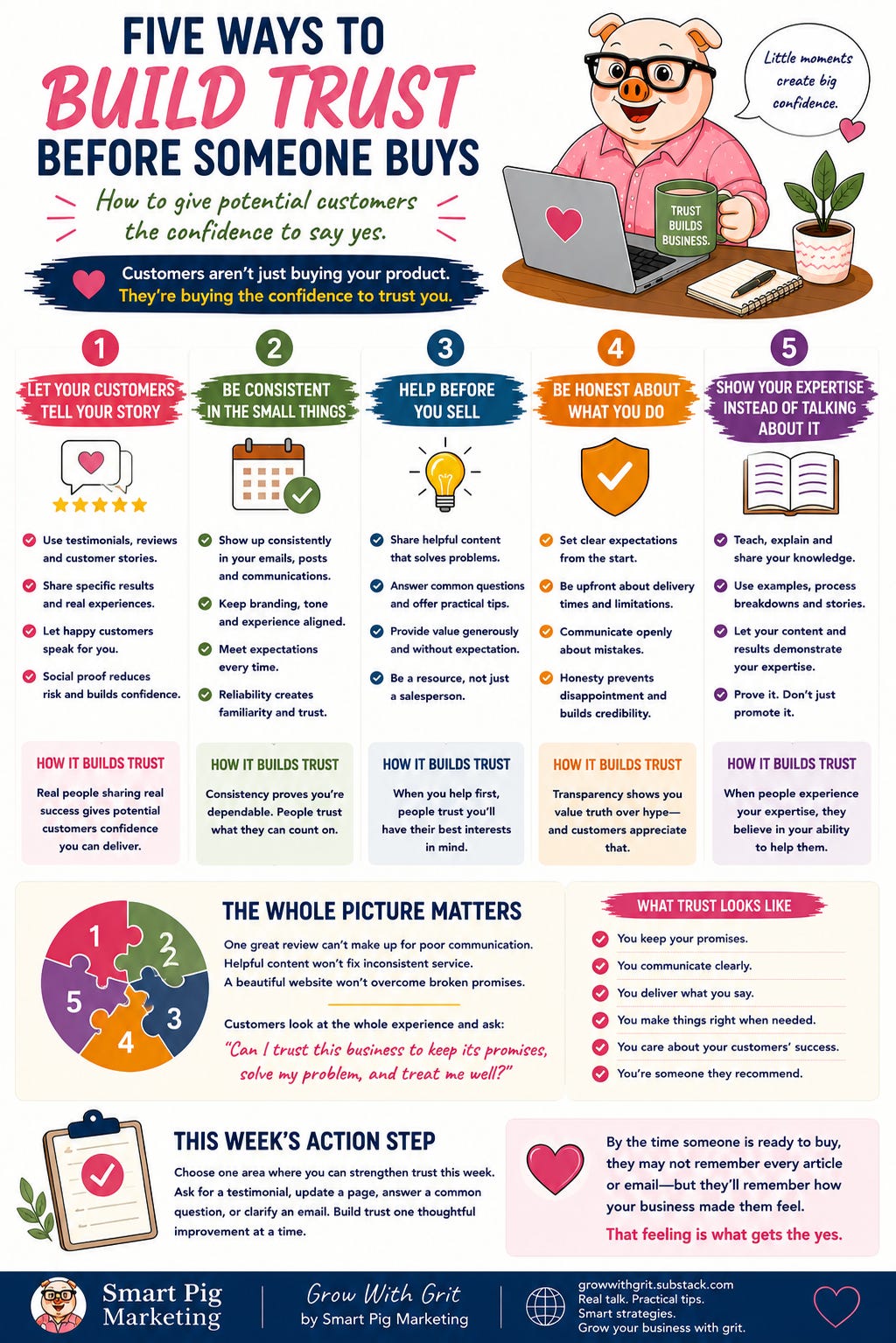
Buying from a small business works much the same way. Long before someone clicks the buy button, they’re collecting little pieces of information that help them decide whether they’re making a good decision. Every interaction with your business either adds to that confidence or quietly chips away at it. The encouraging part is that trust isn’t usually built through one grand marketing campaign. It’s built through dozens of thoughtful moments that, together, make your business feel reliable, capable, and genuine.
Over the years, Tracy and I have found that five habits consistently help businesses earn that confidence.
As business owners, we’re naturally inclined to talk about the quality of our products or the value of our services. The problem is that customers expect us to say those things. After all, we’ve got something to sell.
What carries far more weight is hearing those same things from someone who has nothing to gain.
That’s why testimonials, reviews, and customer stories are so powerful. They provide reassurance that real people have trusted your business before and were glad they did. A thoughtful review doesn’t simply describe a product. It gives a potential customer confidence that they’re unlikely to regret their decision.
This is also why specific testimonials tend to be much more persuasive than generic ones. “Great service!” is nice to read, but a customer explaining how your product solved a particular problem or how you went above and beyond tells a much richer story. Those experiences help future customers picture themselves having the same positive outcome.
Trust grows when people know what to expect.
If your website looks polished but your social media accounts haven’t been updated in two years, people notice. If your newsletters arrive consistently for months and then disappear without explanation, people notice that too. None of those things automatically destroys trust, but they create small moments of uncertainty.
On the other hand, businesses that show up consistently begin to feel familiar. Your readers know they’ll hear from you. Your customers know you’ll respond to questions. Your branding, your tone, and your customer experience all reinforce the same impression.
Consistency isn’t about perfection. Life happens, and every business owner has busy seasons. It’s about demonstrating, over time, that you’re dependable. That dependability becomes part of your reputation, and reputation is one of the strongest marketing assets you can build.
One of the reasons content marketing works so well is that it gives people the chance to experience your expertise before they ever become customers.
Think about the businesses you trust most. Chances are they’ve already helped you in some way. Maybe they answered a question through a blog post, taught you something useful in a newsletter, or shared a tip that saved you time or frustration. By the time you eventually bought from them, you already had confidence that they understood your problem.
That’s exactly what generous marketing does.
Instead of treating every interaction as an opportunity to make a sale, it focuses on creating value first. You answer common questions. You explain complicated ideas in simple language. You share practical advice that people can put to work immediately. Some readers will never become customers, and that’s perfectly fine. Others will remember who helped them when they were looking for answers, and when they’re ready to buy, your business is already at the top of their list.
Generosity isn’t separate from marketing.
Done well, it is marketing.
There’s an old saying that it’s easier to keep a customer than to win back a disappointed one.
One of the simplest ways to avoid disappointment is to set honest expectations from the beginning.
That might mean explaining exactly what’s included in a service, being upfront about delivery times, or acknowledging that your product isn’t the perfect fit for every situation. It can feel uncomfortable to admit limitations because we’re afraid it might cost us a sale. In reality, honesty often has the opposite effect. Customers appreciate businesses that value accuracy over hype because it tells them they’re dealing with someone they can believe.
Transparency also makes it easier to recover when mistakes happen. Every business gets things wrong occasionally. Orders get delayed, emails get missed, and unexpected problems arise. Customers are usually far more forgiving of honest communication than they are of silence or excuses. Owning a mistake and explaining how you’re going to fix it often strengthens trust instead of weakening it.
One of the quickest ways to lose credibility is to spend all your time telling people you’re an expert.
A much better approach is to demonstrate your knowledge through the way you teach, communicate, and solve problems.
When you write helpful articles, answer frequently asked questions, explain your process, or share examples from your own experience, you’re giving people evidence that you know what you’re talking about. You don’t have to convince them with impressive claims because they’re already seeing your expertise in action.
That’s one of the reasons we enjoy writing Grow With Grit each week. We could simply tell readers we’ve been running online businesses for more than twenty years. Instead, we’d rather share what we’ve learned along the way and let those ideas speak for themselves. We believe that’s a much stronger foundation for a long-term relationship.
The same principle applies to every business. Whether you’re a coach, designer, accountant, author, or photographer, your knowledge becomes far more valuable when people can experience it before they become customers.
Trust isn’t built by any one of these habits on its own.
A glowing testimonial can’t make up for poor communication. Helpful content won’t overcome inconsistent customer service. A beautiful website won’t compensate for a business that overpromises and underdelivers.
Customers are looking at the whole picture.
They’re asking themselves whether this feels like a business that will keep its promises, solve their problem, and treat them well after the sale. Every interaction helps answer those questions, which is why trust grows gradually rather than all at once. It’s the result of many small decisions that consistently show people they’re in good hands.
Ready to give this concept a try?
Choose one area where you can strengthen trust this week.
Perhaps it’s asking a happy customer for a testimonial, updating an outdated page on your website, answering a question your customers ask all the time, or rewriting an email so it’s clearer and more helpful. Don’t feel as though you need to tackle all five ideas at once. Building trust is much like building any other part of your business—it happens one thoughtful improvement at a time.
And those improvements have a way of compounding.
By the time someone is ready to buy, they won’t remember every article they read or every email you sent. They’ll simply have a feeling that your business is one they can rely on.
That’s exactly the feeling great marketing is meant to create.
Comments
Nothing yet. Say the first thing.
Sign in to join the conversation.