
I’ve always been fascinated by product positioning. Largely because it is deeply rooted in human psychology and has a profound impact on the success of a business. So, what better topic to cover in the first issue of this newsletter than the ingredients for a powerful positioning strategy!
You’ll learn what exactly is positioning, its importance, the building blocks of positioning, and the process for creating positioning. All the concepts shared in this issue are backed by examples from the SaaS space.
Well, let’s get two things straight:
It’s not something marketing/product people use to sound witty 😉
It is not the same as messaging or value proposition
If you search, the majority of the definitions say that positioning is designed to carve a unique image or perception of a brand in the minds of customers.

Slack = Workplace collaboration
While positioning influences the perception, this explanation doesn’t expose behind the scene processes or the positioning strategy. So, here is an effort in that direction:
”Positioning is establishing how a product is the best at something for a specific set of customers who deeply care about it.“
This acts as the cornerstone of the go-to-market strategy. All the messaging (things a brand says) and campaigns are devised according to the positioning. So yes, that also includes the carefully crafted title text in large font presented on a website’s homepage.
Let’s now consider HubSpot for example:
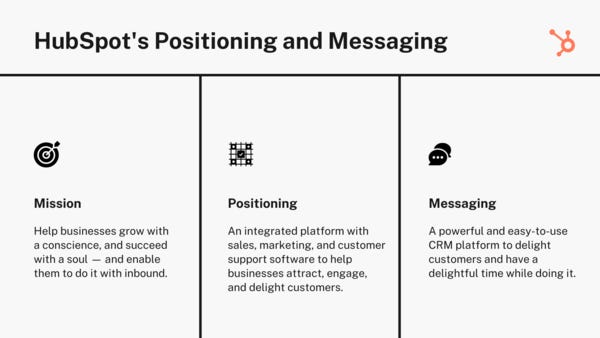
Mission → Positioning → Messaging
Let’s now explore how positioning deeply impacts the success of a business.
I believe the most important benefit of positioning is that it creates an internal north star to keep people aligned. Everything else stems from that.
Here is something Steve Jobs said during the launch of the “Think Differently” campaign:
“This is a very complicated world; it’s a very noisy world. And we’re not going to get a chance to get people to remember much about us. No company is. And so we have to be really clear on what we want them to know about us.”

Do you know the year?
This video is from 1997. If the world was complicated and noisy in 1997, think about our current state. Add the pandemic, metaverse, and inflation into the mix to take the complications to the next level.
Hence, the clarity on the things want to say and expect our customers to remember about us can only be done with a clear positioning.
Let’s imagine I’m talking about a “to-do list” app. You’d think that it must allow me to add tasks, set due dates, categorize tasks, add tags, etc. Probably consider Microsoft To Do, Google Tasks, Todoist, and Trello as its competitors. Pricing-wise, looking at other players, it could have a freemium model.
As you can see just two words are enough to invoke a series of thoughts!

A clear positioning allows us to craft sharp messaging so we can set the premise for our target audiences to form the right kind of notion.
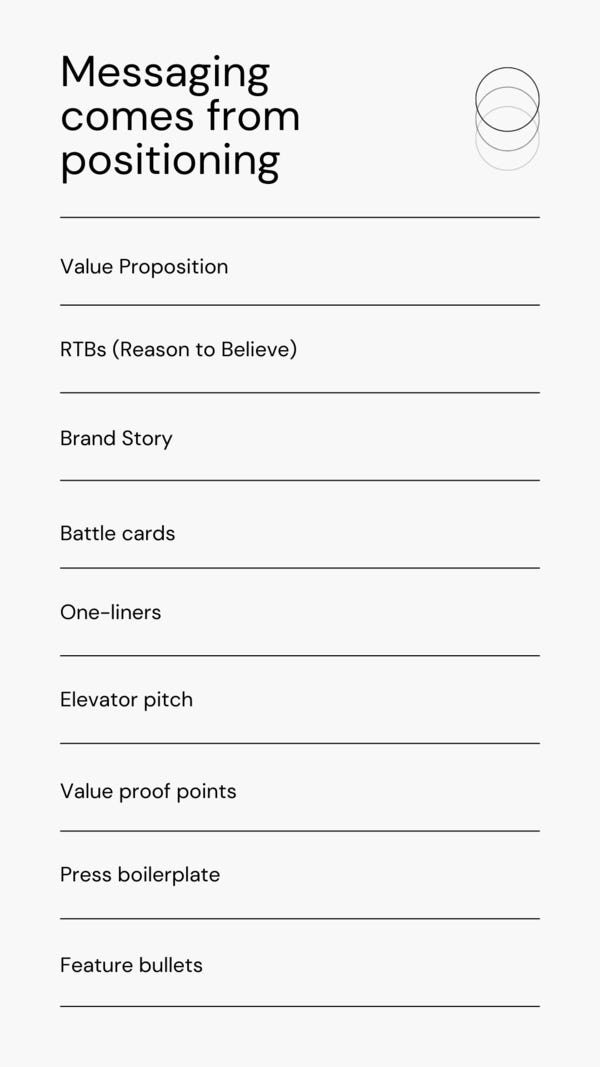
All the marketing campaigns are designed to propagate these messages across different channels.
The end results are the following:
Product is easier to sell
The company acquires the right type of customers
Attracts the right type of partners
We discussed the impact of things we say with positioning. But, what about the things we do? Since positioning allows us to set the internal north star, we can avoid dilemmas and make the decisions to achieve the north star.
In other words, positioning instills discipline and makes us decisive.
Continuing the previous example, let’s consider that the to-do list app is designed for personal use only. That means if we get a potential customer looking for a team messaging feature, we can confidently say that we’re not going to build this feature.

The ability to say no allows you to ruthlessly focus on the right set of customers and build solutions for their hardest problems.
Building blocks of positioning
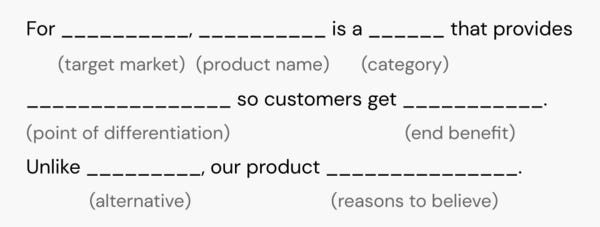
A simple web search will show you templates for creating positioning. Largely there are two types of templates:
1. Positioning statement
2. Positioning canvas
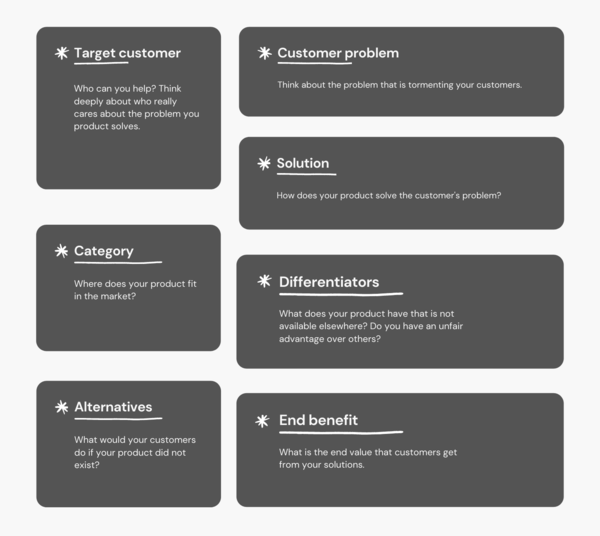
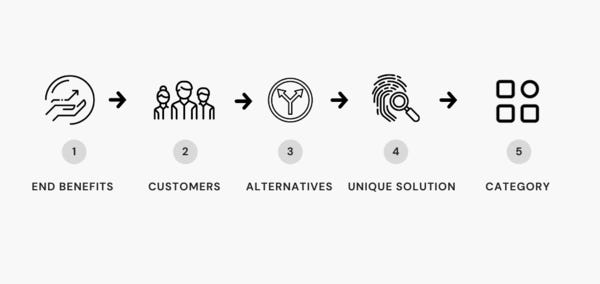
Whether you select the statement or a fancy canvas doesn’t matter. That’s because these are rooted in five essential components. However, the way we approach them sequentially matters.
Whenever a business starts it sets out to solve a specific problem and help customers achieve something. I like to start with that – so the first component will be the end benefit or value delivered by the product. Then we can think of the customers who are most affected by the problem and deeply care about the benefits the product offers. These customers will be the ideal customers. The next step is to look at the alternatives that the customers could use if the product didn’t exist. Once we zero in on the alternatives it is easier for us to frame the point of differentiation, i.e., what makes the product’s unique solution best for the customers. Finally, we look at the market category to help customers draw a reference point and easily understand the value delivered by the product.
Let’s now go through each component and look at the examples:
End benefits
This is the value your product will deliver, i.e., the outcome customers will experience after using the product. Most people are selfish – we care about ourselves. So, consider the following:
Dig into the underlying problem.
Be absolutely clear about the value.
Narrow down a maximum of two or three values.
Don’t go overboard (Coca-Cola can afford to say that they sell happiness) and keep it realistic.
For example, an AI-based copywriting tool’s end benefits are about improving productivity, efficiency, and scaling content marketing. Slack is about team productivity and transparency. Tribe‘s (disclosure: I work here) end benefits are stronger customer relationships and a community of engaged and loyal customers.
Customers
Think deeply about who cares the most about the value your product is best at delivering. Things to consider:
Try to be as sharp as possible to be able to focus on one or two target audiences.
Leverage both first-party (e.g., onboarding stage) and third-party data (e.g., Clearbit enrichment) to learn more about customers.
Customer interviews are the gold mines. Chat with customers you deem perfect to find the common denominator (more on this later).
Things get tricky when your product is horizontal—but you can still come up with top segments by simple audience observation.
Drift focuses on sales and marketing teams since the product is about revenue acceleration.
How about a super horizontal product like Notion? Their top audience segments are personal users, SMBs, and enterprise teams. Particularly designers, engineers, and product people have been most successful at adopting Notion.
Here is an example of how a highly focused audience targeting could look like: Product managers working for a SaaS company with an employee size of 50-500 and 10M-100M annual revenue.
Alternatives
This one is interesting. Alternatives are what customers would turn to if your product didn’t exist. Generally, try to think of the alternatives as some kind of status quo (not another competing company).
I believe that if you can change the status quo, you are automatically considered the go-to brand. At that point, other companies would, well, just try to compete with you.
My favorite example is Slack. If you look at Slack’s website footer, under the “Why Slack” section you’ll see a link - Slack vs. Email.

Slack competing with the alternative
Similarly for Zapier, the alternative would be API-based custom integration built by a developer.
Expanding on this, any edtech company that offers web-based courses competes with YouTube. ¯\_(ツ)_/¯
This doesn’t mean you should not look at other companies that your customers consider when doing their research. Your research for the positioning strategy must factor in both the status quo and other competing companies.
Unique solutions
This is your point of differentiation. Is there some way you deliver value that is uniquely yours? Something that allows you to have an unfair advantage over competitors?
Think of unique solutions that make your product the only or the best way to solve customers’ problems. Again, focus on only one or two solutions that make your product stand out.
Notion’s customizability and the ability to consolidate different use cases are unique solutions. That said, Notion’s community of super users also plays an important part – they create templates, educate, offer help, and make new users feel like they are a part of the global community.
Learn how a customer community can become a powerful moat.
Category
Categories are designed to help customers set minimum expectations for your product. Makes it easy to communicate the problem a product solves or the value a product offers. You can use this for points of parity.
Generally, it is a good practice to use easily recognizable category names.
Of course, as a company, you want to be the winner in your category. Now, there are essentially three ways for defining market categories:
1. Start small
Here you identify a smaller segment of a market you are looking to eventually win and target that submarket.
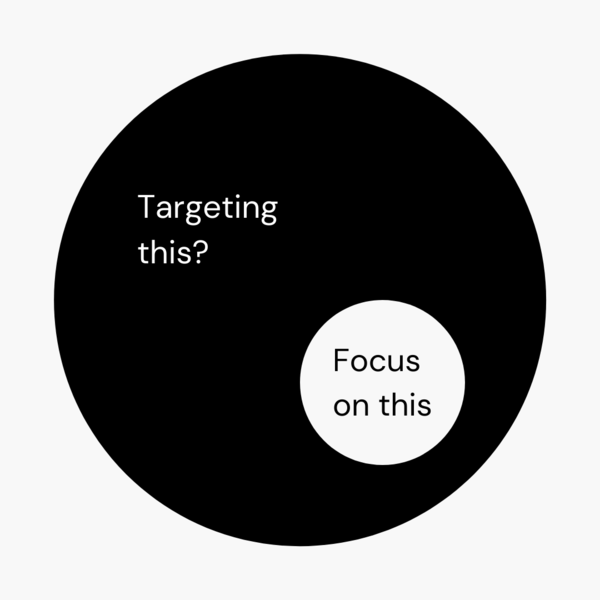
A smaller segment of an existing market
Pros:
Laser focus on narrow market results in sharp messaging
Allows you to showcase unique expertise for a specific set of customers
A quicker and easier sales process that leads to faster revenue generation
Helps generate social proof in a crowded market to win more customers
By focusing on a submarket you’re also limiting the number of competitors
Cons:
As you start looking into other markets, you’ll have to change your messaging
Alienates certain audiences who could have otherwise become customers
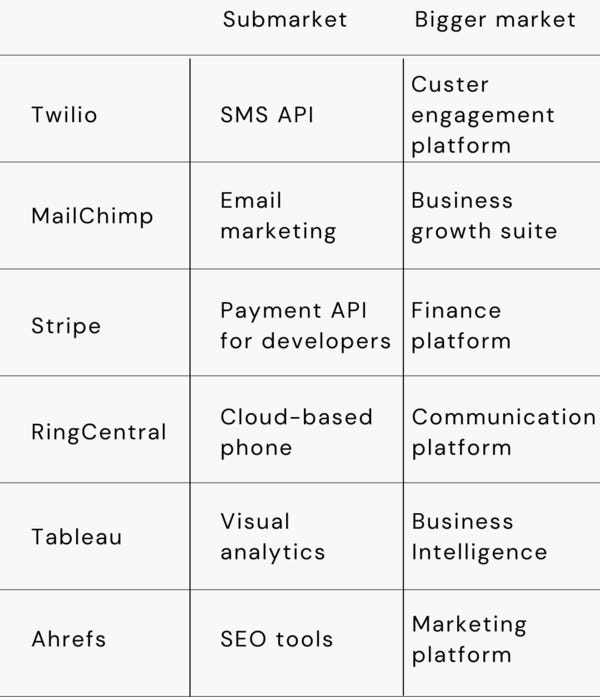
Here are some examples:
When you are a young startup still trying to figure out which market segment allows you to grow faster, it is okay to cast a wide net and use the learning to figure out your sweet spot.
2. Go head-on
In this approach, you go after the entire target market right away. This can be applied when the market is not too crowded. Note that only a handful number of companies have executed this successfully.

Head-on approach
Pro
Messaging doesn’t require massive changes if you are absolutely clear about the market.
Con
Messaging becomes complex since the product most likely says it is something for everyone. This can be solved with personalization though.
An absolute must for the success of this approach is a really elegant product with a top-notch customer experience.
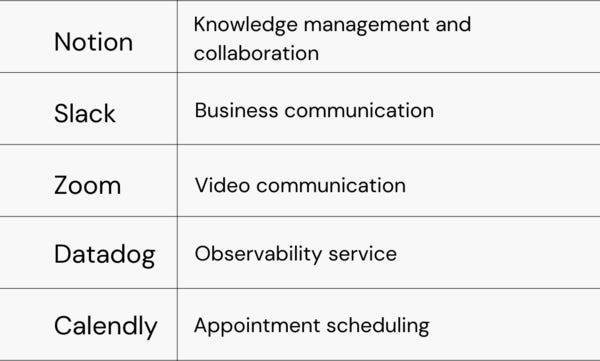
Brands that targeted the entire market
3. Create a new playing field
Often this approach is adopted by companies when the market is too crowded and the product is so unique that it cannot be justified by associating with any of the existing categories.
Your category = your rules
Pros
Creating something entirely new is exciting and inspiring
You set the rules based on your unique advantages
Easier to establish leadership
Customers will not compare you with a bunch of other competitors
Cons
Substantial effort and investment to teach people about a latent need
None knows what you are talking about
Creating a category just because you aspire to be a category-maker will slow down your growth by alienating the active buyer pool. In the worst case, it might kill your product.
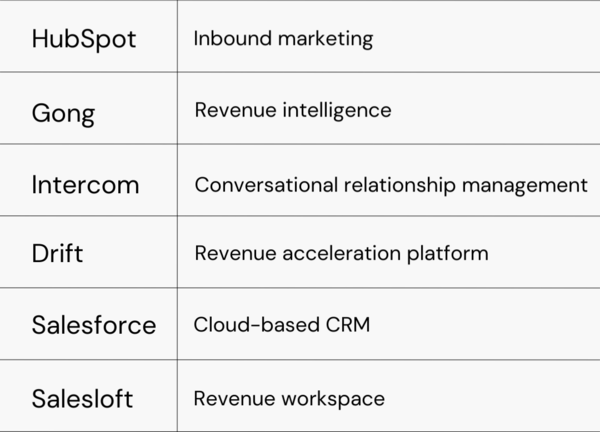
Examples of new categories
Eventually, your new category will attract other players—but that’s a good thing. It validates your market and brings legitimacy.
We discussed the importance of positioning, the building blocks, and examples—but how do we go about creating positioning? Let’s explore that.
Positioning affects the entire company and all the teams. All the department heads must be aligned on the positioning. This alignment becomes all the more crucial because every new hire regardless of the department must know how the product is positioned.
So, the process starts with the internal team agreeing that they need to get the inputs from the following:
Customers
Own people
Market
Customer inputs
The goal is to view problems, solutions, and value from the perspective of customers. Use the data you already have to unravel which customer segment is the most successful with your product.
Customer interviews can help you uncover why certain types of customers are more successful than others.
Here are some questions to ask:
What are your key objectives and biggest problems?
How do you solve those problems? See if you can uncover the status quo.
What are the key triggers that motivate you to search for a solution?
What are the things you look for when evaluating products in <category>?
Which are the most important factors for purchasing?
What would deter you from purchasing a product?
How would you describe <your product> to someone else?
Why exactly did you select <your product>?
What has been the experience so far?
Who could be our direct competitor?
What do you think we do better than them? And what do they do better than us?
If you have recorded conversations with customers and prospects listen to those to figure out if you can find additional insights.
Internal inputs
Now it’s time to introspect and use the data you already have as well as the insights you have collected from customer interactions. We want to first analyze the product:
List all the problems solved by the product. Assign them weightage based on the severity.
A list of all the features our product has. Segment them based on uniqueness and importance to customers.
Mapping of features and the corresponding benefits. You can also go a step further to come up with both emotional and functional benefits.
Here are some questions you need to answer related to customers:
Who would we describe as the ideal customer?
What attributes make for an ideal customer? Look into both the demographic and firmographic data.
What do we not have that customer want?
What are the main reasons sales-qualified leads don’t convert to paying customers?
What constitutes an account we can’t absolutely sell to? Why?
Now it is time to look into the market.
Market inputs
Here you need to analyze the competitors and understand what the industry experts, reporters, and analysts are saying.
Start by creating a list of alternatives based on your research and customer interactions. Certain alternatives will be close competitors in comparison to others. Rank them based on various factors customers use for decision-making.
Here are some data points you can collect:
Hero message on competitor’s website.
For SaaS products, descriptions on software directory sites like Capterra and G2 Crowd are also insightful.
The press release footer can be reverse-engineered to learn more about positioning.
News on various media outlets can tell an underlying story.
Brainstorm on various potential categories for your product and list down different words associated with the categories.
👉 Now based on all the data you have collected and the analysis, create a list of end benefits your product delivers and the benefits that motivate the customers the most.
Look at the common elements. This will help you agree on the most important end benefits to capitalize on.
👉 Finalize the customer segment that cares the most about the benefits you are delivering.
👉 Agree on the status quo or the key competitors.
👉 Establish why your unique solution is the best for solving the customer’s problems.
👉 Select the most suitable category that clearly signifies the value the product delivers.
After you complete the positioning exercise, you’ll have the foundation of go-to-market, messaging, and campaigns.
But, we need to also find out whether what we’re looking to convey is truly understood by the target customers. We need to confirm if we’re effectively shaping the notion and attracting the right type of customers.
This requires continuous research. Based on the stage of the business, your success, and market factors, your positioning will also evolve.
With the right execution of the positioning strategy, you’ll become the natural choice and win the market.
No posts
Comments
Nothing yet. Say the first thing.
Sign in to join the conversation.